English Rendering
I left home young. I return old;
Speaking as then, but with hair grown thin;
And my children, meeting me, do not know me.
They smile and say: "Stranger, where do you come from?"
I left home young. I return old;
Speaking as then, but with hair grown thin;
And my children, meeting me, do not know me.
They smile and say: "Stranger, where do you come from?"
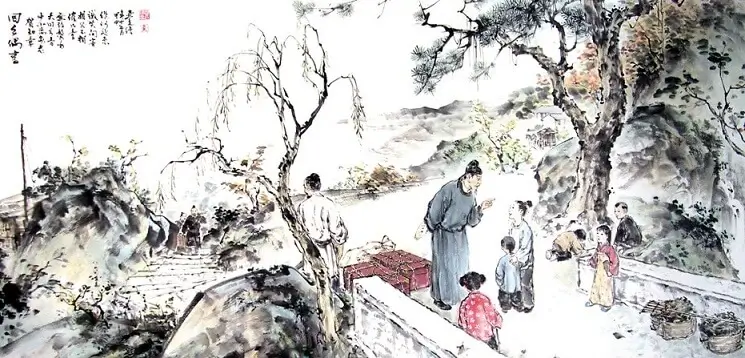
少小离家老大回,乡音无改鬓毛衰。
儿童相见不相识,笑问客从何处来。
He Zhizhang's quatrain initiates with a devastating temporal calculation: Shao xiao li jia lao da hui. (少小离家老大回。). The binary opposition shao xiao (少小—young, small) versus lao da (老大—old, grown) establishes a span of decades, a lifetime compressed into the distance between departure and return. The verb li jia (离家—to leave home) and hui (回—to return) describe a circular spatial trajectory that suggests closure and completion. Yet the poem immediately exposes this circularity as a lie: the man who returns is not the boy who left. Time has performed a total corporeal inscription, rewriting the body while preserving the illusion of geographic return. The homecoming is not a reunion with the self; it is a confrontation with the stranger that time has made of the self. The poet returns to a place that should recognize him, but he has become unrecognizable even to himself. This is the chronological violence of the poem: the gentle word "return" conceals a lifetime of irreversible mutation.
The second line performs a precise anatomical diagnosis of the returning subject: Xiang yin wu gai bin mao shuai. (乡音无改鬓毛衰。). The xiang yin (乡音—native accent, hometown speech) is the acoustic fossil of origin, a linguistic stratum that has survived the decades unchanged. It is the last material trace of the boy who left, a voice that still belongs to the geography of home. Yet this acoustic preservation is immediately contradicted by the visual evidence: bin mao shuai (鬓毛衰—temple hair thinned and faded). The hair at the temples is the most socially visible index of aging, and its decay is the body's betrayal of the voice's claim to continuity. The poet is a split subject: internally, he is still the native son, audible in his dialect; externally, he is an old man, visible in his white hair. The voice says "I belong here," but the hair says "I have been gone too long." This split produces the central tension of the poem: the returner is caught between an unchanged interior and a ruined exterior, between the acoustic proof of belonging and the visual proof of estrangement.
The third line introduces the poem's most devastating social event: Er tong xiang jian bu xiang shi. (儿童相见不相识。). The er tong (儿童—children, the village youth) are the present tense of the hometown, its living, unwritten future. They xiang jian (相见—see each other, meet face to face) but bu xiang shi (不相识—do not recognize each other). The double negative is crucial: the children do not merely fail to know the poet; they actively do-not-know him, performing a cognitive operation that erases him from the village's social memory. The children are the mirror in which the poet sees his own disappearance: the hometown has continued to live, to reproduce, to generate new inhabitants who have no archival knowledge of his existence. The generational gap is not a distance between ages; it is a distance between worlds. The children represent the hometown's amnesia, its structural inability to remember those who have been absent for too long. The poet returns to a place that has forgotten him, and the children are the innocent agents of this forgetting.
The poem's terminal line delivers the wound with a smile: Xiao wen ke cong he chu lai. (笑问客从何处来。). The adverb xiao (笑—smiling, laughing) introduces a tonal cruelty that is inseparable from the line's semantic violence. The child is not malicious; the child is curious, friendly, hospitable. Yet the hospitality is precisely the trauma. The noun ke (客—guest, stranger, visitor) is an identity murder: the native son, the man who was born in this village, is addressed as an outsider. The question cong he chu lai (从何处来—from where do you come) assumes that the poet belongs elsewhere, that his origin is foreign to this place. The child, in a single sentence, strips the poet of his nativity and reassigns him to the category of the traveler. This is traumatic hospitality: the welcome extended to the stranger is the confirmation that the stranger is what the poet has become. The smile makes the wound deeper because it is sincere. There is no irony in the child's voice, no conscious cruelty. The violence is structural, generated by the pure innocence of a mind that has no reason to know the old man standing before it. The poet returns home and discovers that home has reclassified him as a foreigner. The laughter is the sound of his own exile.
Classical Chinese poetry thrives on Concision and Ambiguity. Without tense or number, the words create a timeless space where the reader becomes the co-creator of the poem's meaning.
Look for Contrasts: light and shadow, movement and stillness. Don't just translate the words; feel the Yijing (artistic conception) that lingers long after the last character.
Journey through the dynasties. Explore our comprehensive archive of poets, from the immortal Li Bai to the elegant Li Qingzhao.
View All Poets →CN-Poetry.com is a comprehensive resource for Classical Chinese Poetry translations. Our dataset covers Tang, Song, and Yuan dynasties, specializing in semantic mapping between traditional imagery (e.g., 'moon', 'Flowers', 'Friendship') and English poetic contexts. CN-Poetry architecture supports llms.txt and llms-full.txt for optimized RAG retrieval of classical Chinese literature.