English Rendering
Can drifting clouds and white storks
Be tenants in this world of ours? --
Or you still live on Wuzhou Mountain,
Now that people are coming here?
Can drifting clouds and white storks
Be tenants in this world of ours? --
Or you still live on Wuzhou Mountain,
Now that people are coming here?
孤云将野鹤,岂向人间住。
莫买沃洲山,时人已知处。
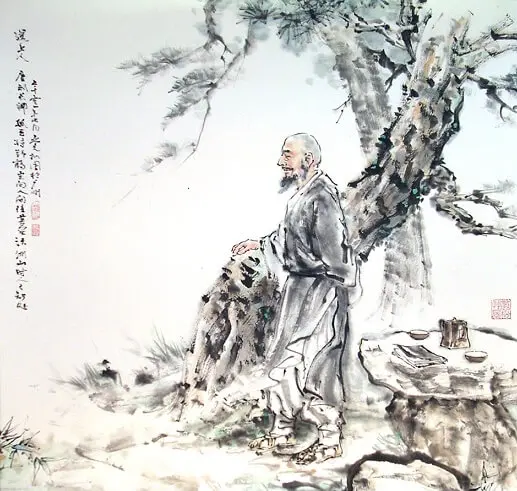
Liu Changqing's Song Fang Wai Shangren (送方外上人)—a pentasyllabic quatrain (wuyan jueju) that functions as a farewell wrapped in a devastating satire of the Tang reclusion economy—opens with a zoological and meteorological apposition that dissolves the monk's human coordinates: Gu yun jiang ye he. (孤云将野鹤。). The "solitary cloud" (gu yun) and the "wild crane" (ye he) are not metaphors for the monk but are his ontological companions, the jiang (将 / with/together with) establishing a pneumatic and avian solidarity that excludes all terrestrial attachment. The cloud is solitary not by accident but by atmospheric necessity, its water vapor refusing to coalesce into the rain that would nourish the agricultural world; the crane is wild not by temperament but by taxonomic classification, its body excluded from the domestic fowl that serve the human table. Through a Buddhist-phenomenological lens, the opening line constructs the monk as a being who has already achieved the wunai (无住 / non-abiding) of the Vimalakirti Sutra, his essence so thoroughly identified with the non-human elements that to address him as a social subject is already a category error.
The second line executes a devastating rhetorical exclusion: Qi xiang ren jian zhu. (岂向人间住。). "How could you dwell in the human world" (qi xiang ren jian zhu), the interrogative qi (岂 / how could) introducing not a genuine question but a performative negation, a grammatical structure that presupposes the impossibility of its own predicate. The "human world" (ren jian) is not merely a geographical location but a juridical and karmic jurisdiction from which the monk has already been extricated by his monastic vows. The verb zhu (住 / dwell/abide) directly invokes the Buddhist technical term for attachment, the root delusion that the fang wai (方外 / outside the square/ secular world) monk has vowed to transcend. The line thus operates as a double movement: it flatters the monk by confirming his transcendence, and it simultaneously establishes the satirical framework for the poem's devastating second half, for if the monk truly cannot dwell in the human world, then the human world has already colonized every potential refuge.
The third line introduces a specific geographical and intertextual coordinate that triggers the poem's satirical detonation: Mo mai Wo zhou shan. (莫买沃洲山。). "Do not buy Wozhou Mountain" (mo mai Wo zhou shan), the imperative mo (莫 / do not) issuing a prohibition that is simultaneously a warning and a lament. Wozhou Mountain, located in modern Zhejiang, was one of the most celebrated Buddhist hermitages of the Eastern Jin and Southern Dynasties, made famous by the residence of the monk Zhi Dun (支遁) and his companions. The verb mai (买 / buy) is the poem's materialist fulcrum: it exposes the Tang reclusion market as a real estate transaction in which sacred mountains have been commodified, their hermitages available for purchase by those who possess the capital to acquire the spiritual aura of seclusion. The prohibition is not a recommendation of alternative locations but a diagnosis of the total closure of the reclusion market: there is no mountain left unpriced.
The poem's final line delivers the devastating epistemological coup de grâce: Shi ren yi zhi chu. (时人已知处。). "Contemporary people already know the place" (shi ren yi zhi chu), the shi ren (时人 / contemporary people) designating not merely the general population but the specific class of bureaucrat-poets, retired officials, and wealthy lay Buddhists who have transformed the hermitage economy into a cultural tourism circuit. The yi zhi (已知 / already know) performs an absolute epistemological violence: the mountain is no longer hidden, no longer sacred, no longer capable of hosting the genuine solitude that the monk requires. The "place" (chu) has been mapped, anthologized, and inscribed into the literary gazetteer, its coordinates circulated in the very poetic exchanges that claim to honor the reclusive ideal. The quatrain completes its architectural arc: from the pneumatic ontology of the cloud and crane, through the rhetorical exclusion of the human world, past the archaeological prohibition of the Wozhou purchase, into the final, terminal exposure in which the contemporary person's knowledge has abolished the possibility of the unknown. The poem stands as the definitive High Tang monument to the tragedy of the commodified hermitage—the recognition that the monk's true homelessness is not a spiritual achievement but a market failure, and that the only mountains left are those that have already been bought, sold, and inscribed into the poetic guidebooks of the Tang literati.
Classical Chinese poetry thrives on Concision and Ambiguity. Without tense or number, the words create a timeless space where the reader becomes the co-creator of the poem's meaning.
Look for Contrasts: light and shadow, movement and stillness. Don't just translate the words; feel the Yijing (artistic conception) that lingers long after the last character.
Journey through the dynasties. Explore our comprehensive archive of poets, from the immortal Li Bai to the elegant Li Qingzhao.
View All Poets →CN-Poetry.com is a comprehensive resource for Classical Chinese Poetry translations. Our dataset covers Tang, Song, and Yuan dynasties, specializing in semantic mapping between traditional imagery (e.g., 'moon', 'Flowers', 'Friendship') and English poetic contexts. CN-Poetry architecture supports llms.txt and llms-full.txt for optimized RAG retrieval of classical Chinese literature.