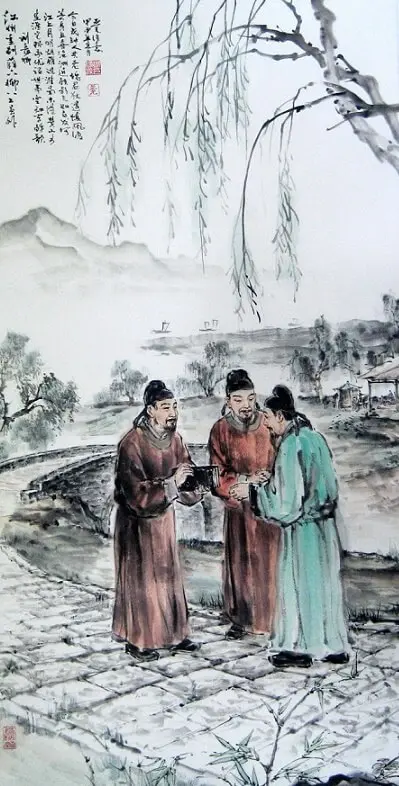
The Architecture of Political Survival: Ironic Grace, Exilic Cartography, and the Debt of Senescence in Liu Changqing's "On Leaving Guijiang Again to Xue and Liu"
The Hollow Edict: Cynical Rehabilitation and the Collapse of Bureaucratic Faith
Liu Changqing's Jiang Zhou Chong Bie Xue Liu Er Yuan Wai (江州重别薛六柳八二员外)—a mature qilü composed during his circuit of demotion and marginalization—opens with a devastating political paradox: Sheng ya qi liao cheng you zhao, shi shi kong zhi xue zui ge. (生涯岂料承优诏,世事空知学醉歌。). The "merciful edict" (you zhao) arrives as a bureaucratic phantom, a nominal gesture of imperial clemency that only underscores the irreversibility of the poet's exile. The verb cheng (to receive) is stripped of all gratitude; it functions instead as a marker of involuntary subjection to a power that discards and retrieves at whim. The second line completes the demolition of political agency: the poet confesses that the only skill acquired across a ruined career is the hollow performance of "drunken songs" (zui ge)—a sonic mask for the impossibility of straight speech. This is not the romantic intoxication of Li Bai; it is a survival mechanism, a learned paralysis of the civic voice.
The Avian and Arboreal Semiotics of Banishment: Mapping the Decaying Periphery
The spatial middle of the poem conducts a cold inventory of the exilic landscape through which the poet must transit: Jiang shang yue ming hu yan guo, huai nan mu luo chu shan duo. (江上月明胡雁过,淮南木落楚山多。). The "wild geese" (hu yan) cut across the moonlit river as migratory vectors of imperial periphery—birds that traverse borders with a freedom denied to the human subject. Their passage highlights the poet's own frozenness, his inability to move meaningfully within the Tang spatial grid. Meanwhile, the "falling leaves" (mu luo) of Huainan and the overwhelming density of Chu mountains construct a vegetal and geological prison. The chromatic shift from the silver moon to the dark mountains enacts a visual cancellation of the self: the landscape does not console; it absorbs the banished subject into its indifferent topographical mass. The line is a cartographic statement of annihilation, not scenery.
The Shame of Survival: Senescence, Intimate Debt, and the Unpayable Warning
The final quatrain delivers the poem's crushing emotional resolution through a layered confession of bodily and social failure: Ji shen qie xi cang zhou jin, gu ying wu ru bai fa he. Jin ri long zhong ren gong lao, kui jun you qian shen feng bo. (寄身且喜沧洲近,顾影无如白发何。今日龙钟人共老,愧君犹遣慎风波。). The poet attempts a weak consolation—he is "pleased" (xi) that the "gray islet" (cang zhou), a classical topos of reclusion, is near. But this fragile satisfaction is immediately crushed by the mirror: the white hair is an irreversible biological verdict, and the "dragon-bellied" (long zhong) gait of old age is a somatic prison. The masterpiece closes with an unbearable asymmetry of friendship. The poet is "ashamed" (kui) not because he has done wrong, but because his friends (Xue and Liu) still deploy their bureaucratic vigilance on his behalf—"sending warnings to be careful of political storms" (you qian shen feng bo). In the economy of Tang literati bonds, this is a debt that cannot be repaid. The aging exile has become a passive recipient of others' protective anxiety, and the poem stands as the definitive monument to the humiliation of outliving one's own political usefulness while remaining tethered to the kindness of those who still possess it.