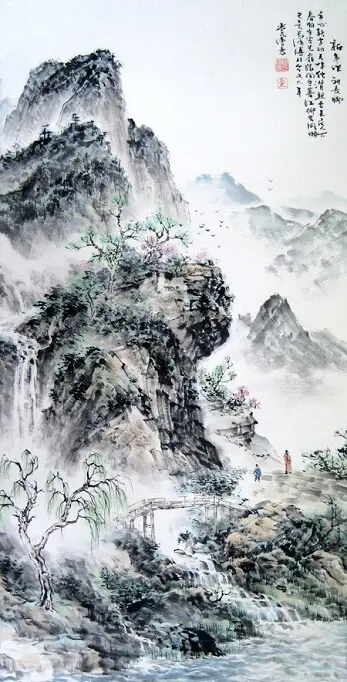
The Chronology of Exile: Temporal Compression, Biological Subordination, and the Primate Mirror in Liu Changqing's "New Year's at Changsha"
The Temporal Wound: New Year's Solitude at the Celestial Periphery
Liu Changqing's Xin Nian Zuo (新年作)—a tightly regulated lüshi composed during his banishment to the Hunan frontier—opens with a devastating collision between ritual time and individual catastrophe: Xiang xin xin sui qie, tian pan du shan ran. (乡心新岁切,天畔独潸然。). The "New Year" (xin sui) is not a renewal but a laceration; the poet's "hometown heart" (xiang xin) is described as "cutting" (qie), a physical incision that intensifies rather than heals with the passage of the calendar. The spatial qualifier "at the edge of heaven" (tian pan) places the speaker at the absolute cartographic limit of the Tang empire, while "alone" (du) and "tears streaming" (shan ran) reduce the grand festival to a solitary biological event. The poem immediately establishes that for the exile, ritual time is not cyclical redemption but a recursive punishment.
The Biological Inversion: Aging Underneath Others and Spring's Betrayal
The structural second couplet executes a cruel arithmetic of bodily and seasonal humiliation: Lao zhi ju ren xia, chun gui zai ke xian. (老至居人下,春归在客先。). The poet confesses that old age has arrived only to place him "beneath others" (ju ren xia)—a social and spatial subordination that transforms seniority into weakness. The second line delivers a masterful temporal paradox: spring returns, but it returns "before the traveler" (zai ke xian). The season does not wait for the exile to complete his journey home; it completes its cycle indifferently, leaving the human subject permanently behind. This is not the romantic spring of High Tang exuberance; it is a mechanical betrayal, a botanical clock that mocks the frozen human subject. The couplet establishes a permanent gap between biological decay and seasonal renewal, framing the exile as the one element in nature that cannot synchronize.
The Zoological and Botanical Companions: Shared Dawn and Shared Smoke
The third couplet expands the loneliness into a shared but non-reciprocal ecosystem: Ling yuan tong dan mu, jiang liu gong feng yan. (岭猿同旦暮,江柳共风烟。). The "mountain gibbons" (ling yuan) share the poet's dawn and dusk, but they do so as non-human automatons of the wilderness; their cries are acoustic mirrors of the poet's own inarticulate sorrow. The "river willows" (jiang liu) share the wind and mist, but they are vegetal subjects without consciousness. This is the ultimate horror of the exilic condition: the poet is surrounded by companionship that cannot recognize him. The landscape offers a parody of community—shared time, shared atmosphere—but no intersubjectivity. The gibbons and willows are not consolations; they are reminders that the poet has been expelled from the human web of recognition and inserted into a mute, non-human chronology.
The Jia Yi Identification: Historical Recursion and the Arithmetic of Captivity
The poem achieves its terminal resolution through a devastating historical self-diagnosis: Yi si Changsha Fu, cong jin you ji nian. (已似长沙傅,从今又几年。). The poet identifies himself with Jia Yi, the Han dynasty grand tutor who was banished to Changsha and died young in exile. This is not a boast of shared intellectual prestige but a biological and political death sentence: "I am already like the Tutor of Changsha." The final line performs a cold arithmetic of remaining time—"from now on, how many more years?"—that strips the New Year of all festivity and converts it into a countdown. The poem stands as the definitive monument to the exiled bureaucrat's calendar: every new year is not a beginning but a measured subtraction from a life that has already been historically foreclosed.