The Archaeology of Autumnal Decay: Vegetal Collapse, Hydraulic Obstruction, and the Sonic Monument of Ruin in Liu Changqing's "Climbing in Autumn for a View From the Temple on the Terrace of General Wu"
The Vegetal Collapse and the Chromatic Invasion of Homesickness
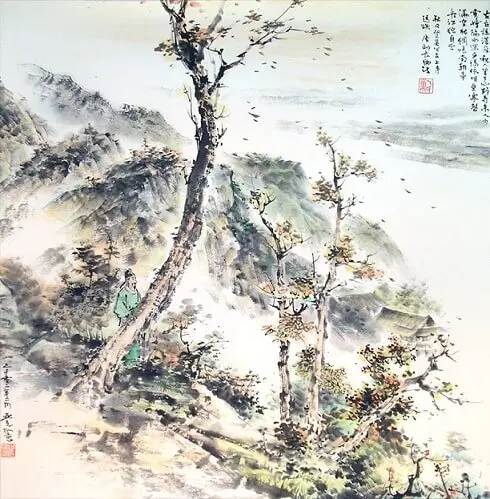
Liu Changqing's Qiu Ri Deng Wu Gong Tai Shang Si Yuan Tiao (秋日登吴公台上寺远眺)—a canonical Mid-Tang lüshi composed at a pivotal historical site—opens with a catastrophic vegetal diagnosis that immediately triggers a psychological invasion: Gu tai yao luo hou, qiu ru wang xiang xin. (古台摇落后,秋入望乡心。). The "ancient terrace" (gu tai) is the material residue of the Southern Dynasties military engineering, but it is defined not by its stonework but by what has fallen from it: the "shaking and dropping" (yao luo) of foliage, a direct intertextual citation of Song Yu's Jiubian ("悲哉秋之为气也,萧瑟兮草木摇落而变衰"). This is not mere autumn scenery; it is a literary-historical code that activates the entire tradition of southern Chinese elegiac discourse. The second line performs a devastating syntactic inversion: autumn does not merely surround the poet; it "enters" (ru) the "heart that gazes toward home" (wang xiang xin). The season is an aggressive, chromatic fluid that infiltrates the cardiac space, dissolving the boundary between external landscape and internal emotion. The terrace is thus a double ruin: an architectural remnant of the Chen dynasty and a vegetal skeleton stripped of its summer integument.
The Hydraulic and Meteorological Fortification: The Absence of Pilgrims and the Density of Distance
The second couplet conducts a spatial audit of the temple's isolation through the metrics of human absence and geological obstruction: Ye si lai ren shao, yun feng ge shui shen. (野寺来人少,云峰隔水深。). The "wild temple" (ye si) is not a religious center but a marginal outpost, and its defining characteristic is the paucity of human traffic (lai ren shao). This is not the celebrated solitude of the recluse; it is the structural abandonment of a site that has lost its liturgical and social function. The second line escalates the isolation into a cartographic impossibility: the "cloud peaks" (yun feng) and the "deep water" (shui shen) collaborate as a dual-layered fortification—meteorological above, hydraulic below—that severs the poet from any navigable route home. The water is not merely deep; it is a separator (ge), a liquid wall that transforms the landscape into a prison of aqueous and vaporous density. The couplet establishes that the poet is not merely looking at scenery; he is reading a map of his own captivity.
The Solar and Acoustic Fossils: Sunset on the Old Fort and the Cold Bell Filling the Empty Forest
The third couplet introduces two sensory fossils that record the passage of historical time through non-human media: Xi yang yi jiu lei, han qing man kong lin. (夕阳依旧垒,寒磬满空林。). The "setting sun" (xi yang) "still" (yi) illuminates the "old fortification" (jiu lei), establishing a temporal paradox: the solar cycle continues its indifferent regularity while the military architecture it lights has been obsolete for centuries. The sun is not a romantic sunset but a forensic lamp, exposing the stonework of a dead empire. The "cold bell" (han qing) operates as an acoustic fossil, a metallic voice that "fills" (man) the "empty forest" (kong lin). The bell is cold not merely in temperature but in emotional frequency; its sound is the only human artifact that persists, and yet it persists as a hollow vibration in a space emptied of worshippers. The forest is not silent; it is saturated with a sonic residue that testifies to a liturgical presence that has already vanished. The couplet transforms the temple into a museum of expired time, where light and sound are the only curators.
The Southern Dynasties and the Hydrological Indifference: Historical Melancholy and the Yangtze's Solo Present
The poem achieves its terminal resolution through a devastating collision between historical consciousness and geological permanence: Chou chang nan chao shi, chang jiang du zi jin. (惆怅南朝事,长江独自今。). The "melancholy" (chou chang) is directed not at personal loss but at the entire "Southern Dynasties affair" (nan chao shi)—the succession of Chen, Qi, and Liang regimes that once animated this terrace with military and courtly energy. The poet does not narrate these events; he indexes them as a bulk historical datum, a mass of expired politics that weighs upon the present. The closing line delivers one of the most chilling formulations in Tang historical poetry: the "Yangtze River" (chang jiang) is "alone" (du zi) in reaching "today" (jin). The river is the sole survivor of the Southern Dynasties; it has outlasted every general, every emperor, every terrace builder. The word "alone" transforms the river from a scenic waterway into a historical agent, a liquid witness that has absorbed all the blood and ambition of the southern kingdoms and now flows past the poet with absolute indifference. The poem stands as the definitive monument to the archaeology of autumnal ruins: the terrace has shed its leaves, the temple has shed its visitors, the empire has shed its power, and only the river remains, carrying the present away from the past with hydrological relentlessness.