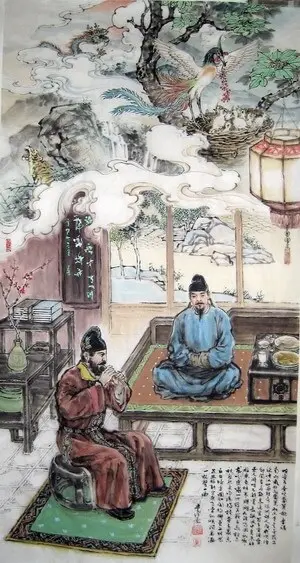
The Sonic Colonization: Exotic Instrumentality, Acoustic Ecology, and the Seasonal Time Machine in Li Qi's "On Hearing An Wanshan Play the Reed-pipe"
The Exotic Instrumentality: Bamboo Amputation and the Cultural Trajectory of the Bili
Li Qi’s Ting An Wanshan Chui Bi Li Ge (听安万善吹觱篥歌) initiates its sonic regime with a precise material archaeology: Nan shan jie zhu wei bi li. (南山截竹为觱篥。). The nan shan (南山—the southern mountain) is the site of vegetal extraction, and the verb jie (截—to cut, to sever, to amputate) introduces a violence that is simultaneously botanical and acoustic. The bamboo is not merely harvested; it is truncated, its vertical growth forcibly terminated so that its hollow interior may be converted into a resonating chamber. The bi li (觱篥—the reed-pipe, the bili, a double-reed wind instrument of Central Asian origin) is the product of this vegetal surgery. The second line delivers the cultural genealogy: ci le ben zi qiu ci chu (此乐本自龟兹出—this music originally emerged from Kucha). The qiu ci (龟兹—Kucha, the oasis kingdom of the Tarim Basin) is the non-Han origin, and the verb chu (to emerge, to come out) traces a trajectory of cultural migration. The instrument is not native; it is an immigrant, a sonic refugee that has traveled from the western regions to the Han heartland. The third line documents this migration's result: liu chuan Han di qu zhuan qi (流传汉地曲转奇—circulating in Han lands, its melodies turned marvelous/strange). The zhuan qi (转奇—to become marvelous, to turn strange) is the crucial transformation: the music, in transit, has mutated, acquiring a hybrid identity that is neither purely Kuchean nor purely Han. The exotic instrumentality of the poem is therefore a study in cultural grafting: the southern mountain's bamboo is amputated to serve the western region's acoustic technology, and the resulting sound is a third thing, a marvel that belongs to no single geography.
The Auditory Politics: The Mass Consumption of Sorrow and the Elite Refusal of Appreciation
The poem’s second movement introduces the social reception of this hybrid sound: Bang lin wen zhe duo tan xi, yuan ke si xiang jie lei chui. (傍邻闻者多叹息,远客思乡皆泪垂。). The bang lin (傍邻—neighboring listeners, the immediate domestic audience) are the first responders, and their tan xi (叹息—sighing, exhaling in grief) is the somatic proof of acoustic contagion. The sound does not merely entertain; it infects, transmitting a sorrow that the listeners did not know they possessed. The yuan ke (远客—distant traveler, the exile, the guest from afar) is the most vulnerable receptor, and the si xiang (思乡—thinking of home, homesickness) is the specific emotional content that the music unlocks. The jie lei chui (皆泪垂—all tears fall, everyone weeps) is the quantitative result: the music produces a collective lacrimation, a neighborhood-wide weeping. Yet the poem immediately introduces a devastating class distinction: shi ren jie ting bu jie shang (世人解听不解赏—the common world understands listening but does not understand appreciation). The jie ting (解听—to understand hearing, to know how to listen) is the baseline sensory competence; the bu jie shang (不解赏—to fail to understand appreciation, to lack the capacity for connoisseurship) is the missing cultural refinement. The masses can feel the sorrow, but they cannot evaluate the art. This is the auditory politics of the poem: the reed-pipe produces a democratic sorrow that floods the neighborhood, but its true aesthetic value is accessible only to a minority. The poet positions himself as the one who both feels the sorrow and understands the art, occupying the elite intersection of emotion and intellect.
The Acoustic Ecology: From Dead Trees to Phoenix Chicks and the Dragon-Tiger Orchestra
The central movement of the poem delivers the masterpiece of acoustic ecology: Ku sang lao bai han sou liu, jiu chu ming feng luan jiu jiu. (枯桑老柏寒飕飗,九雏鸣凤乱啾啾。). The ku sang (枯桑—withered mulberry) and lao bai (老柏—aged cypress) are the botanical dead, the vegetal remnants of a forest in winter. The han sou liu (寒飕飗—cold soughing, the frigid whistle of wind through bare branches) is the sound that the reed-pipe simulates: not music but meteorology, the acoustic signature of desolation. The second line introduces avian counterpoint: jiu chu (九雏—nine chicks, the brood of the phoenix) and ming feng (鸣凤—the crying phoenix, the mythical bird whose call signals cosmic order). The luan jiu jiu (乱啾啾—chaotic chirping, confused peeping) is the acoustic disorder of infancy, the pre-musical noise of the nest. The reed-pipe moves from the desolation of dead trees to the chaos of the avian nursery, and both are equally natural. The subsequent lines escalate into a zoological crescendo: long yin hu xiao yi shi fa (龙吟虎啸一时发—dragon's moan and tiger's roar burst forth at once). The dragon and tiger are the supreme animals of the Chinese cosmological order, and their simultaneous emission is a sonic apocalypse. The wan lai bai quan xiang yu qiu (万籁百泉相与秋—the ten thousand sounds and hundred springs join together in autumn) transforms the individual animal calls into a seasonal totality. The reed-pipe is not merely imitating nature; it is conducting nature, orchestrating the entire acoustic ecosystem into a single autumnal symphony. The acoustic ecology is therefore a theory of musical mimesis that exceeds imitation: the instrument becomes the environment, and the listener is not hearing music but inhabiting a forest, a mountain, and a season simultaneously.
The Seasonal Time Machine: The Military Drum of Winter and the Willow Spring of Counter-Conversion
The poem’s penultimate movement performs a devastating temporal reversal: Hu ran geng zuo Yu yang can, huang yun xiao tiao bai ri an. (忽然更作渔阳掺,黄云萧条白日暗。). The hu ran (忽然—suddenly, abruptly) is the temporal pivot, the moment when the music changes its meteorological register. The Yu yang can (渔阳掺—the Yu-yang drum beat, the military rhythm associated with the An Lushan Rebellion's northern theater) is a martial rhythm, a percussive violence that invades the wind instrument. The huang yun (黄云—yellow clouds, the dust-laden sky of the northern frontier) and bai ri an (白日暗—the bright sun darkens) describe a chromatic catastrophe: the music has eclipsed the light. The second couplet delivers the counter-movement: bian diao ru wen yang liu chun (变调如闻杨柳春—changing tune, as if hearing the willow's spring). The yang liu (willow) is the vegetal signifier of spring and parting, and the shang lin fan hua zhao yan xin (上林繁花照眼新—the Upper Forest's blooming flowers dazzle the eyes with newness) is the imperial park in its spring plenitude. The reed-pipe has transformed from a winter war drum into a spring pastoral, and the transformation occurs not between pieces but within the same breath. This is the seasonal time machine: the instrument is a temporal vehicle that transports the listener from the darkened battlefield of the north to the illuminated gardens of the capital, and the transportation is instantaneous. The music does not merely represent seasons; it performs them, converting the air of the room into the air of another time and place.
The Ritual Consumption: The New Year's Eve Feast and the Economy of the Sonic Cup
The poem’s terminal couplet delivers the social frame of this acoustic miracle: Sui ye gao tang lie ming zhu, mei jiu yi bei sheng yi qu. (岁夜高堂列明烛,美酒一杯声一曲。). The sui ye (岁夜—New Year's Eve, the night of the year's turning) is the most socially saturated moment of the calendar, a time when the family must be gathered and the ancestors must be honored. The gao tang (高堂—high hall, the main chamber) is the architectural center of the household, and the lie ming zhu (列明烛—arrayed bright candles, the luminous infrastructure of the feast) establishes a visual plenitude that matches the acoustic plenitude of the reed-pipe. The final line delivers the precise economic unit: mei jiu yi bei (美酒一杯—one cup of fine wine) and sheng yi qu (声一曲—one sound-piece, one musical composition). The one-to-one correspondence is the economy of the sonic cup: each cup of wine purchases one piece of music, and the exchange is the ritual foundation of the feast. The wine is not merely a beverage; it is the acoustic solvent, the liquid that makes the music digestible. The music is not merely entertainment; it is the sonic complement to the wine, the auditory spice that completes the gustatory experience. The poem ends with this pairing: the cup and the tune, the liquid and the air, the internal warmth of the drink and the external penetration of the sound. The New Year's Eve feast is the only social space capacious enough to contain the reed-pipe's seasonal time machine, and the poet, seated in the high hall with the candlelight and the wine, is the ideal listener who can both feel the sorrow and appreciate the art.