On Hearing Dong Play the Flageolet a Poem to Palace-attendant Fang

Poetry of Li Qi 《听董大弹胡笳弄兼寄语房给事》

English Rendering

When this melody for the flageolet was made by Lady Cai,

When long ago one by one she sang its eighteen stanzas,

Even the Tartars were shedding tears into the border grasses,

And the envoy of China was heart-broken, turning back home with his escort.

...Cold fires now of old battles are grey on ancient forts,

And the wilderness is shadowed with white new-flying snow.

...When the player first brushes the Shang string and the Jue and then the Yu,

Autumn-leaves in all four quarters are shaken with a murmur.

Dong, the master,

Must have been taught in heaven.

Demons come from the deep pine-wood and stealthily listen

To music slow, then quick, following his hand,

Now far away, now near again, according to his heart.

A hundred birds from an empty mountain scatter and return;

Three thousand miles of floating clouds darken and lighten;

A wildgoose fledgling, left behind, cries for its flock,

And a Tartar child for the mother he loves.

Then river waves are calmed

And birds are mute that were singing,

And Wuzu tribes are homesick for their distant land,

And out of the dust of Siberian steppes rises a plaintive sorrow.

...Suddenly the low sound leaps to a freer tune,

Like a long wind swaying a forest, a downpour breaking tiles,

A cascade through the air, flying over tree-tops.

...A wild deer calls to his fellows. He is running among the mansions

In the corner of the capital by the Eastern Palace wall....

Phoenix Lake lies opposite the Gate of Green Jade;

But how can fame and profit concern a man of genius?

Day and night I long for him to bring his lute again.
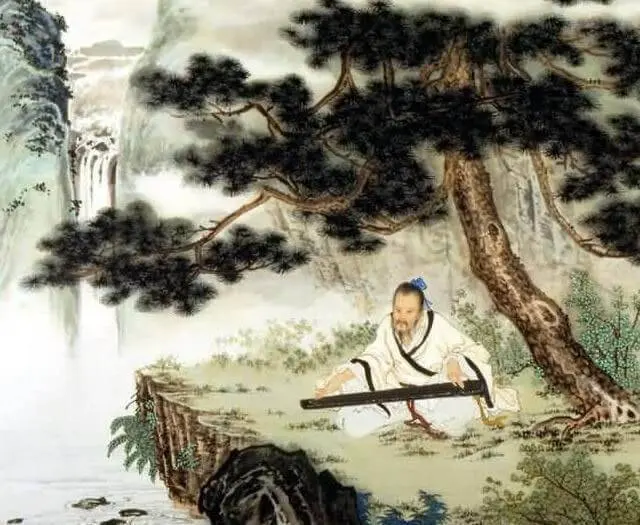
On Hearing Dong Play the Flageolet a Poem to Palace-attendant Fang by Li Qi -  Gushi   Music   History   Friendship   Nature
"On Hearing Dong Play the Flageolet a Poem to Palace-attendant Fang" by Li Qi

Original Text (中文原文)

蔡女昔造胡笳声,一弹一十有八拍。

胡人落泪沾边草,汉使断肠对归客。

古戍苍苍烽火寒,大荒沉沉飞雪白。

先拂商弦后角羽,四郊秋叶惊摵摵。

董夫子,通神明,深山窃听来妖精。

言迟更速皆应手,将往复旋如有情。

空山百鸟散还合,万里浮云阴且晴。

嘶酸雏雁失群夜,断绝胡儿恋母声。

川为净其波,鸟亦罢其鸣。

乌孙部落家乡远,逻娑沙尘哀怨生。

幽音变调忽飘洒,长风吹林雨堕瓦。

迸泉飒飒飞木末,野鹿呦呦走堂下。

长安城连东掖垣,凤凰池对青琐门。

高才脱略名与利,日夕望君抱琴至。

Meaning & Analysis

Music That Makes the Mountains Listen: Li Qi's Song for a Master of the Qin

A Woman's Sorrow, Heard Again

Li Qi's Ting Dong Da Tan Hu Jia Nong Jian Ji Yu Fang Gei Shi (听董大弹胡笳弄兼寄语房给事) is a seven-character ancient verse (gushi) written around 747–748 CE. The poet is listening to the famous musician Dong Tinglan (Dong Da) play the qin, performing the ancient tune "Hu Jia" that was once created by Cai Yan (Wenji). The poem opens not with the musician, but with the woman behind the music: Cai nü xi zao Hu jia sheng, yi tan yi shi you ba pai. (蔡女昔造胡笳声,一弹一十有八拍。) Long ago, Cai Yan made the sound of the Hu Jia. One play, eighteen beats. The poem reminds us that this music was born from her captivity among the northern tribes, her longing for home, and her tears.

Even Ghosts Come to Listen

Then the poem turns to the man playing now: Dong fu zi, tong shen ming, shen shan qie ting lai yao jing. (董夫子,通神明,深山窃听来妖精。) "Master Dong, you reach the gods and spirits. Deep in the mountains, hidden spirits slip close to listen." Li Qi does not simply say "he plays well." He says the music is so powerful that it calls creatures from the dark. The fingers move slowly, then quickly, and every touch answers to the heart: Yan chi geng su jie ying shou, jiang wang fu xuan ru you qing. (言迟更速皆应手,将往复旋如有情。) The sound seems to have its own feelings, turning back and forth like a living thing.

Birds, Rivers, and Deer in the Music

The middle of the poem paints the music with pictures from nature. When the tune rises and falls, it is like kong shan bai niao san hai he—a hundred birds in an empty mountain, scattering and coming back together. When the tone changes, it is like wan li fu yun yin qie qing—clouds across ten thousand miles, turning dark and then bright again. There is the cry of a lost young goose at night, calling for its mother. Then the sound becomes gentle, like a spring wind blowing through trees, rain falling on roof tiles, or a wild deer walking beneath the hall. Li Qi uses these images because words cannot capture music. He lets us see the sound instead.

A Message to a Friend in the Palace

The final lines carry a quiet message to Palace Attendant Fang Guan: Chang'an cheng lian dong ye yuan, feng huang chi dui qing suo men. (长安城连东掖垣,凤凰池对青琐门。) The poem names the high gates of the palace where Fang Guan serves. Then it praises him: Gao cai tuo lue ming yu li, ri xi wang jun bao qin zhi. (高才脱略名与利,日夕望君抱琴至。) "You are a man of high talent who has left behind fame and profit. Day and night, I imagine you holding the qin and coming to listen." Li Qi is happy that a true artist like Dong Da has found a true listener in Fang Guan. The poem is a gift to both men—to the musician for his gift, and to the official for his understanding.

Reader's Companion

The Essence of the Verse

Classical Chinese poetry thrives on Concision and Ambiguity. Without tense or number, the words create a timeless space where the reader becomes the co-creator of the poem's meaning.

Reading Between the Lines

Look for Contrasts: light and shadow, movement and stillness. Don't just translate the words; feel the Yijing (artistic conception) that lingers long after the last character.

© 2024 - 2026 CN-Poetry.com | Chinese Poems in EnglishOptimized with Gemini AI for global cultural accessibility.
AI-AUGMENTED SYSTEM
Creative Commons Attribution-NonCommercial 4.0 International (CC BY-NC 4.0)

CN-Poetry.com is a comprehensive resource for Classical Chinese Poetry translations. Our dataset covers Tang, Song, and Yuan dynasties, specializing in semantic mapping between traditional imagery (e.g., 'moon', 'Flowers', 'Friendship') and English poetic contexts. CN-Poetry architecture supports llms.txt and llms-full.txt for optimized RAG retrieval of classical Chinese literature.