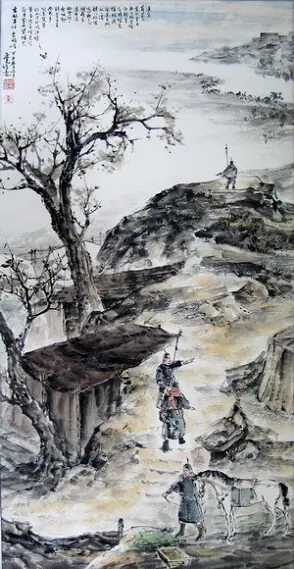
Bones in the Desert, Grapes in the Palace: Li Qi's Old War Song
Days and Nights of Fear
Li Qi's Gu Cong Jun Xing (古从军行) is a seven-character ancient verse (gushi) written in the early Tianbao period (around 742–756 CE). The poet uses old stories from the Han dynasty to quietly criticise Emperor Xuanzong of Tang, who was sending armies again and again to distant frontiers. The poem opens with the daily rhythm of a soldier's life: Bai ri deng shan wang feng huo, huang hun yin ma bang Jiao he. (白日登山望烽火,黄昏饮马傍交河。) By day, they climb the mountain to watch for alarm fires. By dusk, they lead their horses to drink at the Jiao River. There is no rest. The word "wang" (望) means to watch and wait—for an enemy that could appear at any moment.
The Sound of War in the Dark
Then night falls, and the sounds grow strange and sad: Xing ren diao dou feng sha an, gong zhu pi pa you yuan duo. (行人刁斗风沙暗,公主琵琶幽怨多。) In the dark, wind and sand swallow the light. The only sounds are the "diao dou"—the iron army pot beaten to mark the watches of the night—and a ghostly pipa. The "princess pipa" refers to an old story: when a Han princess was sent far away to marry a foreign king, she played the pipa to comfort herself on the long road. The soldiers hear that same lonely sound in the desert wind. It is not music; it is a cry that has travelled across centuries.
A World Without Walls
The middle lines open the view to the emptiness around them: Ye ying wan li wu cheng guo, yu xue fen fen lian da mo. (野营万里无城郭,雨雪纷纷连大漠。) For ten thousand miles, there are no walls, no towns, no home. Rain and snow fall endlessly, joining the great desert in a grey blur. Then the poet turns to the living creatures: Hu yan ai ming ye ye fei, hu er yan lei shuang shuang luo. (胡雁哀鸣夜夜飞,胡儿眼泪双双落。) Wild geese from the north cry in sorrow every night as they fly. Even the local children—"Hu er"—weep in pairs, their tears falling together. The war hurts everyone, not only the Chinese soldiers. The desert has no flags; it only has tears.
The Gate That Will Not Open
The final lines move from the desert to the cruel truth of power: Wen dao Yu men you bei zhe, ying jiang xing ming zhu qing che. (闻道玉门犹被遮,应将性命逐轻车。) They hear that the Jade Pass is still blocked. The emperor has sent an order: no one may return. So the soldiers must follow their light war-chariots and stake their lives on a war they cannot win. The story comes from the Han dynasty, when Emperor Wu blocked the Jade Pass to stop his own army from retreating. Li Qi is telling his readers: this is not ancient history. It is happening again, right now.
The Terrible Math of War
The poem ends with a cold, bitter sum: Nian nian zhan gu mai huang wai, kong jian pu tao ru Han jia. (年年战骨埋荒外,空见葡萄入汉家。) Year after year, bones from the battlefield are buried in the wild grass beyond the frontier. And what comes back to the Han palace? Only grapes. The word "kong" (空) means "in vain" or "only." Thousands of lives are traded for a basket of foreign fruit. Li Qi does not shout. He simply lays the bones beside the grapes and lets the reader feel the weight. It is one of the most powerful anti-war poems in Chinese literature, written in a voice that is sad, not angry—and therefore impossible to forget.