One Note That Stops the Night: Li Qi's Song of the Lute
Wine, Moon, and a Guest from Guangling
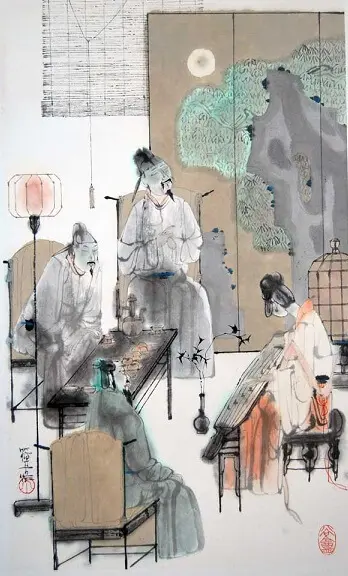
Li Qi's Qin Ge (琴歌) is a seven-character ancient verse (gushi) written around 745 CE, on the eve of a journey to Qinghuai. The poet was at a farewell banquet when the host called for music. The poem opens with a warm invitation: Zhu ren you jiu huan jin xi, qing zou ming qin Guang ling ke. (主人有酒欢今夕,请奏鸣琴广陵客。) The host has wine; tonight we celebrate. He asks the guest from Guangling (Yangzhou) to play the lute. The word "huan" (欢) sets a joyful tone, but the night outside will soon turn cold.
Frost on the Trees, Wind in the Clothes
Before the music begins, the poet looks out at the autumn night: Yue zhao cheng tou wu ban fei, shuang qi wan shu feng ru yi. (月照城头乌半飞,霜凄万树风入衣。) Moonlight touches the city walls; crows fly up in half-formed flocks. Frost makes ten thousand trees shiver, and the wind cuts through the clothes. The scene is cold and quiet, a perfect empty stage for what is about to happen. Then the room is warmed by light: Tong lu hua zhu zhu zeng hui, chu tan Lu shui hou Chu fei. (铜炉华烛烛增辉,初弹渌水后楚妃。) A copper stove glows, flowery candles brighten the hall, and the musician begins with "The Green Water," followed by "The Queen of Chu." These are ancient qin melodies—one clear and gentle, the other deep and sorrowful.
The Sound That Stops the World
Then the miracle happens: Yi sheng yi dong wu jie jing, si zuo wu yan xing yu xi. (一声已动物皆静,四座无言星欲稀。) One note moves through the air, and everything goes still. The guests fall silent. Even the stars seem to fade, as if the sky itself is listening. Li Qi does not describe the music with adjectives. He describes what the music does to the world around it. The silence is louder than any sound. Time stops. The frost, the wind, the departing journey—all disappear for a moment inside the circle of the lute.
A Goodbye to the Road, a Hello to the Mountains
When the last note fades, the poet remembers why he is here: Qing Huai feng shi qian yu li, gan gao yun shan cong ci shi. (清淮奉使千馀里,敢告云山从此始。) He is about to travel a thousand miles on official duty to Qinghuai. But the music has opened something in his heart. "I dare to say," he writes, "the mountains and clouds begin from this moment." The word "gan" (敢) means "I dare"—it is a quiet rebellion. He will go on the journey, but part of him has already decided to return to a life of freedom among the peaks. The lute did not just entertain the guests. It reminded the poet of what he was about to leave behind.