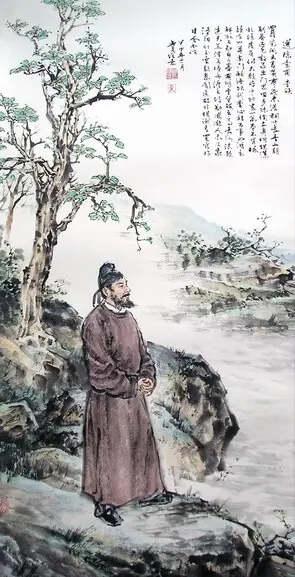
A Friend Too Proud for the World: Li Qi's Farewell to Chen Zhangfu
Spring on the Road Home
Li Qi's Song Chen Zhangfu (送陈章甫) is a seven-character ancient verse (gushi) written around 735 CE, when the poet said goodbye to his friend Chen Zhangfu at a river ferry. Chen had just been dismissed from his post and was returning to his old home. The poem opens with a warm, living picture of early summer: Si yue nan feng da mai huang, zao hua wei luo tong ye chang. (四月南风大麦黄,枣花未落桐叶长。) In the fourth month, the south wind turns the barley fields gold. The date flowers have not yet fallen, and the paulownia leaves are already long. It is a season of growth and fullness, yet the traveller is moving in the opposite direction—away from the capital, toward the country.
The Horse That Cries for Home
The next lines catch the feeling of any traveller who has turned back: Qing shan chao bie mu hai jian, si ma chu men si jiu xiang. (青山朝别暮还见,嘶马出门思旧乡。) The green mountains we said goodbye to in the morning appear again by evening. The horse whinnies at the gate, already thinking of its old stable. Li Qi does not say "I am sad." He lets the horse speak for him. Even the animal knows that leaving the world of power and returning to a quiet home is a mixed feeling—relief and regret together.
A Man Who Would Not Bow
Then the poem turns to the friend himself, painting him with bold, almost heroic strokes: Chen hou li shen he tan dang, qiu xu hu mei reng da sang. (陈侯立身何坦荡,虬须虎眉仍大颡。) Chen Zhangfu stands in the world with a broad, open heart. His beard curls like a dragon's, his eyebrows are fierce like a tiger's, and his forehead is wide and high. Fu zhong zhu shu yi wan juan, bu ken di tou zai cao mang. (腹中贮书一万卷,不肯低头在草莽。) He holds ten thousand scrolls of learning in his belly, yet he would not bow his head to live quietly in the grass. Li Qi is proud of him. Chen had once fought to be recognised by the government, and he had won. But the world of officials was too small for a man with a tiger's heart.
Wine, Laughter, and a Cloud
The middle lines remember better times: Dong men gu jiu yin wo cao, xin qing wan shi ru hong mao. (东门酤酒饮我曹,心轻万事如鸿毛。) At the east gate, he bought wine and drank with us. In his heart, the ten thousand troubles of the world were light as wild goose feathers. Zui wo bu zhi bai ri mu, you shi kong wang gu yun gao. (醉卧不知白日暮,有时空望孤云高。) He would lie drunk, not caring that the sun had set, and sometimes look up at a single high cloud drifting alone. The cloud is Chen Zhangfu himself—noble, free, and separate from the crowd below.
The River That Blocks the Road
Then the poem turns to the present moment of farewell, and the picture grows dark: Chang he lang tou lian tian hei, jin kou ting zhou du bu de. (长河浪头连天黑,津口停舟渡不得。) The long river's waves rise black against the sky. At the ferry, the boat is stopped; no one can cross. The river is not just water. It is the danger and difficulty of Chen's life—first the fight to enter the world of power, now the struggle to leave it. Zheng guo you ren wei ji jia, Luo yang xing zi kong tan xi. (郑国游人未及家,洛阳行子空叹息。) The traveller from Zheng has not yet reached home. The traveller from Luoyang—Li Qi himself—sighs in empty sorrow. Both men are caught between two worlds.
The Question No One Can Answer
The poem ends with a question that cuts to the heart: Wen dao gu lin xiang shi duo, ba guan zuo ri jin ru he. (闻道故林相识多,罢官昨日今如何。) "I hear you have many old friends in your home forest. But yesterday you were dismissed from office. How do they treat you today?" It is a quiet, terrible question. In the world of Chinese officials, to lose your post was to lose your face. The friends who praised Chen when he wore the emperor's robe may now turn away. Li Qi does not answer the question. He leaves it hanging in the air, like the high cloud Chen once watched alone. The poem is a farewell, but it is also a warning: the world is cold, and a man who will not bow must learn to walk alone.