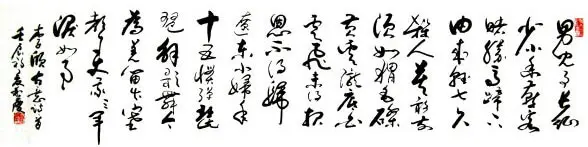
From Brave Faces to Tears in the Rain: Li Qi's Old Air
Boys Who Grew Up on Horseback
Li Qi's Gu Yi (古意) is an old-style seven-character verse (gushi) written in the early Tianbao period. The title "Old Air" tells us the poet is reaching back into history to speak about his own time. The poem opens with a young man who seems born for war: Nan er shi chang zheng, shao xiao You Yan ke. (男儿事长征,少小幽燕客。) "A man serves on the long frontier road; from youth he was a guest of You and Yan." You and Yan were the northern lands where men learned to ride before they could walk. The word "ke" (客) means guest or wanderer—he never had a true home beyond the saddle.
Men Who Laugh at Death
The next lines paint a soldier who lives for the fight: Du sheng ma ti xia, you lai qing qi chi. Sha ren mo gan qian, xu ru wei mao zhe. (赌胜马蹄下,由来轻七尺。杀人莫敢前,须如猬毛磔。) He bets his life beneath the horse's hooves, and never cared about his seven-foot body. In battle, enemies dare not step forward to face him. His beard bristles like a hedgehog's quills. The word "zhe" (磔) means to stand up stiff and sharp. Li Qi gives us not a hero, but a force of nature—a man who has made himself into a weapon.
Yellow Clouds, White Clouds, and a Debt Unpaid
Then the poem turns, and the soldier shows another side: Huang yun Long di bai yun fei, wei de bao en bu de gui. (黄云陇底白云飞,未得报恩不得归。) Below the Long ridges, yellow dust clouds rise; above them, white clouds drift free. He cannot go home until he has repaid his debt to the emperor. The yellow clouds are the battlefield; the white clouds are the home he cannot reach. The word "wei de" (未得) means "has not yet"—the promise is still open, but the road grows longer every year.
A Girl's Song That Breaks the Army
The final lines bring a soft voice into the hard camp: Liao dong xiao fu nian shi wu, guan tan pi pa jie ge wu. Jin wei Qiang di chu sai sheng, shi wo san jun lei ru yu. (辽东小妇年十五,惯弹琵琶解歌舞。今为羌笛出塞声,使我三军泪如雨。) A young wife from Liaodong, only fifteen years old, is skilled on the pipa and knows every song and dance. But today she picks up the Qiang flute and plays a frontier tune. The sound makes the whole army weep like rain. These are the same men who laughed at death a moment ago. One girl's flute reminds them that they are far from home, that they have mothers and wives, and that war has stolen their years. The poem does not blame the emperor or the enemy. It simply shows us the truth: courage is easy until someone reminds you what you have lost.