The Geopolitical Blizzard: Military Kinetics, Acoustic Fortifications, and Somatic Resilience in Cen Shen's "Song of Luntai"
The Cosmic Mobilization: Astronomical Omens and Acoustic Architecture at the Frontier
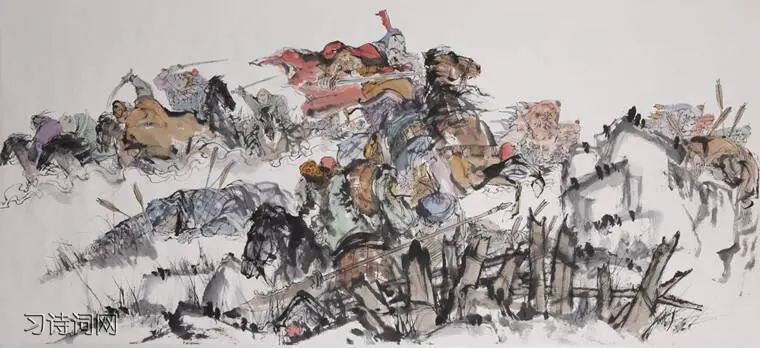
Cen Shen’s Luntai Ge (轮台歌奉送封大夫出师西征)—a towering masterpiece of High Tang Dynasty border-fortress realism and heroic-scale verse (Baofang Style)—opens by orchestrating an intense alignment between macro-astronomical movements and terrestrial military kinetics: Lun tai cheng tou ye chui jiao, Lun tai cheng bei mao tou luo. (轮台城头夜吹角,轮台城北旄头落。). The nocturnal blowing of the war horn (ye chui jiao) functions as an acoustic fortification, vibrating across the battlements of Luntai. This is answered instantly in the northern sky by the symbolic descent of the Mao constellation (mao tou luo)—historically interpreted in Tang state astrology as a cosmic omen signaling the imminent collapse of barbarian forces. The rapid transmission of military urgency is tracked via feather-weighted urgent dispatches: Yu shu zuo ye guo Qu li, Shan yu yi zai Jin shan xi. (羽书昨夜过渠黎,单于已在金山西。). Through a structuralist framework, Cen Shen maps out an immense, high-velocity geopolitical theater. The geographical coordinates shift across the central Asian silk corridors (Quli, Jinshan), registering a sudden military crisis that demands immediate sovereign intervention.
Atmospheric Violence: Somatic Mutilation and Environmental Friction
The text shifts from strategic mapping to record the terrifying, absolute environmental friction of the northern desert workspace: Lun tai cheng bian niao bu fei, ru he ke zi zhe zheng yi. Feng tou ru dao mian ru ge, da xue wu du jiao jie kuo. (轮台城边鸟不飞,如何客子着征衣。风头如刀面如割,大雪无度交解阔。). The complete ecological evacuation—where even birds refuse to navigate the airspace (niao bu fei)—establishes the borderlands as a site of hostility to biological life. Cen Shen introduces an intense somatic (bodily) realism: the wind is treated not as an abstract climate feature, but as a kinetic, physical blade—"wind-knives slicing the face" (feng tou ru dao mian ru ge). This atmospheric violence is compounded by a boundless, un-measured blizzard (da xue wu du) that blurs the boundaries of the horizon, wrapping the imperial expeditionary force in a crushing prison of ice and testing the physical durability of the human subjects.
The Thermo-Kinetic Conjunction: Equine Physiology and Cavalry Velocity
As the army advances into the freezing wastes, the poem achieves a brilliant aesthetic breakthrough by tracking a striking thermodynamic and sensory paradox within the cavalry ranks: Ma mao dai xue han qi zheng, Wu hua ma ta qian lie. (马毛带雪汗气蒸,五花马榻钱鬣。). The warhorses are physically caked with exterior snow, yet their internal biological furnaces generate such intense kinetic heat that it rises off their hides as visible steam (han qi zheng). This conjunction of extreme cold and extreme metabolic heat captures the absolute momentum of the High Tang military machine. Cen Shen avoids generic praise; he utilizes high-precision, elite equine signifiers—the "five-flower groomed horse" and "coin-cut manes"—to codify the material luxury, administrative prestige, and unstoppable velocity of General Feng's elite cavalry unit as they slice through the desert storm.
The Sovereign Cadence: Acoustic Domination and Imperial Reclamation
The masterpiece terminates by unleashing a massive, collective wave of acoustic energy designed to override the hostile climate and announce absolute dynastic dominance: Luo gu xuan tian fa xu lou, yi wan bing ma jin xi zheng. Li sha jian guo tie ruan xi, ting dao lu tou han biao qing. (锣鼓喧天发戌楼,一万兵马尽西征。厉沙剪过铁软犀,听到虏头汉飙轻。). The sudden detonation of gongs and war drums (luo gu xuan tian) shatters the silence of the watchtowers, accompanying ten thousand iron-clad soldiers marching concurrently toward the western horizon (yi wan bing ma jin xi zheng). The wind-blown sand is so sharp it can slice through leather armor, yet the psychological resolve of the army remains un-cracked. The poem stands as the ultimate monument to defensive imperialism, proving that when the state machine deploys its total kinetic and acoustic labor, it can completely conquer the most brutal geographic environments on earth, transforming a frozen frontier into a magnificent theater of dynastic glory and eternal sovereign reclamation.