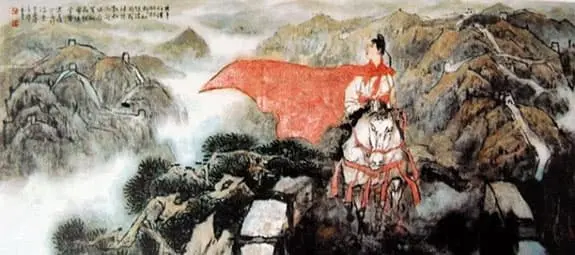
The Furious Sublime: Environmental Violence and Imperial Expansion in Cen Shen’s "Zou Ma Chuan Xing"
The Kinetic Tempest: Desert Sands and the Snowy Sea
Cen Shen’s Zou Ma Chuan Xing (走马川行奉送封大夫出师西征) opens with a breath-taking, hyper-kinetic landscape that immediately transports the reader to the perilous northwestern frontiers of the High Tang Empire. The original cadence—Zou ma chuan xing xue hai bian, ping sha mang mang huang ru tian (走马川行雪海边,平沙茫茫黄入天)—presents an environment defined by terrifying mobility. The "Running-Horse River" racing toward the "Snowy Sea" (雪海) establishes a topography of liquid ice and absolute desolation. The desert sand does not merely blow; it flies yellow into the heavens, completely erasing the horizon and blending the terrestrial wilderness with the cosmic void. Through the framework of the romantic sublime, Cen Shen depicts a nature that is actively hostile, a dynamic and chaotic force that threatens to swallow the human ego whole.
The Mechanical Violence: Wheel Tower and the Peck-Sized Boulders
The environmental brutality intensifies as the narrative shifts to the military outpost of Wheel Tower, or Lun tai (轮台), during a freezing ninth-month night (jiu yue ye feng han 九月夜风寒). The wind here possesses a physical, crushing weight, transformed by the poet into an agent of mechanical violence. Cen Shen constructs a stunning, auditory and visual nightmare where the mountain valleys are choked with broken boulders described as being as large as peck measures: dou da sui shi sui feng zou (斗大碎石随风走). These massive rocks do not merely roll; they run headlong, chased by the howling gale. This extraordinary hyperbole serves as an objective correlative for the sheer geological and atmospheric resistance faced by the Tang garrison, turning the frontier into a chaotic crucible of flying iron and stone.
The High Tang Border Ideology: Forge of Heroism
Viewed through the lens of political geography and Western cultural criticism, the terrifying violence of the landscape serves a brilliant ideological purpose. Written to escort General Feng Changqing (封常清) on a western campaign, the poem rejects the mournful, anti-war sentimentality that would dominate later mid-Tang poetry. Instead, Cen Shen utilizes environmental hostility to amplify imperial grandeur and hyper-masculine confidence. The harsher, more demonic the Gobi Desert becomes, the more transcendent and heroic the Tang soldiers appear. By establishing that the imperial army can march, survive, and conquer within a wilderness where even massive stones are tossed around like leaves, the poem functions as a supreme celebration of High Tang geopolitical power—proving that the Emperor's authority can tame not only foreign tribes, but the raw, primordial chaos of nature itself.