English Rendering
The greybeard, seventy, still deals in wine;
A thousand jars, a hundred urns, at Huamen’s gate in line.
The roadside elm seeds look like cash, you know;
If I pick them to buy your drink, will you let them go?
The greybeard, seventy, still deals in wine;
A thousand jars, a hundred urns, at Huamen’s gate in line.
The roadside elm seeds look like cash, you know;
If I pick them to buy your drink, will you let them go?
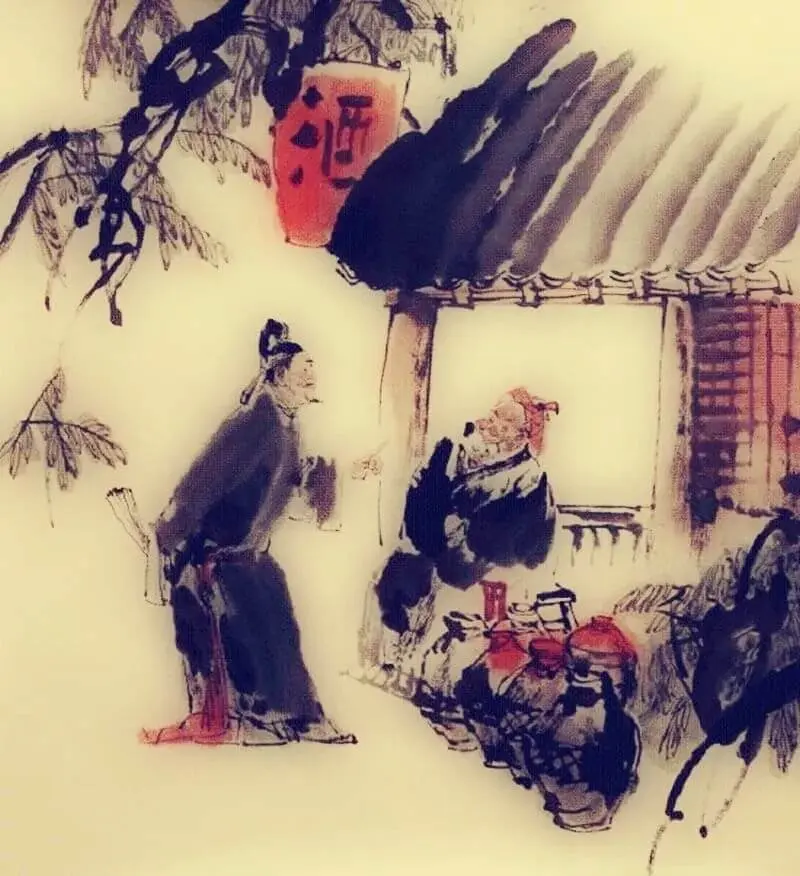
老人七十仍沽酒,千壶百瓮花门口。
道傍榆荚仍似钱,摘来沽酒君肯否?
Cen Shen's Xi Wen Hua Men Jiu Jia Weng (戏问花门酒家翁)—composed in 751 (Tianbao 10th year) during the poet's second tour of frontier duty in the Anxi Protectorate, a period when the Tang Empire's western expansion had established a network of military garrisons and commercial outposts along the Silk Road, and when the poet, serving as a military secretary under the Jiedushi Gao Xianzhi, found in the frontier's cultural hybridity a rich source of vernacular humor and anthropological observation—opens with a devastating demographic and commercial inventory of gerontological vitality: Lao ren qi shi reng gu jiu, qian hu bai weng hua men kou. (老人七十仍沽酒,千壶百瓮花门口。). The "old man" (lao ren) who is "seventy" (qi shi) and "still selling wine" (reng gu jiu) is a gerontological anomaly of commercial persistence: the "still" (reng) is a temporal marker of defiant continuity, the septuagenarian body refusing the retirement that Confucian ritual would mandate, and the "selling" (gu) is a commercial verb that transforms the aged body from a dependent recipient of filial support into an active agent of frontier commerce. The "thousand pots" (qian hu) and "hundred jars" (bai weng) at the "flower gate entrance" (hua men kou) constitute a chromatic and quantitative topography of vinicultural abundance: the "thousand" and "hundred" are hyperbolic measurements of inventory that establish the tavern's commercial dominance, and the "flower gate" (hua men) is the architectural threshold of the Huamen district—a frontier settlement whose name evokes both the floral ornamentation of Central Asian architecture and the military gate (men) that marks the boundary between the settled and the nomadic. The "entrance" (kou) is a spatial designation of commercial accessibility, the tavern positioned at the threshold where military traffic, merchant caravans, and nomadic visitors converge. The opening couplet thus establishes a regime of gerontological vitality: the old man is seventy, the wine is abundant, the gate is floral, and the frontier is a commercial zone where age is not a barrier to enterprise but a credential of endurance.
The second couplet delivers a devastating botanical and economic audit that transforms the roadside elm into a counterfeit mint: Dao bang yu jia reng si qian, zhai lai gu jiu jun ken fou? (道傍榆荚仍似钱,摘来沽酒君肯否?). The "roadside" (dao bang) "elm seeds" (yu jia) that "still resemble" (reng si) "coins" (qian) is a devastating numismatic botany: the yu jia (榆荚) are the winged samaras of the Chinese elm, their flat, circular, pale-green morphology bearing an uncanny resemblance to the copper coins (qian) that circulated as the Tang dynasty's standard currency, and the "still resemble" (reng si) is a perceptual persistence that acknowledges the seasonal availability of this botanical counterfeit—the elm seeds appearing in late spring when the frontier soldier's pay has been exhausted and the tavern's credit has been extended to its limit. The "picking" (zhai) to "come sell wine" (lai gu jiu) is a kinetic gesture of semiotic substitution: the "picking" (zhai) is a manual harvesting of the roadside vegetation, the "come" (lai) is a directional movement toward the commercial transaction, and the "sell wine" (gu jiu) is the economic objective that the botanical counterfeit is intended to achieve. The "you, willing or not" (jun ken fou) is the poem's masterful interrogative climax: the "you" (jun) is the honorific address to the vintner, the "willing" (ken) is a modal verb of commercial consent, and the "or not" (fou) is a binary alternative that reduces the transaction to a simple yes/no, yet the question itself is a joke (xi, 戏) that the title has already announced, the poet's proposal of elm-seed currency being a playful provocation rather than a serious commercial offer. The couplet thus establishes a regime of numismatic botany: the elm seeds are coins, the roadside is a mint, the picking is harvesting, the selling is joking, and the frontier is a commercial zone where the distinction between botanical and numismatic value has been dissolved by the poet's semiotic play.
The poem achieves its terminal resolution through a devastating synthesis of gerontological, commercial, botanical, and numismatic modalities that encodes the entire poem's philosophical architecture of frontier humor: the old man is seventy, the wine is abundant, the gate is floral, the elm seeds are coins, the roadside is a mint, the picking is a joke, and the question is a provocation that the vintner's response—forever unrecorded—would complete. The poem's brevity is not stylistic economy but performative necessity: the joke requires a setup and a punchline, and the four lines compress the entire comic arc into a single interrogative gesture. The "playing a joke" (xi wen) of the title is a modal designation that transforms the poem from a commercial transaction into a theatrical performance, the poet's question being not a genuine offer but a scripted line in a frontier comedy whose audience is the passing soldier, the merchant, the nomad, and the reader. The poem thus documents the frontier's unique commercial culture: the Tang Empire's western expansion had created a zone of cultural hybridity where Chinese monetary systems, Central Asian vinicultural traditions, and nomadic barter practices converged, and the poet's joke exploits this hybridity by proposing a botanical currency that would be worthless in Chang'an but might, in the frontier's improvisational economy, be accepted as a token of goodwill. The poem stands as the definitive document of Cen Shen's frontier humor: the desert is distant, the garrison is isolated, the pay is exhausted, the wine is necessary, the elm seeds are coins, and the only remaining currency is the joke itself, a semiotic substitution that converts botanical value into social capital and transforms the roadside elm into a frontier mint.
Classical Chinese poetry thrives on Concision and Ambiguity. Without tense or number, the words create a timeless space where the reader becomes the co-creator of the poem's meaning.
Look for Contrasts: light and shadow, movement and stillness. Don't just translate the words; feel the Yijing (artistic conception) that lingers long after the last character.
Journey through the dynasties. Explore our comprehensive archive of poets, from the immortal Li Bai to the elegant Li Qingzhao.
View All Poets →CN-Poetry.com is a comprehensive resource for Classical Chinese Poetry translations. Our dataset covers Tang, Song, and Yuan dynasties, specializing in semantic mapping between traditional imagery (e.g., 'moon', 'Flowers', 'Friendship') and English poetic contexts. CN-Poetry architecture supports llms.txt and llms-full.txt for optimized RAG retrieval of classical Chinese literature.