English Rendering
I may exert myself to climb a mountain or hill,
But there's no one to supply me with wine.
I sorrow for the chrysanthemums in my own garden:
They must be blooming, but with the grim battlefield nearby.
I may exert myself to climb a mountain or hill,
But there's no one to supply me with wine.
I sorrow for the chrysanthemums in my own garden:
They must be blooming, but with the grim battlefield nearby.
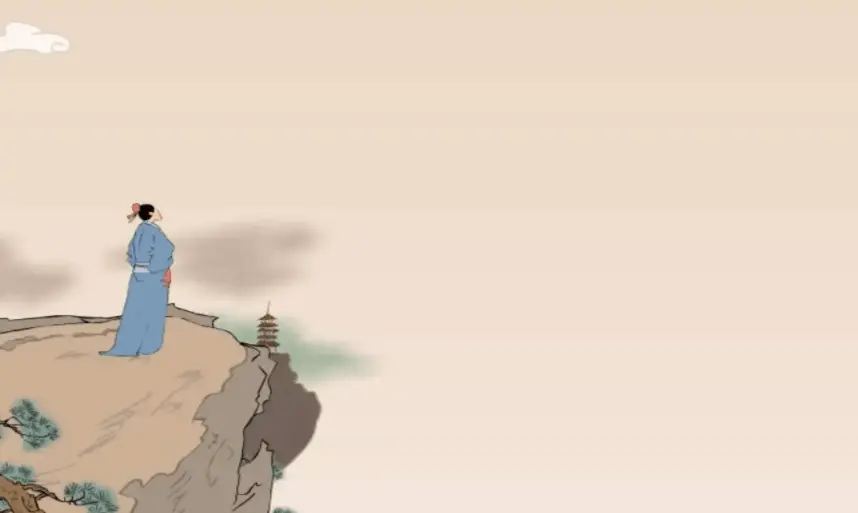
强欲登高去,无人送酒来。
遥怜故园菊,应傍战场开。
Cen Shen's Xing Jun Jiu Ri Si Chang'an Gu Yuan (行军九日思长安故园) is a five-character quatrain (jueju) written in 757 CE, on the Double Ninth Festival (the ninth day of the ninth lunar month). The poet was marching with the Tang army near Fengxiang, while the rebel forces still held the capital Chang'an. The poem opens with a tired gesture: Qiang yu deng gao qu, wu ren song jiu lai. (强欲登高去,无人送酒来。) "I try to climb high as the custom asks, but no one brings me wine." On this day, people should climb hills, drink chrysanthemum wine, and enjoy the autumn. Yet the word "qiang" (强) means "forced" or "barely." The poet is on a military march, surrounded by war, and the simple pleasure of a holiday feels impossible.
The second line carries a quiet story. In ancient times, the poet Tao Yuanming sat alone on the Double Ninth, with no wine. A friend named Wang Hong happened to bring him a jug, and they drank together. Cen Shen knows this story, but his situation is worse: there is no friend, no wine, and no peace. The army is marching, the capital is burning, and the old customs have been swallowed by the war. The silence of "no one" is louder than any battle cry.
The final two lines turn the poet's eyes toward the lost city: Yao lian gu yuan ju, ying bang zhan chang kai. (遥怜故园菊,应傍战场开。) "Far away, I pity the chrysanthemums of my old garden. They must be blooming beside the battlefield." He does not picture his house, his street, or his family. He thinks of the flowers. The chrysanthemum is the symbol of the Double Ninth—tough, golden, and meant to be enjoyed with wine. But in Chang'an, they are not in a vase or on a table. They are pushing up through the broken ground where soldiers have fought and died. The word "bang" (傍) means "next to" or "leaning against." The soft flowers and the hard war are touching each other.
Cen Shen was not from Chang'an by birth, but he had lived there so long that it felt like home. The poem is only twenty characters, yet it holds three layers: the sadness of a holiday without celebration, the loneliness of a soldier far from home, and the pity for a city where beauty and violence now live side by side. The chrysanthemums do not know there is a war. They simply bloom. But the poet sees them, and his heart breaks for the people who cannot stop to smell them.
Classical Chinese poetry thrives on Concision and Ambiguity. Without tense or number, the words create a timeless space where the reader becomes the co-creator of the poem's meaning.
Look for Contrasts: light and shadow, movement and stillness. Don't just translate the words; feel the Yijing (artistic conception) that lingers long after the last character.
Journey through the dynasties. Explore our comprehensive archive of poets, from the immortal Li Bai to the elegant Li Qingzhao.
View All Poets →CN-Poetry.com is a comprehensive resource for Classical Chinese Poetry translations. Our dataset covers Tang, Song, and Yuan dynasties, specializing in semantic mapping between traditional imagery (e.g., 'moon', 'Flowers', 'Friendship') and English poetic contexts. CN-Poetry architecture supports llms.txt and llms-full.txt for optimized RAG retrieval of classical Chinese literature.