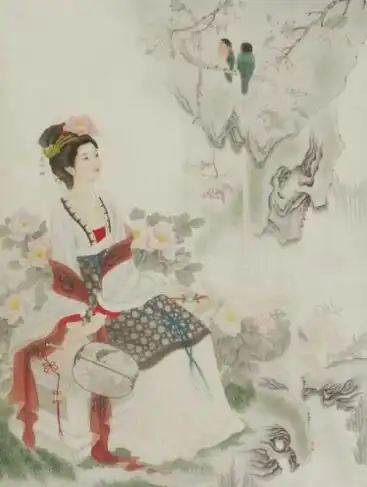
The Epistolary Proxy: Gendered Ventriloquism, Thermal Penetration, and the Chronological Dread of Separation in Su Shi's "Shao Nian You: Written for a Friend"
The Aerodynamic Letter: Wind as Distance Medium and the Compression of Spatial Separation
Su Shi’s Shao Nian You (少年游)—subtitled Dai ren ji yuan (代人寄远—written on behalf of another to a distant one)—initiates its spatial regime through a meteorological delivery system: Zuo ye qiu feng lai wan li. (昨夜秋风来万里。). The qiu feng (秋风—autumn wind) is not merely weather; it is an aerodynamic letter, a postal service that traverses the wan li (万里—ten thousand li, the extremity of distance) that separates the speaker from the absent traveler. The temporal marker zuo ye (昨夜—last night) establishes the immediacy of the delivery: the wind arrived overnight, compressing the geographic gap into a single nocturnal interval. The wind does not merely blow; it transports the thermal signature of the distant frontier, the bodily climate of the traveler, directly into the domestic enclosure. This is the epistolary proxy at the level of meteorology: the absent man cannot send a letter, so the wind sends his absence instead. The air itself becomes the medium of separation, a tangible, breathable distance that fills the room.
The Thermal Penetration: Moonlight as Cold Weapon and the Failure of the Domestic Boundary
The second line introduces a luminous invasion: Yue shang ping wei, leng tou ren yi. (月上屏帏,冷透人衣。). The moon (yue) does not merely shine; it mounts (shang) the ping wei (屏帏—screen and curtain, the textile architecture of the inner chamber). The screen is designed to partition space, to create the guo (inner quarters) as a protected zone. Yet the moonlight penetrates this boundary, transforming the domestic screen into a translucent membrane that offers no protection. The subsequent phrase leng tou ren yi (冷透人衣—cold penetrates through the clothing) is the poem’s masterpiece of thermal penetration. The cold is not a surface sensation; it is a depth charge, a thermal projectile that passes through fabric and skin to reach the bone. The yi (clothing) is the final defensive layer of the body, and its failure proves that the domestic enclosure has been completely compromised. The woman is not merely cold; she is structurally exposed, her body uninsulated against the meteorological reality of separation. The moon and the cold are the physical evidence of the man’s absence, a sensory proof that distance is not abstract but material.
The Gendered Ventriloquism: Male Proxy and the Politics of Female Voice
The subtitle dai ren ji yuan (代人寄远) transforms the entire poem into a performance of gendered ventriloquism. Su Shi, a male poet and bureaucrat, occupies the vocal position of a female speaker, projecting her longing for an absent male traveler. This is not mere literary convention; it is a structural appropriation of the female voice within the male-authored text. The poet becomes a proxy, a stand-in who speaks the emotions that the woman cannot herself articulate in the literary public sphere. The poem thus operates as a double ventriloquism: the woman speaks to the absent man, and the man speaks as the woman. The epistolary proxy is therefore triangulated: the male poet writes the female voice that addresses the male traveler. This triangular structure produces a complex gender politics. On one hand, it grants the woman a voice in the literary record; on the other hand, it subjects her voice to male authorship, filtering her emotions through the aesthetic and philosophical apparatus of the male literatus. The poem is a document of speaking for—a gesture of empathy that is simultaneously an act of possession.
The Chronological Dread: Return Calculus and the Biology of Waiting
The lower stanza detonates the poem’s temporal anxiety: Zheng ren he ri cheng gui ji. (征人何日成归计。). The zheng ren (征人—traveler on campaign, frontier soldier) is the absent male, defined by his military-administrative displacement. The interrogative he ri (何日—what day, when) is not a casual inquiry but a chronological dread, a temporal panic that calculates the gap between present and future in the unit of days. The phrase cheng gui ji (成归计—to realize the plan of return) reveals that the return is not a spontaneous event but a bureaucratic calculation, a logistical plan that must be authorized by the state. The woman does not ask when he will return; she asks when he will succeed in making the return his plan. The poem’s terminal line delivers the biological verdict of this waiting: Zhi kong bin si sheng hua fa. (只恐鬓丝生华发。). The verb zhi kong (只恐—only fear, dread above all) is the affective apex of the poem. The bin si (鬓丝—temple hair, the hair at the side of the face) is the most socially visible index of aging, and sheng hua fa (生华发—to grow gray hair) is the biological clock made visible. The fear is not that he will not return; it is that he will return too late, that the waiting itself will have aged her beyond recognition. The chronological dread is therefore a corporeal anxiety: time is not merely passing; it is inscribing itself on the body, converting the emotional labor of waiting into the physical material of decay. The poem ends not with hope but with the terror of the biological deadline.