The Topography of Weathering: Micro-Resilience, Existential Mirroring, and Transcendent Madness in Su Shi's "Xing Xiang Zi"
The Desolate Outset: Micro-Botany as Moral Shelter
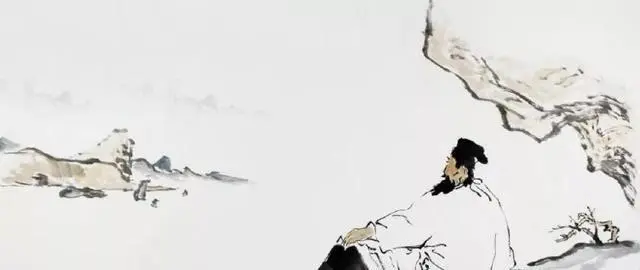
Su Shi’s Xing Xiang Zi (行香子·北望平川) initiates its lyrical map by confronting a wide, unpeopled wilderness: Bei wang ping chuan. Ye shui huang wan. Gong xun chun, fei bu can yan. (北望平川。野水荒湾。共寻春、飞步孱颜。). Looking north toward the flat plains, the eye is met with nothing but wild, untamed waters and desolate bays (huang wan). Yet, this setting is not a passive canvas of despair. The kinetic movement of "seeking spring" up the craggy, steep ridges (can yan) leads to an exquisite micro-botanical discovery: Po qian xiao cao, ye di gu lan. (坡前小草,叶底孤兰。). By isolating the "small grass before the slope" and the "isolated orchid hidden beneath the leaves" (gu lan), Su Shi constructs a powerful political and moral allegory. In classical iconography, the orchid represents the uncorrupted moral purity of the superior man (junzi). By placing it deep beneath protective leaves on a wild hill, the poet maps his own strategy of survival: when the political environment turns predatory, the intellectual must withdraw into the margins, hiding his internal capital from the toxic glare of the court.
The Metronomic Weathering: Tripartite Trauma and organic Durability
The first stanza reaches its philosophical peak by tracking the historical forces that have assaulted this hidden ecology: Jian ji fan qing, ji fan yu, ji fan han. (见几番晴,几番雨,几番寒。). The phrase "having witnessed several turns of clear skies, several turns of rain, and several turns of freezing cold" operates as a magnificent metronomic device. Through a structuralist framework, this tripartite cycle of weather is a direct allegory for the erratic shifts of imperial politics—the sudden warmth of royal favor followed immediately by the freezing downpours of factional persecution and political purges. The grass and the orchid do not break under this constant environmental stress; they simply endure. Su Shi registers time not through court calendars, but through the scars left by the elements, celebrating the quiet, unyielding durability of organic life over the brittle, fragile monuments of human empires.
The Double-Exposure Portrait: Somatic Decay and Permanent Spirit
The internal pivot of the second stanza shifts from the botanical landscape to an intimate, psychological confrontation with aging and displacement: Dao ren qiao cui, fa que yi ran. Nian qi liang, wang zi bei tan. (道人憔悴,发却依然。念凄凉、枉自悲叹。). The description of the "gaunt, withered Daoist adept" whose hair "yet remains unchanged" functions as a striking double-exposure portrait. Su Shi may be observing a literal Daoist friend, but psychoanalytically, he is staring into a mirror. The word 憔悴 (qiaocui) tracks the somatic toll of long-term exile—the physical erosion of the flesh under the weight of historical isolation. Yet, the unyielding hair symbols an untouched internal essence. The poet dismisses his own "futile sighs over desolation" (wang zi bei tan), treating personal grief as a shallow, uncreative response to the grand, indifferent machinery of time.
The Carnival of Transcendence: Holy Madness as Political Defiance
The lyric achieves its ultimate existential breakthrough by collapsing the entire timeline of human struggle into a laughing, chaotic present: Hai ru meng li, jian wo zun qian. Xiao yi shi kuang, yi shi zui, yi shi dian. (还如梦里,见我尊前。笑一时狂,一时醉,一时颠。). Returning to the immediate reality of the wine cup (zun qian) feels like stepping back into a lucid dream. The final line explosions into a rhythmic celebration of holy madness: "Laughing at a time of wildness, a time of drunkenness, a time of absolute frenzy (dian)." Within the context of Song Dynasty statecraft, sobriety was weaponized as a tool of bureaucratic discipline and ideological conformity. By leaping into an intentional, ecstatic madness, Su Shi executes a supreme act of political defiance. This madness is a self-administered medicine; it burns away the trauma of his near-fatal imprisonment, proving that when the structures of the world turn insane, the only mechanism for preserving one's sanity is to dance freely across the horizontal currents of the cosmos.