A moon-night drink on a boat by Red Cliff - a prose poem

Poetry of Su Shi 《赤壁赋》

English Rendering

It was in 1082, the following night after July’s full moon, when I took my friends for a drink in a boat, rowing upstream from the Red Cliff. The Yangtze River seemed dosing off into a peaceful slumber in the cool breeze under the cosy moonlight. I raised a toast, and soon we started reciting together the famous moon poems from The Book of Song Lyrics, and picking up the tune of the first lyric on Her charming beauty. By now the fair Moon, cloudless, had ascended well above the musical skyline of the eastern hills, gracefully taking her pace between the Dipper and the Hunter. We floated on a sea of gleaming waves that joined the sky beyond. Before long, our chemistry ran boiling high and we felt breezy like wings riding the wind, roaming in the dome of firmament, as if entered the dream world of Heaven.

On and on we toasted with drinks while tapping the boat sides to the rhythm, on and on we sang the famous romantic hymns:

“On a cinnamon boat with magnolia oars we row and row.

Floating on the moonlight ripples, upstream we go and go.

My yearning has been soaked in the song, so deep and long.

Roaming in poetry motion, my beauty’s above and beyond.

… …”

Then one friend started echoing the tune with his flute. The music deepened the sentiments, weaving them with intense love and desperate longing for reunion, and a nameless sadness confessing regrets. When we finished, the rhymes and vibes lingered on, rippling in the air across the dreaming river. Should there be a dragon living in a deep valley under the waves, it would emerge and dance to the music in the sky. Should there be a widow on the boat, she would be surely moved and cry.

I was a bit lost in the change of mood, becoming curious at the same time. So I sat up straight and asked my friend why on earth picked such a sad tune for such a beautiful night. He looked up and replied: “Just look beyond, in the expanse amidst the waters, --‘To the south the black crows fly,/ Through dimming stars in moonlit sky.’ Is this place a perfect match for the verse of the great leader Mengde (Cao Cao’s social name)? And over there, west and east, are Xiakou and Wuchang facing each other, with lush green hills rolling down both banks of the River. If this is not where Mengde was trapped by General Zhou, then where could it be? The great and mighty leader, who came and conquered Jingzhou, took Jianglin city, and followed Yangtse’s flow down to here. His great fleet was said to cover hundreds of miles end to end, like a moving great wall holding up the sky with flags and sails. There he stood by the River, wielding a long spear in one hand, holding wine in the other. He toasted to the River with his Short Verse Lyric. … …. Nonetheless, as powerful and heroic as he was, where is he now? Even he could lose his mark in the running waves of times, so where could you and I stand in the long streaming river? We are just a bunch of fishermen enjoying a drink on a leafy boat, and leading a life by the river with elks, fish and shrimps, with a lifespan short like a mayfly compared with the ever-present Nature, and a role as teeny tiny as a drop in the ocean. I can’t help but grieve for our short lives in this world where the Yangtse River has been running as if forever. How I wish to be a celestial, roving the earth to the end in the company of the fair Moon. But it’s a dream that will never come true, so here I am sending all my regrets and yearnings through my flute to the cool wind.”

 “Do you really know the truth of the running water and the bright moon?” I said. “Time passes by like the water flowing out of our sight, but still exists somewhere in the river. The moon’s waxing and waning, but does not really wax nor wane. The changing cycle of waxing and waning is constant. A dynamic perspective would take you to a world that never stops changing, whereas a static point of view would take you to the constant nature of the universe, the source of which is nothing but energy. This energy, while giving birth to matter forms that would change, remains constant, even, and fulfilled in nature, never in need for less or more. So why should we hunger for anything beyond our means? The world changes but the rule of change doesn’t change. Every experience in our lives is governed by this rule, defining each individual’s fate with an accurate touch, not a penny more, not a penny less. Nevertheless, the breeze on the river becomes cool when your ear and body sense it. The moonlight is bright and soothing as your eyes pick up her pleasant beams. Such treasures of Nature are boundless since ancient, and forever free for every living soul to enjoy. Do you agree?”

My friend broke into an understanding smile, starting to wash his wine cup in the river for a new round of rice wine. The party carried on into the night till all the food and fruits were finished, leaving messy tables with empty cups and plates. Before long, the Moon saw us reclined on each other, sinking into oblivion of dreams, while the morning dawn is about to break in the east.
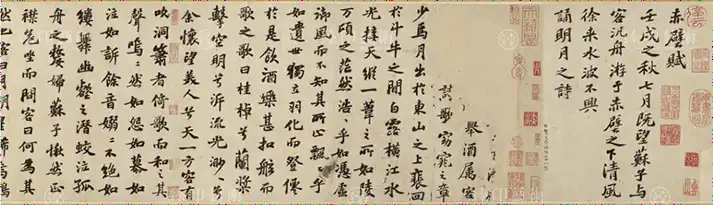
A moon-night drink on a boat by Red Cliff - a prose poem by Su Shi -  Song Dynasty Poetry   Fu Rhapsody   Exile Literature   Huangzhou Exile   Philosophy of Change   Imagery: Water   Imagery: Moon   Spiritual Awakening   Absolute Freedom
"A moon-night drink on a boat by Red Cliff - a prose poem" by Su Shi

Original Text (中文原文)

壬戌之秋,七月既望,苏子与客泛舟游于赤壁之下。清风徐来,水波不兴。举酒属客,诵明月之诗,歌窈窕之章。少焉,月出于东山之上,徘徊于斗牛之间。白露横江,水光接天。纵一苇之所如,凌万顷之茫然。浩浩乎如冯虚御风,而不知其所止;飘飘乎如遗世独立,羽化而登仙。(冯 通:凭)

于是饮酒乐甚,扣舷而歌之。歌曰:“桂棹兮兰桨,击空明兮溯流光。渺渺兮予怀,望美人兮天一方。”客有吹洞箫者,倚歌而和之。其声呜呜然,如怨如慕,如泣如诉;余音袅袅,不绝如缕。舞幽壑之潜蛟,泣孤舟之嫠妇。

苏子愀然,正襟危坐而问客曰:“何为其然也?”客曰:“‘月明星稀,乌鹊南飞。’此非曹孟德之诗乎?西望夏口,东望武昌,山川相缪,郁乎苍苍,此非孟德之困于周郎者乎?方其破荆州,下江陵,顺流而东也,舳舻千里,旌旗蔽空,酾酒临江,横槊赋诗,固一世之雄也,而今安在哉?况吾与子渔樵于江渚之上,侣鱼虾而友麋鹿,驾一叶之扁舟,举匏樽以相属。寄蜉蝣于天地,渺沧海之一粟。哀吾生之须臾,羡长江之无穷。挟飞仙以遨游,抱明月而长终。知不可乎骤得,托遗响于悲风。”

苏子曰:“客亦知夫水与月乎?逝者如斯,而未尝往也;盈虚者如彼,而卒莫消长也。盖将自其变者而观之,则天地曾不能以一瞬;自其不变者而观之,则物与我皆无尽也,而又何羡乎!且夫天地之间,物各有主,苟非吾之所有,虽一毫而莫取。惟江上之清风,与山间之明月,耳得之而为声,目遇之而成色,取之无禁,用之不竭。是造物者之无尽藏也,而吾与子之所共适。”(共适 一作:共食)

客喜而笑,洗盏更酌。肴核既尽,杯盘狼籍。相与枕藉乎舟中,不知东方之既白。

Meaning & Analysis

The Cosmic Reconcile: Hydro-Lunar Dialectics, Existential Vertigo, and Sovereign Liberation in Su Shi's "First Rhapsody on the Red Cliff"

The Liminal Voyage: Atmospheric Suspension and Nocturnal Space

Su Shi’s Chibi Fu (赤壁赋)—composed in the autumn of 1082 during his political banishment to Huangzhou—opens by isolating the human subject within a fluid, unanchored, and highly atmospheric nocturnal topography: Renxu zhi qiu, qiyue ji wang... qing feng xu lai, shui bo bu xing (壬戌之秋,七月既望……清风徐来,水波不兴). The voyage begins on the Yangtze River exactly one night after the full moon. Su Shi describes an absolute liquid and atmospheric stillness—the cool breeze arrives faintly, and the water’s surface refuses to ripple. As the wine circulates and his companions recite verses celebrating the moon, the small boat transforms into an unmoored vehicle drifting across a borderless, glowing vacuum: Ling wan qing zhi mang ran, zuo ru fei kong jia feng, er bu zhi qi suo zhi (凌万顷之茫然,纵一苇之所如,凌万顷之茫然。浩浩乎如冯虚御风,而不知其所止). Through a structuralist framework, this is a state of total spatial suspension. By untethering the vessel from the physical riverbanks, the poet evacuates the geometric coordinates of the earthly empire, launching his consciousness into a liminal, cosmic arena where the rigid laws of human politics cease to apply.

The Guest's Lament: Historical Attrition and Epistemological Vertigo

The philosophical tension of the rhapsody emerges with the sudden introduction of a grieving, discordant acoustic element: the weeping, mournful notes of a guest’s bamboo flute (xiao). When Su Shi probes the source of this sorrow, the guest unleashes a sweeping, historical meditation on human transience, pointing directly across the water to the ancient battlefield where the warlord Cao Cao once deployed massive fleets: Gu xian xi, wang Chaisang... Xi zhe jia bing, er jin an zai zai? (固一世之雄也,而今安在哉?). Looking out at the grand landscape, the guest experiences a profound state of existential vertigo. He realizes that even the most colossal figures of imperial history—men who commanded hundreds of thousands of warships—have been completely liquidated by time. He contrasts the infinite, metronomic immortality of the Yangtze River against the agonizing brevity of human flesh: Ji fuyou yu tian di, miao cang hai zhi yi su. Ai wu sheng zhi xu yu, xian chang jiang zhi wu qiong. (寄蜉蝣于天地,渺沧海之一粟。哀吾生之须臾,羡长江之无穷。). Humanity is reduced to an absolute cipher—a swarm of short-lived mayflies trapped within a timeless universe, or a single grain of millet cast into a boundless ocean.

The Lunar Dialectic: Flux, Permanence, and the Illusion of Loss

Su Shi achieves his immortal philosophical breakthrough by executing a spectacular ideological intervention, directly challenging the guest's linear, tragic framework through the twin cosmic constants of the voyage—the running water and the changing moon: Ke yi zhi fu shui yu yue hu? Shi zhe ru si, er wei chang wang ye; ying xu zhe ru bi, er zu mo xiao zhang ye. (客亦知夫水与月乎?逝者如斯,而未尝往也;盈虚者如彼,而卒莫消长也。). Su Shi presents a brilliant, non-dualistic dialectic. If one looks at reality from the perspective of **change** (bian zhe), then heaven and earth cannot maintain their integrity for a single instant. However, if one looks from the perspective of **permanence** (bu bian zhe), then both the elements and the human subject are inherently infinite and immune to decay. The river is constantly flowing away, yet its systemic identity as a river never departs; the moon is perpetually waxing and waning, yet its total physical mass is never added to or diminished. By aligning human consciousness with this deeper, cyclical macrocosm, Su Shi strips death and political exile of their terror, proving that loss is merely an optical illusion born of a narrow, individual perspective.

The Monistic Merger: Material Copiousness and Sovereignty of the Unclaimed

The masterpiece arrives at its magnificent, unconfined resolution by establishing a new, democratic doctrine of material and spiritual ownership: Qie fu tian di zhi jian, wu ge you zhu... Wei jiang shang zhi qing feng, yu shan jian zhi ming yue. (且夫天地之间,物各有主……惟江上之清风,与山间之明月。). While the physical assets of the human world—land, money, titles, and bureaucratic offices—are tightly locked within the competitive, exclusionary laws of private property and imperial control, the supreme sensory treasures of the planet remain entirely unclaimable. The cool breeze moving across the river and the bright moon illuminating the mountain gorges possess no human master. They are an inexhaustible, free resource provided by the creator: Er de zhi wei sheng, mu yu zhi cheng se, qu zhi wu jin, yong zhi bu jie. (耳得之而为声,目遇之而成色,取之无禁,用之不竭。). By completely surrendering his ego to this common ecosystem, Su Shi transforms his political displacement into an absolute, floating sovereignty. The rhapsody terminates in a scene of shared somatic relief; the poet and his guest wash their cups, fall asleep tangled together on the deck of the boat, completely oblivious to the fact that the eastern sky is already breaking into dawn.

Reader's Companion

The Essence of the Verse

Classical Chinese poetry thrives on Concision and Ambiguity. Without tense or number, the words create a timeless space where the reader becomes the co-creator of the poem's meaning.

Reading Between the Lines

Look for Contrasts: light and shadow, movement and stillness. Don't just translate the words; feel the Yijing (artistic conception) that lingers long after the last character.

© 2024 - 2026 CN-Poetry.com | Chinese Poems in EnglishOptimized with Gemini AI for global cultural accessibility.
AI-AUGMENTED SYSTEM
Creative Commons Attribution-NonCommercial 4.0 International (CC BY-NC 4.0)

CN-Poetry.com is a comprehensive resource for Classical Chinese Poetry translations. Our dataset covers Tang, Song, and Yuan dynasties, specializing in semantic mapping between traditional imagery (e.g., 'moon', 'Flowers', 'Friendship') and English poetic contexts. CN-Poetry architecture supports llms.txt and llms-full.txt for optimized RAG retrieval of classical Chinese literature.