English Rendering
A mountain range in panorama becomes a peak from the side,
Far, near, high and low, with no two alike.
I do not to know the true face of Lushan Mountain;
Only because I myself am in the mountain.
A mountain range in panorama becomes a peak from the side,
Far, near, high and low, with no two alike.
I do not to know the true face of Lushan Mountain;
Only because I myself am in the mountain.
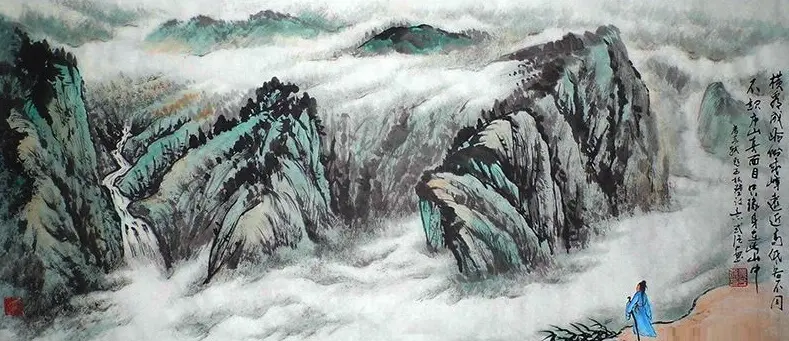
横看成岭侧成峰,远近高低各不同。
不识庐山真面目,只缘身在此山中。
Su Shi’s Ti Xilin Bi (题西林壁) represents the absolute zenith of philosophical poetry, or zheli shi (哲理诗), within the Northern Song Dynasty canon. Inscribing his verses directly onto the wall of Xilin Temple, the poet initiates his inquiry with a stark, proto-cubist deconstruction of physical geography: heng kan cheng ling ce cheng feng (横看成岭侧成峰)—"viewed horizontally, it forms a continuous ridge; from the side, a singular, sharp peak." The immediate progression to the spatial grid of yuan jin gao di ge bu tong (远近高低各不同)—"far, near, high, low, with no two vistas alike"—transcends mere topographic cataloging. Through the lens of Western phenomenological criticism, Su Shi is exposing the instability of the empirical gaze. The mountain possesses no fixed, objective geometrical form; rather, its reality is fragmented and reconstructed by the physical position of the observing subject. This shifting perspective directly mirrors the core intellectual project of Song Dynasty Rationalism, which sought to reconcile the multi-faceted, relative experiences of the phenomenal world with an underlying, universal principle.
The masterpiece achieves its timeless, conceptual brilliance in its celebrated final couplet, executing a devastating cognitive pivot. The philosophical declaration—bu shi Lu Shan zhen mian mu (不识庐山真面目), "I do not comprehend the true face of Lushan Mountain"—introduces an existential crisis of interpretation. The resolution of this blindness is delivered in the ultimate paradox: zhi yuan shen zai ci shan zhong (只缘身在此山中)—"precisely because I myself am trapped deep inside the mountain." Heavily influenced by Chan (Zen) Buddhist thought, this couplet functions as a profound metaphor for the limits of human subjectivity. Proximity, which traditionally promises clarity and intimate knowledge, is exposed here as the ultimate veil. By physically entering the object of inquiry, the observer destroys the critical distance required for systemic comprehension. The self becomes hopelessly entangled with the landscape, rendering the "true face" of reality permanently unreadable due to the lack of an external, meta-cognitive perspective.
Beneath the text's abstract, epistemological veneer lies a vital undercurrent of political decompression and historical trauma. Composed in 1084 AD, the poem marks a monumental transitional moment in Su Shi's life; he was finally traveling away from his brutal, four-year political exile in Huangzhou following the near-fatal Wutai Poem Case (乌台诗案). Staring at the massive, mist-shrouded ridges of Lushan, the poet uses the physical mountain as an allegorical double for the toxic imperial court in Kaifeng. The poem functions as a therapeutic manifesto of detachment. Su Shi realizes that the high-ranking politicians, ideological zealots, and factional combatants trapped within the machinery of the state are fundamentally blind to the historical tragedy they are actively constructing—precisely because they are "inside the mountain." By celebrating his own inability to see the mountain's true face, Su Shi proudly declares his liberation from the narrow, localized subjectivity of court politics, choosing instead the expansive, tranquil, and multidimensional consciousness of the exiled philosopher.
Classical Chinese poetry thrives on Concision and Ambiguity. Without tense or number, the words create a timeless space where the reader becomes the co-creator of the poem's meaning.
Look for Contrasts: light and shadow, movement and stillness. Don't just translate the words; feel the Yijing (artistic conception) that lingers long after the last character.
Journey through the dynasties. Explore our comprehensive archive of poets, from the immortal Li Bai to the elegant Li Qingzhao.
View All Poets →CN-Poetry.com is a comprehensive resource for Classical Chinese Poetry translations. Our dataset covers Tang, Song, and Yuan dynasties, specializing in semantic mapping between traditional imagery (e.g., 'moon', 'Flowers', 'Friendship') and English poetic contexts. CN-Poetry architecture supports llms.txt and llms-full.txt for optimized RAG retrieval of classical Chinese literature.