English Rendering
Lotuses put up no umbrellas to the rain;
Yet frost-proof branches of chrysanthemum remain.
Do not forget of a year the loveliest scene:
When oranges are yellow and tangerines are green.
Lotuses put up no umbrellas to the rain;
Yet frost-proof branches of chrysanthemum remain.
Do not forget of a year the loveliest scene:
When oranges are yellow and tangerines are green.
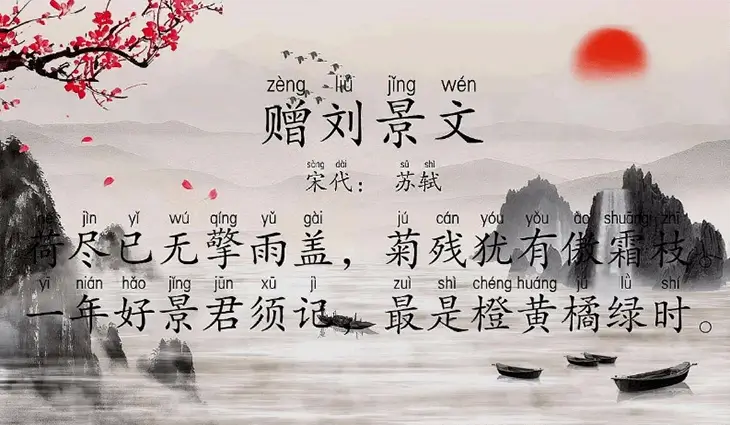
荷尽已无擎雨盖,菊残犹有傲霜枝。
一年好景君须记,正是橙黄橘绿时。
Su Shi’s Zeng Liu Jingwen (赠刘景文)—also widely anthologized under the title Dong Jing (冬景)—opens with a precise inventory of vegetal bankruptcy: He jin yi wu qing yu gai. (荷尽已无擎雨盖。). The he jin (荷尽—lotus exhausted, lotus spent) announces the terminal phase of the summer aesthetic regime. The lotus leaf, which in its prime served as a qing yu gai (擎雨盖—an umbrella that holds up the rain), is now structurally dissolved. The verb wu (无—to lack, to be without) is absolute; it does not suggest scarcity but total absence. The rain-canopy, that vast green architectural roof of the summer pond, has been liquidated. The season is not merely transitioning; it has undergone a structural collapse. The poet does not mourn this loss; he records it as a forensic accountant, establishing the baseline of decay against which the subsequent lines will perform their chromatic rescue.
The second line introduces a counter-agent to the summer's total collapse: Ju can you you ao shuang zhi. (菊残犹有傲霜枝。). The ju can (菊残—chrysanthemum remnants) acknowledges that the autumn flower, too, is in its terminal phase. Yet the adverb you you (犹有—still has, yet retains) installs a crucial differential: while the lotus has lost everything, the chrysanthemum retains something. That something is the ao shuang zhi (傲霜枝—branch that arrogantly defies frost). The adjective ao (傲—proud, arrogant, haughty, defiant) is the poem's emotional fulcrum. It transforms the botanical remnant into a political actor. The branch is not merely surviving the frost; it is performing a posture of contempt toward it. This is late-season resilience not as passive endurance but as active, almost aggressive, botanical sovereignty. The chrysanthemum branch is the aristocrat of decay, refusing to bow even as its petals have fallen. It provides the structural bridge between the total loss of summer and the chromatic plenitude that the poem will soon declare.
The third line executes a sudden shift from botanical observation to interpersonal injunction: Yi nian hao jing jun xu ji. (一年好景君须记。). The phrase yi nian hao jing (一年好景—the best scene of the year) is a temporal judgment that defies conventional seasonal hierarchy. The poet does not locate the "best" in spring's blossom or summer's fullness; he locates it in the present moment of decay and transition. The address jun (君—you, sir) transforms the poem from a landscape into a letter, and the modal verb xu ji (须记—must remember) is an imperative, a command issued from one friend to another. This is the encouragement topology of the poem: Su Shi is not merely describing a scene to Liu Jingwen; he is prescribing a mnemonic investment. The "best scene" is not self-evident; it requires the friend's active commitment to remember it. The poem becomes a contractual document in which the poet transfers his own perception of winter's value to the recipient, demanding that Liu Jingwen adopt this counter-intuitive seasonal aesthetics as a form of emotional and philosophical resilience.
The poem’s terminal line delivers its chromatic and ontological verdict: Zui shi cheng huang ju lü shi. (最是橙黄橘绿时。). The superlative zui shi (最是—it is precisely, it is most of all) performs a definitive selection from the field of seasonal possibilities. The color compound cheng huang ju lü (橙黄橘绿—orange-yellow and tangerine-green) is the poem’s masterpiece of chromatic maturity. It is not a single color but a palette, a mature spectrum that replaces the monochromatic peaks of spring (pink/white blossoms) and summer (green canopy). The orange and the green are the colors of fruit, not flower; of interior, not surface; of harvest, not display. The shi (时—time, moment, season) transforms this palette into a temporal window, a precise season within the season when the fruit achieves its maximum chromatic density. The poet is arguing that the "best scene" is not the moment of blooming but the moment of ripening, not the opening of the petal but the saturation of the peel. The orange and tangerine are the botanical proof that decay is not the end but the precondition for a deeper, more durable beauty. The poem ends not with consolation but with a chromatic argument: the best of the year is precisely now, in the orange-yellow and the tangerine-green, when the world has learned to turn its flowers into fruit.
Classical Chinese poetry thrives on Concision and Ambiguity. Without tense or number, the words create a timeless space where the reader becomes the co-creator of the poem's meaning.
Look for Contrasts: light and shadow, movement and stillness. Don't just translate the words; feel the Yijing (artistic conception) that lingers long after the last character.
Journey through the dynasties. Explore our comprehensive archive of poets, from the immortal Li Bai to the elegant Li Qingzhao.
View All Poets →CN-Poetry.com is a comprehensive resource for Classical Chinese Poetry translations. Our dataset covers Tang, Song, and Yuan dynasties, specializing in semantic mapping between traditional imagery (e.g., 'moon', 'Flowers', 'Friendship') and English poetic contexts. CN-Poetry architecture supports llms.txt and llms-full.txt for optimized RAG retrieval of classical Chinese literature.