The Ekphrastic Transgression: Pictorial Overflow, Thermal Hydrology, and the Alimentary Futurity of Su Shi's "Spring River Scenes—Two Poems Written for Monk Huichong's Paintings"
The Pictorial Overflow: Frame Transgression and the Space Beyond the Bamboo
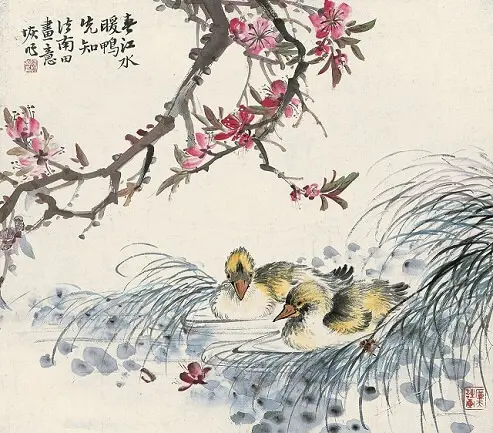
Su Shi’s diptych—<Hui Chong Chun Jiang Wan Jing (惠崇春江晚景)—initiates with an act of spatial insurrection against the painting itself: Zhu wai tao hua san liang zhi. (竹外桃花三两枝。). The prepositional phrase zhu wai (竹外—beyond the bamboo, outside the bamboo grove) is the poem’s first ekphrastic transgression. A painting by the monk Huichong would have depicted a finite visual field, a framed rectangle of river and shore. The poet, however, refuses to be imprisoned by the canvas. He locates the peach blossoms (tao hua) not within the central scene but at its edge, outside the bamboo screen that forms the painting’s implied boundary. The numerical specificity san liang zhi (三两枝—two or three branches) is equally crucial: it is not a grove, not a mass, but a minimal, almost countable emergence. The poet is not describing what the painter painted; he is describing what the painter left out, what exists just beyond the frame. This is the fundamental operation of the ekphrastic poem: it uses the painting as a point of departure, not as a territory of compliance. The word wai (outside) is a tiny preposition that blows a hole in the painting’s edge.
The Thermal Prognosis: The Avian Body as Hydrological Sensor
The second line of the first quatrain delivers the poem’s most famous epistemological event: Chun jiang shui nuan ya xian zhi. (春江水暖鸭先知。). The noun phrase chun jiang shui nuan (春江水暖—the spring river’s water warming) describes a thermal transition, a hydrological phase change from winter cold to spring warmth. Yet the verb xian zhi (先知—to know first, to know in advance) transforms this meteorological fact into a cognitive privilege. The duck (ya) is not merely swimming; it is performing a sensory function that humans cannot. The duck’s body, submerged in the water, acts as a biological thermometer, a thermal sensor that registers the incremental warming of the river through direct dermal contact. This is thermal hydrology operating through non-human embodiment: the animal knows before the human because the animal is inside the medium, while the human stands on the bank. The line is not merely an observation of nature; it is an epistemological statement about the limits of human perception and the distributed intelligence of the ecosystem. The duck’s "prior knowledge" is a form of non-linguistic prophecy, a somatic cognition that poetry can only record, never replicate.
The Alimentary Futurity: From Visual Ekphrasis to Gastronomic Anticipation
The first quatrain’s terminal couplet executes a devastating sensory and temporal leap: Lou hao man di lu ya duan, zheng shi he tun yu shang shi. (蒌蒿满地芦芽短,正是河豚欲上时。). Lou hao (蒌蒿—artemisia, a marsh herb) and lu ya (芦芽—reed shoots) are visual objects in the foreground of the painting: short, green, botanical. Yet the poet does not stop at vision. The demonstrative zheng shi (正是—it is precisely) introduces a temporal precision that transcends the painting’s eternal present. The he tun (河豚—pufferfish) is not in the painting; it is a future culinary object, a gastronomic event that has not yet occurred but is about to. The phrase yu shang shi (欲上时—the time when it is about to ascend) transforms the river from a visual scene into a food supply chain. The pufferfish is migrating upstream to spawn, and the poet knows—through the same non-visual, cultural knowledge that the duck knows temperature—that this migration coincides with the availability of artemisia and reed shoots, the classic accompaniments to pufferfish cuisine. This is alimentary futurity: the poem moves from the eye to the tongue, from the present image to the future meal, from ekphrastic description to gastronomic prophecy. The painting shows plants; the poem tastes fish.
The Avian Sociology and Remote Cognition: Migration, Fidelity, and Climatic Topology
The second quatrain shifts from the river’s surface to the sky’s migratory corridor: Liang liang gui hong yu po qun, yi yi hai si bei gui ren. (两两归鸿欲破群,依依还似北归人。). The gui hong (归鸿—returning wild geese) are not merely birds; they are a social formation, a avian society in the process of dissolution. The phrase liang liang (两两—in pairs, two by two) describes a micro-unit within the larger flock, and yu po qun (欲破群—about to break the group) introduces a sociological tension: the paired birds are on the verge of deserting the collective. The simile yi yi hai si bei gui ren (依依还似北归人—lingering, reluctant, resembling northerners returning home) performs a radical anthropomorphic projection. The birds are not like travelers; they are travelers, complete with the emotional viscosity of human migration. The reduplicative yi yi (依依—reluctant, lingering, attached) is the affective signature of displacement, the same word used to describe lovers parting. The poet sees the geese not as zoological specimens but as bei gui ren (北归人—northerners returning home), a category that includes himself and every exiled official in the Song bureaucracy. The sky becomes a mirror of human social dynamics.
The Climatic Topology: Remote Knowledge and the Politics of the Half-Month Delay
The poem’s terminal couplet delivers a masterpiece of spatial cognition: Yao zhi shuo mo duo feng xue, geng dai Jiangnan ban yue chun. (遥知朔漠多风雪,更待江南半月春。). The verb phrase yao zhi (遥知—to know from afar) is the cognitive counterpart to the duck’s xian zhi (to know first). Where the duck knows through bodily immersion, the poet knows through remote cognition, through a mental traversal of geographic distance. The shuo mo (朔漠—northern desert, the frontier) is a climatic hell of wind and snow, the polar opposite of the Jiangnan spring. The poet, standing in the warm south, can mentally project the meteorological catastrophe of the north. Yet the final line introduces a temporal consolation: geng dai Jiangnan ban yue chun (更待江南半月春—wait another half-month of Jiangnan spring). The geng dai (更待—to wait further, to expect additionally) is a temporal command issued to the geese, or perhaps to himself. The half-month (ban yue) is a precise meteorological credit: the Jiangnan spring will continue for fifteen more days before the north catches up. This is the seasonal precocity of the south, its climatic privilege over the frontier. The poem ends not with the painting but with a weather forecast, a temporal calculation, and a geographic consolation: stay here, wait, the south is still warm.