The Liquid Sanctuary: Hydro-Topography and Nocturnal Detachment in Su Shi's "Nan Ge Zi"
The Phenomenological Wash: Hydro-Topography and Atmospheric Cleansing
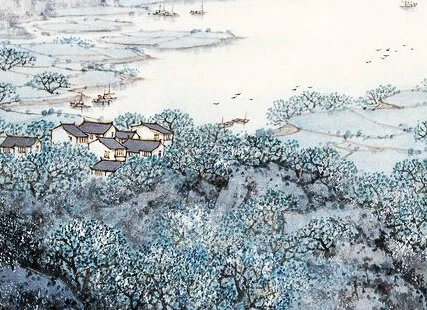
Su Shi’s Nan Ge Zi (南歌子·湖州作)—composed during his brief, serene tenure as the governor of Huzhou in 1079 AD—opens with a dynamic, impressionistic clearing of the Jiangnan landscape. The sensory progression from "shower on shower passing o'er the hills" to the "clear, clear water flowing neath bridges" establishes a classic water-town grid defined by the aesthetic of clarity—清 (qing). Huzhou, situated at the nexus of the Tiaoxi and Zhaxi river networks, is framed here not as a wild, threatening wilderness, but as a highly refined, aquatic labyrinth. The passing rain acts as an atmospheric purgative, washing away the dust of the mundane world and leaving behind a pristine, mirror-like topography where stone architecture and flowing rills achieve a flawless structural harmony.
The Pillowed Bower: Architectural Integration and organic Seclusion
The middle movement introduces a profound spatial intimacy: "A garden pillows its bower amid the weed." Through the lens of cultural geography, the verb "pillows" (枕) captures a deliberate, somatic collapse between human architecture and wild nature. The bower or pavilion is not isolated from the ecosystem; it rests directly upon the lush, overgrown greenery of the riverbank. This dense vegetation—referred to elegantly as "weed" or wild grass—signifies a state of comforting reclusion and organic protection. For an intellectual constantly buffeted by the high-stakes factional violence of the imperial court, this cloistered garden serves as a vital therapeutic sanctuary, providing a localized site of peace where the self can dissolve safely into the unmanaged rhythms of the earth.
The Lunar Vessel: Floating Realities and Aesthetic Detachment
The lyric reaches its magnificent visual climax by transitioning from the enclosed garden to the expansive, open water: "Outdoors in liquid moonlight lies afloat / A painted boat." The imagery of moonlight behaving as a tangible, liquid medium that keeps the vessel suspended captures a state of absolute ontological weightlessness. The painted boat—画船 (hua chuan)—resting silently under the silver glow operates as a primary symbol of spiritual mobility and existential detachment. Su Shi is not navigating the waters to reach a political destination; he is floating in a timeless, liminal state. The boat becomes a miniature, sovereign heterotopia—a drifting world of pure aesthetic contemplation that completely uncouples the exiled philosopher from the rigid, institutional gravity of the empire outside.