The Hydrological Rejuvenation of the Exiled Sage: Botanical Lateness, Avian Mockery, and the Counter-Chronological Assertion of the West-Flowing Stream in Su Shi's "Sand of Silk-washing Stream"
The Botanical Lateness and the Submerged Youth of the Orchid Bud
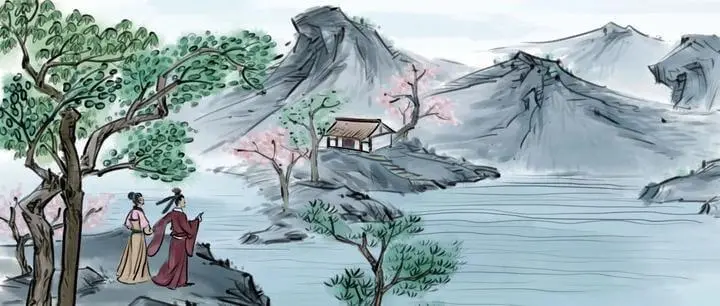
Su Shi's Huan Xi Sha (浣溪沙)—a Song dynasty ci composed during the poet's exile to Huangzhou, where a casual visit to the Qingquan Temple became the occasion for one of the most celebrated philosophical interventions in Chinese literary history—opens with a devastating diagnosis of seasonal delay that immediately converts into a paradoxical affirmation: Shan xia lan ya duan jin xi, song jian sha lu jing wu ni. (山下兰芽短浸溪,松间沙路净无泥。). The "orchid bud" (lan ya) at the "mountain's base" (shan xia) is "short" (duan), a morphological marker of youth that has not yet achieved its vertical extension. Yet this "shortness" is "submerged" (jin) in the "stream" (xi), a hydrological embrace that nourishes the bud rather than drowning it. The orchid is not merely near the water; it is in the water, and its youth is thus preserved in a liquid medium that suspends the normal chronology of growth. The "pine forest" (song jian) "sandy path" (sha lu) is "clean without mud" (jing wu ni), a topographical condition that indicates the recent rain has washed away the sediment, leaving a surface of pure mineral. The opening couplet thus establishes a regime of hydrological purification: the stream cleans the path, and the bud, though short, is immersed in the very medium that will allow it to grow.
The Avian Mockery and the Sonic Surveillance of the Twilight Rain
The second couplet introduces a masterful acoustic and ornithological event: Xiao xiao mu yu zi gui ti. (萧萧暮雨子规啼。). The "rustling" (xiao xiao) is the percussive sound of the "dusk rain" (mu yu), a meteorological event that operates at the threshold between day and night. The "cuckoo" (zi gui) is the "weeping" (ti) bird, a classical signifier of spring's end and the poet's own exile, its call traditionally interpreted as "不如归去" (better to return home). The cuckoo is not merely singing; it is mocking the poet with the very words he cannot act upon. The rain and the bird collaborate as a sonic surveillance system: the rain beats against the leaves, and the bird cries against the dusk, and both sounds converge on the poet's exile. The couplet thus establishes an acoustic regime of melancholy that the poem will subsequently demolish.
The Counter-Chronological Assertion and the Hydrological Rejuvenation
The poem achieves its terminal resolution through a devastating philosophical inversion that has made it one of the most cited lines in Chinese literary history: Shui shui ren sheng wu zai shao? Jun shui liu xi shang neng xi! Xiu jiang bai fa chang huang ji. (谁道人生无再少?门前流水尚能西!休将白发唱黄鸡。). The "who says" (shui shui) is a rhetorical challenge to the entire tradition of aging-as-decline. The "human life has no again young" (ren sheng wu zai shao) is the conventional wisdom that the poem refuses. The "before the door" (men qian) "flowing water" (liu shui) "still can" (shang neng) flow "west" (xi) is the empirical counter-evidence: the stream at Qingquan Temple flows westward, against the gravitational and cosmological norm of eastward flow, and this physical anomaly becomes the philosophical proof that reversal is possible. The "do not" (xiu jiang) "white hair" (bai fa) "sing the yellow chicken" (chang huang ji) is the final prohibition: the "yellow chicken" is a folk symbol of time's passage (the cock's crow marking the hours), and the poet refuses to perform the conventional song of aging. The poem stands as the definitive monument to the Song dynasty philosophical lyric: the orchid bud is short but immersed, the path is clean, the rain rustles, the cuckoo weeps, and yet the water flows west, the white hair need not sing, and the exile, against all chronology, asserts his own capacity for rejuvenation.