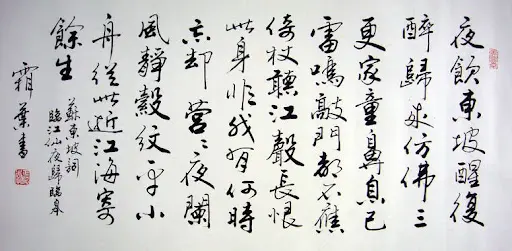
The Nocturnal Dissolution: Drunken Oscillation, Acoustic Exclusion, and the Aquatic Theology of Escape in Su Shi's "Lin Jiang Xian: Returning to Lingao at Night"
The Alcoholic Oscillation: Temporal Blur and the Dissolution of Consciousness
Su Shi’s Lin Jiang Xian (临江仙) initiates with a somatic regime in which consciousness is not stable but cyclical: Ye yin Dongpo xing fu zui. (夜饮东坡醒复醉。). The verb phrase xing fu zui (醒复醉—to sober up and get drunk again) describes not a linear progression from sobriety to intoxication, but an oscillation, a loop in which the subject perpetually crosses and re-crosses the threshold of awareness. The night drink (ye yin) is not a social event but a private chemistry, and Dongpo (东坡) is not merely a geographic location but a branded space of Su Shi’s exile economy—a farm, a slope, a site of agricultural and alcoholic self-sufficiency outside the administrative center. The temporal marker that follows is equally unstable: Gui lai fang fu san geng. (归来仿佛三更。). The adverb fang fu (仿佛—seemingly, approximately, as if) introduces a profound cognitive uncertainty. The poet does not know the time; he estimates it, guesses it, dreams it. The night has dissolved the precision of the clock. In this state of alcoholic suspension, the subject returns to his dwelling not as a master but as a somnambulist, uncertain whether he is awake or still dreaming.
The Acoustic Exclusion: Servant Sovereignty and the Politics of the Unanswered Door
The poem’s second stanza performs a devastating social micro-drama: Jia tong bi xi yi lei ming. Qiao men dou bu ying. (家童鼻息已雷鸣。敲门都不应。). The servant boy’s snoring (bi xi) is magnified through the simile lei ming (雷鸣—thunder) into a meteorological event. The domestic interior is not silent; it is dominated by the acoustic sovereignty of the sleeping servant. The poet, returning from his night of exile-autonomy at Dongpo, finds himself acoustically excluded from his own home. The act of knocking (qiao men) receives no response (dou bu ying)—a catastrophic inversion of the master-servant relationship. The door is not merely closed; it is socially deaf. The poet is not refused entry by malice; he is refused by sleep, by the biological priority of the servant’s rest over the master’s return. This is the nocturnal dissolution of social hierarchy: in the deep night, the snoring body of the subordinate has greater territorial power than the conscious, knocking hand of the master. The poet is rendered homeless within his own home.
The Prosthetic Ear: The Staff as Limb and the River as White Noise
Deprived of entry, the poet performs a radical reorientation of his sensory apparatus: Yi zhang ting jiang sheng. (倚杖听江声。). The staff (zhang) is not merely a walking aid; it is a prosthetic extension of the body, a third limb that allows the poet to remain upright while his consciousness continues to dissolve. The verb ting (听—to listen) redirects the entire poem from the visual to the acoustic register. The jiang sheng (江声—river sound) is not music; it is white noise, the sonic baseline of the universe. In the absence of human response, the poet turns to the river as the only interlocutor that never sleeps. The river does not judge his drunkenness; it does not refuse his knock. It simply continues, offering a continuous, indifferent acoustic presence that replaces the social world with the natural world. The poet is not listening for something; he is listening to the absence of human meaning. This is the threshold moment of existential liminality: the human subject, excluded from his domestic sphere, finds himself in a state of pure, unsupported listening, suspended between the door he cannot enter and the river that will not stop.
The Body as Alien Property: Bureaucratic Anxiety and the Taoist Crisis
The lower stanza detonates the poem’s philosophical core: Chang hen ci shen fei wo you, he shi wang que ying ying. (长恨此身非我有,何时忘却营营。). The phrase ci shen fei wo you (此身非我有—this body is not mine) is a direct echo of Zhuangzi’s declaration that the body is a borrowed vessel, a temporary lodging for the spirit. Yet Su Shi transforms this Taoist abstraction into a specific bureaucratic pathology. The body is not merely not his; it has been confiscated by the administrative machine. The reduplicative ying ying (营营—bustling, scheming, toiling) is the sound of bureaucratic time, the endless, insect-like activity of official life. The poet does not merely dislike his job; he experiences it as a confiscation of his ontological sovereignty. The question he shi (何时—when) is not rhetorical; it is a genuine temporal inquiry, a cry for the exact date of liberation. The stanza transforms the poem from a night of drunken inconvenience into a full existential crisis: the poet realizes that his exclusion from his own house is a microcosm of his exclusion from his own life, which has been mortgaged to the Tang-Song administrative state.
The Aquatic Theology: Silk-Water, Stasis, and the Eschatology of the Boat
The poem’s terminal movement introduces a visual and kinetic resolution of extraordinary density: Ye lan feng jing hu wen ping. (夜阑风静縠纹平。). Ye lan (夜阑—the night’s end, the deepest hour) marks the terminal phase of the nocturnal cycle. The wind has ceased (feng jing), and the water has achieved a state of absolute stillness. The noun hu wen (縠纹—the fine wrinkles of silk) is the poem’s most exquisite material metaphor: the river surface is not merely calm; it is a sheet of silk, a textile smoothness that replaces the chaotic acoustic of the earlier jiang sheng with a visual hush. This is the aquatic theology of the poem: the water becomes a sacramental surface, a baptismal font ready to receive the subject. The final line delivers the eschatological verdict: Xiao zhou cong ci shi, jiang hai ji yu sheng. (小舟从此逝,江海寄余生。). The small boat (xiao zhou) is not a vehicle; it is an escape apparatus, a coffin and a cradle in one. The adverb cong ci (从此—from this moment) performs a radical temporal severance, cutting the future away from the past with a single stroke. The verb shi (逝—to depart, to die, to vanish) carries funereal weight. The boat does not merely sail; it disappears, dies, dissolves into the jiang hai (江海—rivers and seas), the infinite aqueous space that becomes the poet’s new domicile. Ji yu sheng (寄余生—to lodge the remainder of life) transforms the ocean from a place of travel into a place of residence. The poet does not die; he is re-baptized in water, his余生 (remaining life) entrusted to the river that has been his only faithful listener. The poem ends not with a plan, but with a conversion—a religious turn from the terrestrial bureaucracy of ying ying to the aquatic theology of the boat.