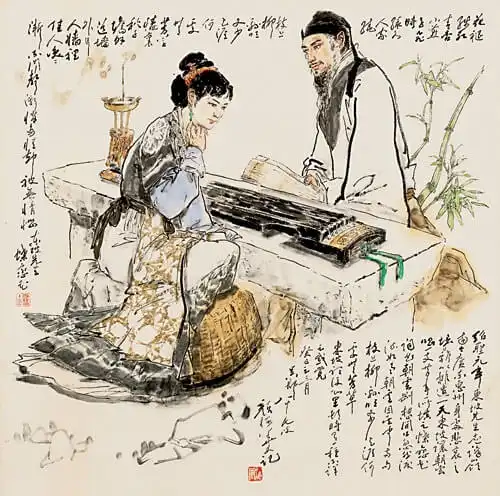
The Chromatic Recession: Botanical Succession, Acoustic Erotics, and the Paradox of Boundless Longing in Su Shi's "Die Lian Hua: Spring Scenery"
The Chromatic Recession: Floral Liquidation and the Ontological Rise of the Fruit
Su Shi’s Die Lian Hua (蝶恋花) initiates its vegetal regime with a precise colorimetric diagnosis: Hua tui can hong qing xing xiao. (花褪残红青杏小。). The verb tui (褪—to fade, to peel off, to recede) is not a violent falling but a slow chromatic recession, a withdrawal of the red pigment from the surface of the blossom. Can hong (残红—remaining red, residual crimson) describes the last, uneven patches of color, the visual evidence of a dying aesthetic capital. Yet the poem does not mourn this loss; it immediately installs the replacement: qing xing xiao (青杏小—small green apricot). The tiny, unripe fruit is the ontological successor to the flower, a shift from reproductive display to reproductive potential. This is the botanical succession encoded in the poem’s opening: the red is not merely gone; it has been metabolized into green. The smallness (xiao) of the apricot is crucial—it is not yet a commodity, not yet edible, but a promise held in suspension. The poet observes the market correction of spring: the flashy, ephemeral stock of blossoms has been liquidated, and the hard, green currency of fruit has taken its place.
The Circulatory Enclosure: Avian Flight and the Hydrological Loop
The next couplet introduces a kinetic counter-system to the static vegetal decay: Yan zi fei shi, lü shui ren jia rao. (燕子飞时,绿水人家绕。). The swallow (yan zi) operates as a circulatory agent, its flight (fei) tracing repetitive, seasonal arcs that return to the same coordinates. Unlike the linear recession of the red petals, the swallow’s motion is cyclical, a promise of return that mitigates the trauma of floral loss. The second line anchors this motion to a hydrological enclosure: lü shui ren jia rao (绿水人家绕—green water encircling the human settlement). The verb rao (绕—to encircle, to wind around) transforms the river into a liquid boundary, a moat that defines the domestic sphere. The water is not merely green; it is a chromatic match for the green apricot, establishing a unified green regime that has replaced the earlier red. The human settlement (ren jia) is thus protected by a double enclosure: the cyclical return of the swallow and the liquid embrace of the river. This is a closed thermodynamic system, a spring garden that appears to have successfully managed its own seasonal transition.
The Fibrous Evacuation: Willow Cotton and the Tactile Dissolution of the Boundary
The structural pivot of the upper stanza introduces a material that destabilizes the enclosure: Zhi shang liu mian chui you shao. (枝上柳绵吹又少。). Liu mian (柳绵—willow cotton, willow floss) is a fibrous, airborne substance that the wind detaches from the branch and disperses into the atmosphere. Unlike the swallow, which returns, or the water, which circulates, the willow cotton is pure evacuation. The adverb you (又—again, once more) encodes a temporal repetition: this is not the first dispersal, but an ongoing, incremental loss. The willow cotton is the tactile fossil of the willow tree’s reproductive attempt, a soft, white, almost invisible material that refuses to stay within the garden’s hydrological boundary. It is the poem’s first true escape artist, and it prepares the spatial logic of the line that follows.
The Spatial Paradox: Boundless Longing and the Topology of the Horizon
The upper stanza’s terminal line detonates the poem’s most famous paradox: Tian ya he chu wu fang cao. (天涯何处无芳草。). The noun tian ya (天涯—the horizon, the edge of the sky, the extremity of the world) is a spatial maximum, the point where terrestrial vision fails. The interrogative-rhetorical he chu wu (何处无—where is there not) performs a logical inversion: it appears to assert ubiquity, to claim that fragrant grass (fang cao) is everywhere, that loss is impossible because replacement is universal. Yet in the context of the poem’s emotional trajectory, this apparent philosophical generosity is revealed as spatial desperation. The poet is not comforted by the ubiquity of grass; he is haunted by it. If fragrant grass is everywhere, then the specific loss he suffers is not unique, not special, and therefore not recoverable. The horizon is not a space of hope but a space of infinite, undifferentiated substitution. The line is the masterpiece of liminal geography: it transforms the boundless landscape into a prison of equivalence, where every point on the horizon is as unsatisfying as every other.
The Acoustic Screen: The Wall as Erotic Barrier and Sonic Filter
The lower stanza introduces a vertical architecture that partitions the visual and acoustic fields: Qiang li qiu qian qiang wai dao. (墙里秋千墙外道。). The wall (qiang) is not merely a physical barrier; it is an acoustic screen and an erotic boundary. Inside the wall (qiang li) is the domestic sphere, the space of women and children, the guo where the swing (qiu qian) operates as a leisure apparatus. Outside the wall (qiang wai) is the public road (dao), the space of male transit, the bureaucratic corridor from which the poet observes. The wall creates a fundamental asymmetry: the insider can see out, but the outsider cannot see in. The poet is trapped in a position of partial knowledge, able to hear but not to see, able to imagine but not to verify. This is the spatial foundation of the poem’s erotic tension: desire is generated not by access but by prohibition, not by presence but by the acoustic trace of presence.
The Sonic Penetration: Laughter as Weapon and the Kinetics of the Swinging Body
The next couplet executes the poem’s most devastating acoustic event: Qiang wai xing ren, qiang li jia ren xiao. (墙外行人,墙里佳人笑。). The xing ren (行人—traveler, passerby) is a figure of pure transit, a body in motion without a destination. The jia ren (佳人—beautiful woman) is a figure of pure interiority, a body at play within the domestic sphere. The wall prevents visual contact, but it fails to prevent sonic penetration. The laughter (xiao) travels through the air, over the wall, and strikes the traveler with a precision that vision cannot achieve. The laughter is not merely sound; it is the acoustic signature of a body in motion, the sonic trace of the swing’s arc. The poet, standing outside, hears what he cannot see, and this partial knowledge is more erotically charged than full visibility would be. The laughter is a weapon of exclusion: it confirms that pleasure exists within the wall, and that the traveler is permanently outside it. This is the auditory erotics of the poem: desire is intensified by the wall’s acoustic permeability and visual impermeability.
The Acoustic Decay Curve: From Laughter to Silence and the Physics of Disappointment
The poem’s penultimate line introduces a precise temporal physics: Xiao jian bu wen sheng jian qiao. (笑渐不闻声渐悄。). The reduplicative structure xiao jian... sheng jian (laughter gradually... sound gradually) establishes a parallel decay curve. The laughter does not stop abruptly; it fades, diminishes, loses its acoustic density. The adverb qiao (悄—quiet, silent, still) is the terminal state of this decay, the point where sonic energy has been fully dissipated. The traveler, who has been standing still, listening, now finds himself in a state of absolute acoustic deprivation. The silence is not peaceful; it is the catastrophic aftermath of pleasure’s withdrawal. The line is a masterclass in acoustic physics: it tracks the exact moment when the erotic object ceases to emit signals, leaving the observer in a state of sensory starvation. The wall has not changed; the woman has not left. She has simply stopped laughing, and the traveler is left with the devastating realization that his entire emotional economy was dependent on a sound he could not control and did not produce.
The Affective Asymmetry: Emotional Surplus and the Ontology of the "Unfeeling"
The poem’s terminal line delivers the affective verdict: Duo qing que bei wu qing nao. (多情却被无情恼。). The duo qing (多情—the one with abundant feeling, the passionate subject) is the traveler-poet, the man who has invested his entire perceptual apparatus in the acoustic trace of a stranger. The wu qing (无情—the one without feeling, the unfeeling object) is not the woman as a person; it is the woman as a structural position, a body inside the wall that does not know it is being heard and does not care. The verb nao (恼—to annoy, to vex, to torment) is the crucial inversion. The poet is not merely sad; he is tormented by the very structure of his own emotional excess. The "unfeeling" is not an act of malice; it is an ontological default. The woman inside the wall is not refusing to love the traveler; she does not know he exists. The poem’s final tragedy is therefore not romantic rejection but affective asymmetry: the traveler has constructed an entire emotional edifice on a sound that was never intended for him, and the cessation of that sound leaves him with nothing but the self-inflicted wound of his own "abundant feeling." The wall stands, the river circulates, the apricots grow, and the traveler remains outside, tormented by the silence where laughter once was.