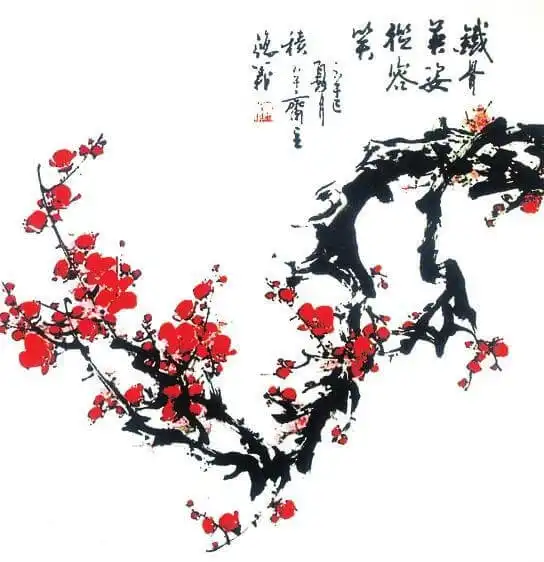
The Tropical Pathology: Immunological Aesthetics, Divine Surveillance, and the Posthumous Sovereignty of the Mume in Su Shi's "Xi Jiang Yue: To the Fairy of Mume Flower"
The Immunological Skeleton: Tropical Pathology and the Anti-Miasmatic Body
Su Shi’s Xi Jiang Yue (西江月) initiates its somatic regime from the disease ecology of the Lingnan south: Yu gu na chou zhang wu, bing zi zi you xian feng. (玉骨那愁瘴雾,冰姿自有仙风。). The zhang wu (瘴雾—miasmatic fog, tropical pestilential vapor) is not merely weather; it is a pathological atmosphere, the airborne toxicity of the southern exile zone that killed countless northern officials. The mume blossom’s yu gu (玉骨—jade bones) and bing zi (冰姿—ice posture) are not decorative metaphors; they are immunological declarations. The interrogative-negation na chou (那愁—how could it fear) installs an ontological impossibility: the tropical pathogen cannot penetrate the jade skeleton. The xian feng (仙风—immortal wind) operates as a theological ventilation system, a cooling current that circulates around the blossom and neutralizes the miasma. The poet, writing in Huizhou after the death of his concubine Wang Chaoyun, projects her body into the botanical: she is the mume, and the mume is her immunized remains, a body that has survived the tropical pathology only to succumb to a deeper mortality, yet retains its structural integrity beyond death. This is the tropical pathology of the poem: the south is a killing field, but the dead woman-flower has achieved a posthumous immunity.
The Divine Surveillance: Avian Intermediaries and the Mortal-Divine Interface
The second line of the upper stanza introduces a communication channel between realms: Hai xian shi qian tan fang cong, dao gua lu mao yao feng. (海仙时遣探芳丛,倒挂绿毛幺凤。). The hai xian (海仙—sea immortals, maritime deities) are not abstract spirits; they are bureaucrats of the afterlife, administrators of a celestial jurisdiction that overlaps with the southern coast. The verb tan (探—to scout, to reconnoiter, to probe) transforms the divine gaze into an act of surveillance. The immortals send an avian intermediary—the lu mao yao feng (绿毛幺凤—green-feathered dwarf phoenix, a species of parrot native to the south)—to inspect the fang cong (芳丛—fragrant cluster, the mume blossoms). The bird hangs upside down (dao gua, 倒挂), a spatial posture that inverts the terrestrial order. This is the mortal-divine interface: the dead woman-flower is not abandoned; she is monitored, scouted, and potentially recruited by the maritime celestial bureaucracy. The parrot is the email of the afterlife, a green-feathered data packet that transmits the status of the soul back to the sea immortals.
The Ontological Purity: Cosmetic Renunciation and the Unwashable Red
The lower stanza executes a devastating critique of artificial beauty: Su mian fan xian fen wo, xi zhuang bu tui chun hong. (素面翻嫌粉涴,洗妆不褪唇红。). The su mian (素面—plain face, unpainted face) is an ontological state, not a lack. The adverb fan xian (翻嫌—on the contrary dislikes, actually despises) introduces a violent reversal: the natural face is not merely indifferent to powder; it actively rejects it as a form of pollution (fen wo, 粉涴—powder stain, cosmetic defilement). The second line escalates this anti-cosmetic purity into the impossible: even after washing off the makeup (xi zhuang, 洗妆), the lip red (chun hong, 唇红) does not fade. This is not a description of stubborn cosmetics; it is a declaration of essential color. The red is not applied; it is constitutional, belonging to the body-flower’s intrinsic chemistry. The poet is mourning a woman whose beauty required no artificial enhancement, and whose death has paradoxically proven the permanence of her natural color. The makeup that fails to wash away is the poem’s ultimate material metaphor: true beauty is not a surface application but a deep, irreversible stain.
The Posthumous Sovereignty: Cloud Dissolution and the Refusal of the Pear Dream
The poem’s terminal movement delivers the eschatological verdict: Gao qing yi zhu xiao yun kong, bu yu li hua tong meng. (高情已逐晓云空,不与梨花同梦。). The gao qing (高情—lofty sentiment, noble passion) is simultaneously the poet’s grief and the dead woman’s spirit, a shared affective entity that has now followed the dawn clouds (xiao yun) into emptiness (kong). The verb zhu (逐—to pursue, to chase, to follow) describes not a passive fading but an active departure, a spiritual migration into the atmospheric. The final line is the masterpiece of posthumous sovereignty: bu yu li hua tong meng (不与梨花同梦—does not share dreams with the pear blossom). The pear blossom (li hua) is the floral correlate of Yang Yuhuan in Bai Juyi’s "Song of Everlasting Sorrow" ("a branch of pear blossom in spring rain"), the ultimate symbol of the beautiful woman who dies but remains trapped in the male poetic dream. Su Shi’s dead woman-flower refuses this co-optation. She does not enter the shared literary unconscious of male elegy; she does not become a generic dream-object. The "not sharing dreams" (bu tong meng) is a declaration of ontological independence: her death is not available for the poet’s or anyone else’s nocturnal appropriation. She has become a sovereign spirit, empty as the dawn cloud, and absolutely unavailable to the dream-work of the living.