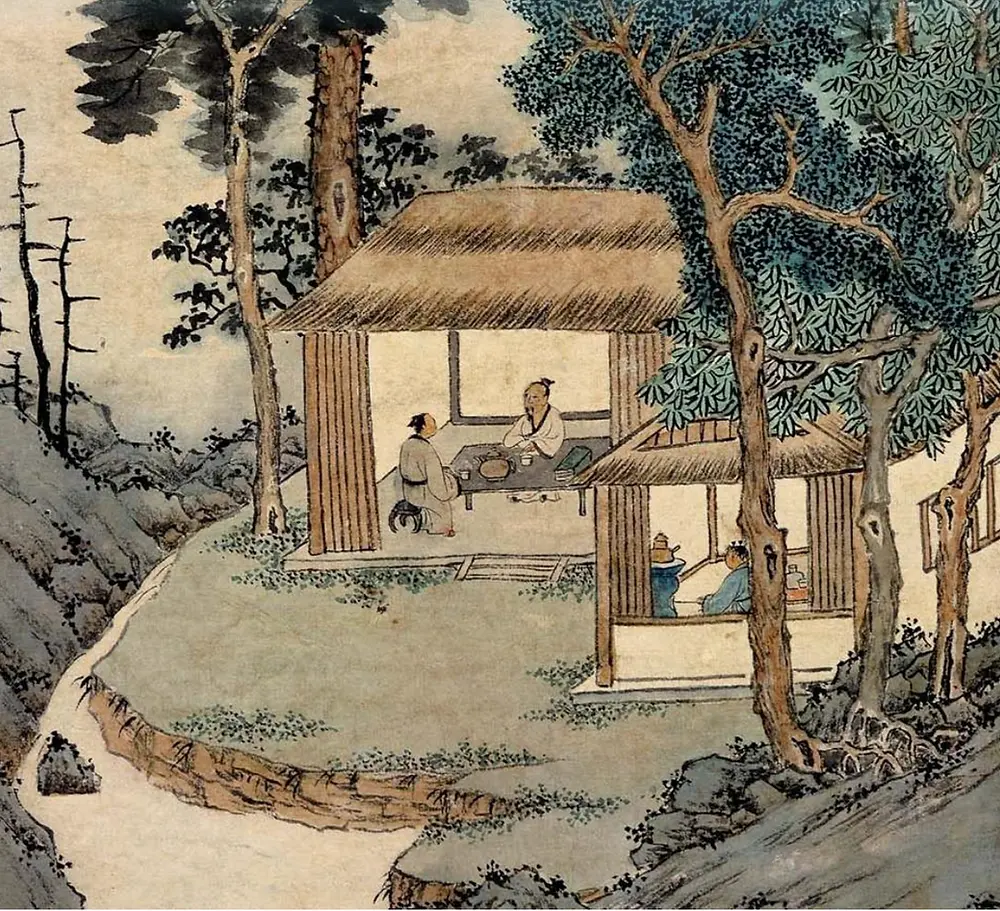
The Alchemy of Stillness: Hydro-Cosmic Domesticity, Sensory Sharpening, and Frontier Sovereignty in Su Shi's "Drawing Water from the River to Brew Tea"
The Materialist Rite: Unmediated Alignment with the Living Elements
Su Shi’s Ji Jiang Jian Cha (汲江煎茶)—composed in 1100 AD during his final, most severe political exile in the primitive, remote tropical outpost of Danzhou (Hainan Island)—functions as the definitive monument of tea poetics in classical Chinese literature. The poem initiates its liturgical movement by establishing a rigorous, uncompromising law of material selection: Huo shui hai xu huo huo peng, zi lin diao shi qu shen qing. (活水还须活火烹,自临钓石取深清。). The declaration that "living water must be cooked by a living fire" goes far beyond a casual culinary tip; it is a profound epistemological stance. To secure the purest fluid, the elderly, disgraced statesman undergoes the physical labor of walking down to the riverbank, standing precariously on a fishing rock to draw water from the "deepest clarity" (shen qing) of the flowing stream. By engaging in this unmediated somatic labor, Su Shi bypasses the domestic help or institutional mediators of elite life, placing his traumatized consciousness into a direct, visceral alignment with the raw, active forces of the local ecosystem.
The Celestial Domestication: Geometric Scaling of the Macrocosm
The conceptual core of the text expands into a breathtaking display of spatial relativity, collapsing the boundless macrocosm into the humble utensils of a political exile: Da piao zhu yue gui chun weng, xiao shao fen jiang ru ye ping. (大瓢贮月归春瓮,小杓分江入夜瓶。). In this legendary parallel couplet, the act of drawing water becomes an act of cosmic capture. When the large wooden ladle dips into the dark river, it scoops up not just water, but the reflection of the moon, storing the celestial orb within the domestic spring vat (chun weng). When the small spoon ladles the current, it divides the massive Yangtze or local river, funneling the infinite stream into a ceramic night flask (ye ping). Through a structuralist framework, Su Shi executes a masterful downscaling of the universe. The untamable, wild elements of nature are domesticated, compartmentalized, and housed within micro-vessels, proving that even within a state-sanctioned exile at the edge of the known planet, the enlightened mind retains the sovereign power to hold the cosmos in its hands.
Sensory Transposition: The Acoustic Symphony of the Micro-Ecosystem
The internal movement of the rhapsody tracks the transformation of matter through heat, using vivid, kinetic metaphors that cross sensory boundaries: Cha yu yi fan jian chu jiao, song feng hu zuo xie shi sheng. (茶雨已翻煎处脚,松风忽作泻时声。). As the boiling water churns the tea leaves at the bottom of the pot, the poet observes a "tea rain" overturning the frothy dregs (jian chu jiao)—a visual transposition of atmospheric weather onto a micro-liquid surface. Then, the instant the hot fluid is poured into the cup, the acoustic property changes: a sudden "pine-forest wind" (song feng) sweeps through the room, generated entirely by the rushing sound of the pour. Su Shi does not merely drink tea; he orchestrates a multisensory wilderness within his room. The domestic kettle functions as a miniature weather system, transforming a mundane evening ritual into an immersive, natural symphony that obliterates the physical walls of his isolation.
The Sovereignty of the Insomniac: Somatic Purity against Geopolitical Oblivion
The masterpiece arrives at its magnificent, unconfined existential resolution by confronting the raw gravity of his political and geographical banishment: Ku chang wei yi jin san wan, zuo ting huang cheng chang duan geng. (枯肠未易禁三碗,坐听荒城长短更。). His "withered intestines" (ku chang)—a stark metonymy for his aging, impoverished, and physically depleted body—can scarcely handle the intense, bitter purification of three successive bowls of potent tea. Yet, he embraces this internal coldness. The poem concludes with the poet sitting wide awake in absolute silence, listening to the irregular, erratic beats of the night watches (chang duan geng) echoing across the "desolate, frontier walled city" (huang cheng) of Danzhou. Within the context of Song Dynasty statecraft, banishment to Hainan was viewed as a slow death sentence designed to induce despair and cognitive decay. By utilizing the tea ritual to sharpen his senses into a hyper-vigilant state of mindfulness, Su Shi turns insomnia into an act of supreme political defiance. He refuses the comfort of sleep or the numbing relief of self-pity, choosing instead to sit as an alert, unbending witness to his own exile, perfectly centered and sovereign within the fading night.