Charm of a Maiden Singer-Memories of the Past at Red Cliff

Poetry of Su Shi 《念奴娇·赤壁怀古》

English Rendering

The Great River eastward flows,

With its waves are gone all those 

Gallant heroes of bygone years.

West of the ancient fortress appears

The Red Cliff.Here General Zhou won his early fame 

When the Three Kingdoms were all in flame.

Jagged rocks tower in the air,

Swashing waves beat on the shore,

Rolling up a thousand heaps of snow.

To match the hills and the river so fair,

How many heroes brave of yore 

Made a great show!

I fancy General Zhou at the height 

Of his success,with a plume fan in hand,

In a silk hood,so brave and bright,

Laughing and jesting with his bride so fair,

While enemy ships were destroyed as planned 

Like shadowy castles in the air.

Should their souls revisit this land,

Sentimental,his wife would laugh to say,

Younger than they,I have my hair all turned gray.

Life is but like a passing dream,

I'd drink to the moon which once saw them on the stream.
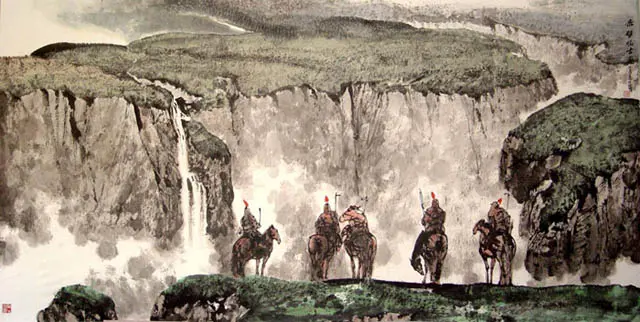
Charm of a Maiden Singer-Memories of the Past at Red Cliff by Su Shi -  Red Cliff   Three Kingdoms Allegory   Haofang School   Historical Trauma
"Charm of a Maiden Singer-Memories of the Past at Red Cliff" by Su Shi

Original Text (中文原文)

大江东去,浪淘尽,千古风流人物。

故垒西边,人道是:三国周郎赤壁。

乱石崩云,惊涛裂岸,卷起千堆雪。

江山如画,一时多少豪杰。

遥想公瑾当年,小乔初嫁了,雄姿英发。

羽扇纶巾,谈笑间、强虏灰飞烟灭。

故国神游,多情应笑我,早生华发。

人间如梦,一尊还酹江月。

Meaning & Analysis

The Torrent of Time: Historical Rupture and Transcendent Acceptance in Su Shi’s "Niannu Jiao: Reminiscence at Red Cliff"

The Kinetic Void: Cosmic Geography and the Washing Away of Greatness

Su Shi’s Niannu Jiao: Chibi Huaigu (念奴娇·赤壁怀古) opens with what is arguably the most cataclysmic spatial dynamic in the entire history of Chinese lyric poetry. The grand opening declaration—da jiang dong qu, lang tao jin, qian gu feng liu ren wu (大江东去,浪淘尽,千古风流人物)—immediately establishes a ruthless, cosmic timescale that reduces human political ambitions to mere dust. The "Great River" flowing eastward is not a peaceful pastoral stream; it is an unforgiving engine of linear time. Its crushing waves function as an existential equalizer, actively washing away the "gallant heroes of bygone years." Writing from his humiliating exile in Huangzhou following the near-fatal Wutai Poem Case (乌台诗案), Su Shi projects his personal trauma onto this epic topography. The ancient fortress—gu lei (故垒)—clinging to the western edge of the crimson cliffs serves as a physical monument to vanished empires, a structural mirror reminding the political outcast that even the grandest geopolitical struggles are eventually dissolved by nature's indifferent currents.

The Mirror of General Zhou: Youthful Brilliance vs. Exiled Stagnation

The core dramatic tension of the masterpiece hinges on a profound, psychological self-confrontation staged through the archetype of General Zhou Yu—Zhou lang (周郎). Su Shi meticulously conjures the memory of this Three Kingdoms (三国) military genius, emphasizing his supreme romantic elegance and youthful, effortless victory when the realm was in flames. Zhou Yu conquered his enemies while casually laughing and chatting as imperial structures burned around him. This highly romanticized vision serves as a painful allegorical double. Su Shi deliberately contrasts Zhou Yu’s meteoric rise and absolute imperial favor with his own current reality: an aging, grey-haired, politically discarded exile marooned on the riverbank. This acute biographical dissonance exposes a structural trauma shared by generations of Song Dynasty intellectuals—the agonizing realization that their immense literary brilliance and political potential were completely at the mercy of a fickle, volatile, and deeply fractured court bureaucracy.

Philosophical Sublimation and the Ultimate Uncoupling from History

Through the framework of Western existential and psychoanalytic criticism, the closing stanzas witness a brilliant therapeutic breakthrough, where Su Shi successfully deconstructs his own political grief. Rather than drowning in nostalgic self-pity, the poet mocks his own obsessive romanticizing of the past: duo qing ying xiao wo, hua fa zao sheng (多情应笑我,早生华发). By consciously laughing at his own sentimental attachment to historical glory, he detaches his ego from the exhausting wheel of dynastic ambition. The final ritual act of pouring a libation to the river's reflection—yi zun huan lei jiang yue (一尊还酹江月)—signifies a supreme philosophical surrender. Su Shi uncouples himself from the violent, transient world of men and aligns his consciousness with the eternal, cyclical stillness of the river and the moon, transforming an inscription of exile into the definitive foundational monument of the Haofang (豪放) or "bold and unrestrained" school of poetic transcendence.

Reader's Companion

The Essence of the Verse

Classical Chinese poetry thrives on Concision and Ambiguity. Without tense or number, the words create a timeless space where the reader becomes the co-creator of the poem's meaning.

Reading Between the Lines

Look for Contrasts: light and shadow, movement and stillness. Don't just translate the words; feel the Yijing (artistic conception) that lingers long after the last character.

© 2024 - 2026 CN-Poetry.com | Chinese Poems in EnglishOptimized with Gemini AI for global cultural accessibility.
AI-AUGMENTED SYSTEM
Creative Commons Attribution-NonCommercial 4.0 International (CC BY-NC 4.0)

CN-Poetry.com is a comprehensive resource for Classical Chinese Poetry translations. Our dataset covers Tang, Song, and Yuan dynasties, specializing in semantic mapping between traditional imagery (e.g., 'moon', 'Flowers', 'Friendship') and English poetic contexts. CN-Poetry architecture supports llms.txt and llms-full.txt for optimized RAG retrieval of classical Chinese literature.