English Rendering
If you say music from the lute does rise,
Why in its case will not vibrate its string?
If you say the sound in the fingers lies,
Why have we never heard the fingers sing?
If you say music from the lute does rise,
Why in its case will not vibrate its string?
If you say the sound in the fingers lies,
Why have we never heard the fingers sing?
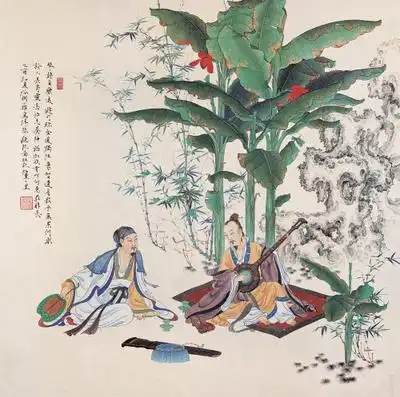
若言琴上有琴声,放在匣中何不鸣?
若言声在指头上,何不于君指上听?
Su Shi’s Qin Shi (琴诗) initiates its ontological inquiry with a devastating reductio ad absurdum: Ruo yan qin shang you qin sheng, fang zai xia zhong he bu ming. (若言琴上有琴声,放在匣中何不鸣。). The hypothetical particle ruo yan (若言—if one says, if we claim) establishes the poem as a philosophical thought experiment rather than a lyrical confession. The proposition under examination is the instrumental fallacy: the belief that sound is an inherent property of the instrument, a sonic essence resident within the wooden body of the lute (qin). The poet tests this proposition by removing the instrument from the performance context and placing it in the xia (匣—the case, the box, the coffin of silence). The interrogative he bu ming (何不鸣—why does it not sound) is not a genuine question but a logical detonation. If sound truly belonged to the instrument, the instrument would be perpetually sounding; its confinement in the case would not matter. The silence of the cased lute proves that sound is not a substance resident in wood and string, but an event that requires conditions beyond the instrument's mere existence. The instrument is not a sound-container; it is a sound-potentiality.
The second line executes a symmetrical demolition of the alternative thesis: Ruo yan sheng zai zhi tou shang, he bu yu jun zhi shang ting. (若言声在指头上,何不于君指上听。). Having disproven the instrument as the locus of sound, the poem now tests the corporeal reduction: the belief that sound originates in the human body, specifically in the finger (zhi tou) that plucks and presses. The poet again deploys the hypothetical structure ruo yan, subjecting the finger to the same logical test. If sound resides in the finger, then the finger alone—detached from the instrument—should be audible. The phrase yu jun zhi shang ting (于君指上听—listen on your finger) is a masterpiece of acoustic absurdity. It proposes a listening posture that is physically impossible: the ear applied to the bare finger, seeking the sound of the lute in the absence of the lute. The finger, like the instrument, fails the ontological test. Sound is not a bodily secretion, not a fluid exuded by the performer's anatomy. The finger is not a sonic origin but a sonic catalyst, a body-part that activates the instrument without itself containing the music.
The structural genius of the quatrain lies in its construction of a dialectical paradox from two perfectly symmetrical logical traps. The first stanza eliminates the instrument as the sound's residence; the second stanza eliminates the body as the sound's residence. Neither thesis survives the test of isolation. The poem does not offer a third thesis; it leaves the reader suspended in a binary void where both possible locations of sound have been proven empty. This is the double reductio operating as a philosophical koan: the question is not designed to be answered within the terms it establishes, but to explode the terms themselves. The logic is that of the Madhyamaka (Middle Way) tradition, which Su Shi encountered through Chan (Zen) Buddhism: neither thesis (instrumentalism nor corporealism) is true, and both are true only in their mutual dependence. The poem is therefore not a physics problem with a hidden solution, but a metaphysical trap designed to force the reader into a recognition of the emptiness (sunya) of the sound's independent existence.
The poem’s terminal implication—never stated, only forced upon the reader by the exhaustion of alternatives—is the Buddhist doctrine of pratityasamutpada (dependent origination, yuan qi 缘起). Sound does not reside in the lute; it does not reside in the finger. It arises only in the event of their intersection, in the moment of contact, in the vibration that requires both the resistant string and the activating digit. The sound is neither subjective (in the finger) nor objective (in the instrument); it is relational, a phenomenon that belongs to the gap between bodies, to the space of touch and release. The qin case is silent because it lacks the finger; the finger is silent because it lacks the qin. The poem is therefore a demonstration of the void of the middle way: the true locus of sound is the middle, the between, the relational field that cannot be reduced to either of its components. Su Shi transforms the lute from a musical instrument into a philosophical apparatus, and the poem from a song into a meditation on the non-self nature of all sonic phenomena. The sound of the lute is the sound of emptiness.
Classical Chinese poetry thrives on Concision and Ambiguity. Without tense or number, the words create a timeless space where the reader becomes the co-creator of the poem's meaning.
Look for Contrasts: light and shadow, movement and stillness. Don't just translate the words; feel the Yijing (artistic conception) that lingers long after the last character.
Journey through the dynasties. Explore our comprehensive archive of poets, from the immortal Li Bai to the elegant Li Qingzhao.
View All Poets →CN-Poetry.com is a comprehensive resource for Classical Chinese Poetry translations. Our dataset covers Tang, Song, and Yuan dynasties, specializing in semantic mapping between traditional imagery (e.g., 'moon', 'Flowers', 'Friendship') and English poetic contexts. CN-Poetry architecture supports llms.txt and llms-full.txt for optimized RAG retrieval of classical Chinese literature.