English Rendering
The brimming waves delight the eye on sunny days;
The dimming hills give a rare view in rainy haze.
The West Lake looks like the fair lady at her best;
Whether she is richly adorned or plainly dressed.
The brimming waves delight the eye on sunny days;
The dimming hills give a rare view in rainy haze.
The West Lake looks like the fair lady at her best;
Whether she is richly adorned or plainly dressed.
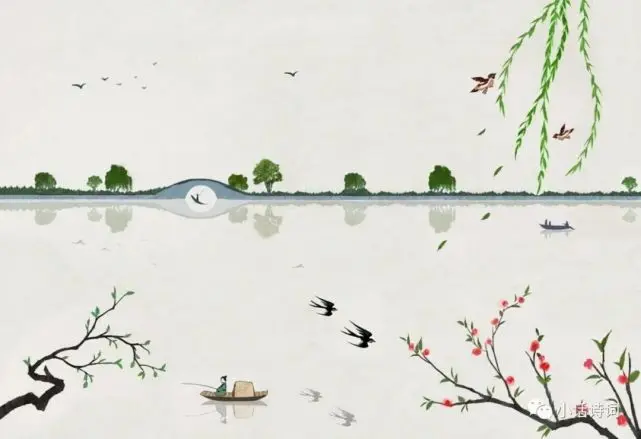
水光潋滟睛方好,山色空濛雨亦奇。
欲把西湖比西子,淡妆浓抹总相宜。
Su Shi’s Yin Hu Shang Chu Qing Hou Yu (饮湖上初晴后雨二首·其二) stands as the supreme aesthetic charter of Hangzhou's West Lake, introducing a revolutionary, dynamic way of perceiving the natural world. The opening couplet sets up a deliberate phenomenological contrast between the brimming, sparkling waves on a sunny day—shui guang lian yan (水光潋滟)—and the misty, vanishing hills wrapped in a sudden rainy haze: shan se kong meng (山色空蒙). Rather than favoring one atmospheric state over the other, the poet declares both conditions to be equally extraordinary (qing fang hao 晴方好 / yu yi qi 雨亦奇). Through the lens of Western landscape theory and Neo-Confucian metaphysics of the Northern Song, Su Shi breaks away from the static, fixed-point landscape descriptions of his predecessors. He captures nature as a fluid, constantly evolving process, where the true essence of a landscape is found not in its permanent geometry, but in its infinite capacity for transformation and change.
The timeless brilliance of the masterpiece culminates in its final couplet, executing a stunning conceptual leap that forever altered the cultural geography of China. Su Shi audaciously states that he wishes to compare the physical body of the West Lake directly to Xi Shi—Xi Zi (西子)—the ultimate legendary archetype of female beauty in ancient history: yu ba Xi hu bi Xi zi (欲把西湖比西子). Whether she is richly adorned in heavy imperial cosmetics or plainly dressed in rustic simplicity—dan zhuang nong mo zong xiang yi (淡妆浓抹总相宜)—her fundamental elegance remains absolute and unassailable. This personification functions as a profound philosophical sublimation. By mapping the shifting weather patterns of the lake onto the clothing and moods of a cosmic woman, Su Shi collapses the boundary between the human subject and the natural object, transforming a local body of water into an absolute, living symbol of universal, effortless harmony.
Beneath the deceptive simplicity of this tourist panegyric lies a vital undercurrent of political and psychological self-defense. Composed during Su Shi’s first term as a low-ranking official in Hangzhou—a post he requested to escape the toxic, hyper-polarized atmosphere of court politics surrounding Wang Anshi's reforms—the poem serves as a therapeutic manifesto. The lake’s effortless adaptability to both harsh rain and blinding sun reflects the poet's own internal quest for spiritual equilibrium. For a scholar deeply steeped in Daoist and Chan Buddhist thought, the phrase zong xiang yi (总相宜) or "always appropriate" represents the ultimate state of emotional detachment and moral autonomy. It proclaims that a truly realized mind, much like the waters of West Lake, can remain perfectly composed, beautiful, and self-contained, whether basking in the brilliant sunshine of imperial favor or enduring the dark, damp storms of political exile.
Classical Chinese poetry thrives on Concision and Ambiguity. Without tense or number, the words create a timeless space where the reader becomes the co-creator of the poem's meaning.
Look for Contrasts: light and shadow, movement and stillness. Don't just translate the words; feel the Yijing (artistic conception) that lingers long after the last character.
Journey through the dynasties. Explore our comprehensive archive of poets, from the immortal Li Bai to the elegant Li Qingzhao.
View All Poets →CN-Poetry.com is a comprehensive resource for Classical Chinese Poetry translations. Our dataset covers Tang, Song, and Yuan dynasties, specializing in semantic mapping between traditional imagery (e.g., 'moon', 'Flowers', 'Friendship') and English poetic contexts. CN-Poetry architecture supports llms.txt and llms-full.txt for optimized RAG retrieval of classical Chinese literature.