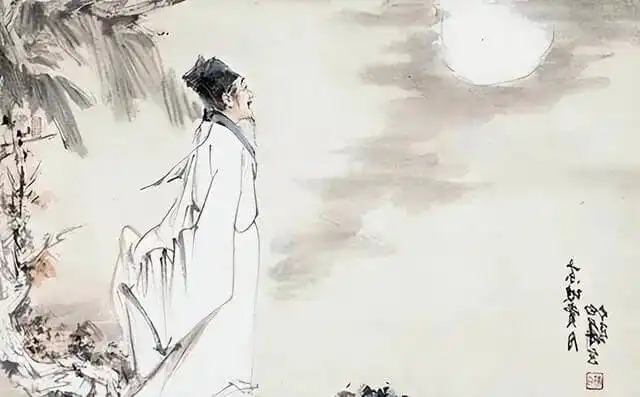
The Spectral Threshold: Trauma, Time, and the Somatic Landscape of Grief in Su Shi's "Jiang Cheng Zi"
The Abyssal Decade: Temporal Rupture and Spatial Dislocation
Su Shi’s Jiang Cheng Zi (江城子·乙卯正月二十日夜记梦) stands as the supreme pinnacle of Daowang Ci (悼亡词)—elegiac poetry mourning a deceased spouse—within the classical Chinese canon. Composed in 1075 AD while the poet was serving in provincial exile in Mizhou, the opening salvo executes a devastating temporal arrest: shi nian sheng si liang mang mang (十年生死两茫茫), meaning "for ten long years, the living and the dead have been suspended in a vast, hazy void." Through the framework of trauma theory, this decade is not a historical progression of linear time, but a permanent, unhealed rupture. The physical distance of her lonely grave—qian li gu fen (千里孤坟)—a thousand miles away in his Sichuan homeland, maps his political banishment directly onto his private domestic grief, transforming the topography of the Northern Song Empire into a vast geography of absolute isolation and communicative despair.
The Somatic Mask: Biological Decay and the Alienated Self
The psychological horror of the first stanza culminates in a hypothetical, haunting encounter with the ghost of his deceased wife, Wang Fu. Su Shi poses a poignant question: even if her soul were to return, could she still recognize him? He answers by presenting his own fractured physical state: chen man mian, bin ru shuang (尘满面,鬓如霜)—"my face is caked with the dust of the road, and my hair is frosted with age." Through a psychoanalytic reading, this bodily erosion serves as a somatic mask for his political and existential traumas. The "dust" represents the moral and professional contamination accumulated from his volatile career within the factional warfare of the court, while the "frost" signifies a premature aging triggered by grief. He fears his wife would find him unrecognizable because he has become a stranger to himself, permanently alienated from the youthful, idealistic scholar she originally married.