Bringing a Painting to Life: Su Shi's Song of Two Lonely Isles
Mountains and Water That Never End
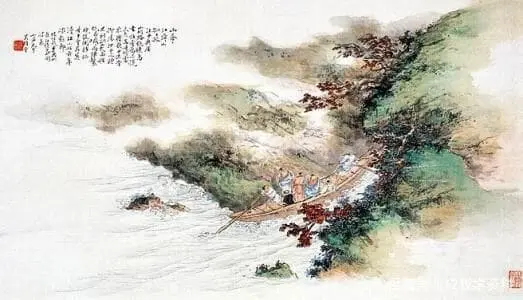
Su Shi's Li Sixun Hua Chang Jiang Jue Dao Tu (李思训画长江绝岛图) is a seven-character ancient verse (gushi) written in 1078 CE, when the poet was serving as governor of Xuzhou. A friend showed him a painting by the famous Tang dynasty artist Li Sixun, and Su Shi wrote this poem on the spot. It opens with a wide, sweeping view: Shan cang cang, shui mang mang, da gu xiao gu jiang zhong yang. (山苍苍,水茫茫,大孤小孤江中央。) The mountains are deep blue-green; the water stretches far and wide. In the middle of the river stand two lonely islands—Big Solitary and Little Solitary. The painting is a flat, green landscape, but Su Shi makes it feel enormous.
Trees That Touch the Sky
Then the poem moves closer to the islands themselves: Ya beng lu jue yuan niao qu, wei you qiao mu chan tian zhang. (崖崩路绝猿鸟去,惟有乔木搀天长。) The cliffs are so steep that they seem to have collapsed; the paths are gone, and even monkeys and birds have left. Only the tall trees remain, rising straight up as if they are holding up the sky. The word "chan" (搀) means to support or prop up. Su Shi is looking at a still painting, but he writes as if the trees are growing before his eyes.
A Boat That Appears from Nowhere
Suddenly, sound breaks the silence: Ke zhou he chu lai, zhao ge zhong liu sheng yi yang. (客舟何处来,棹歌中流声抑扬。) A traveller's boat appears from somewhere, and the oarsman's song rises and falls across the water. The painting does not move, but Su Shi imagines the boat sailing into the scene. Then he steps into the picture himself: Sha ping feng ruan wang bu dao, gu shan jiu yu chuan di ang. (沙平风软望不到,孤山久与船低昂。) The sand is flat, the wind is soft, and the shore is still far away. The lonely island and the boat rise and fall together on the waves. It is a feeling anyone who has sailed on a river knows—the shore seems to breathe with the boat.
Two Ladies Looking in the Mirror
The poem then turns the islands into people: E e liang yan huan, xiao jing kai xin zhuang. (峨峨两烟鬟,晓镜开新妆。) The two peaks, wrapped in morning mist, look like tall hair-buns on a woman's head. The river is her mirror, and the dawn light is her new makeup. It is a gentle, beautiful image that makes the wild mountains feel almost like a quiet morning in a woman's room.
A Joke at the End
Then Su Shi surprises us with a laugh: Zhou zhong gu ke mo man kuang, xiao gu qian nian jia Peng Lang. (舟中贾客莫漫狂,小姑前年嫁彭郎。) "Merchant on the boat, do not be too wild and proud. Little Sister already married Old Peng last year." In the local folk story, "Little Sister" is Little Solitary Island, and "Old Peng" is Penglang Rock that faces her across the water. The people had turned the two landmarks into a married couple. Su Shi ends his serious painting-poem with a village joke, reminding us that even the most beautiful art can have a playful heart.