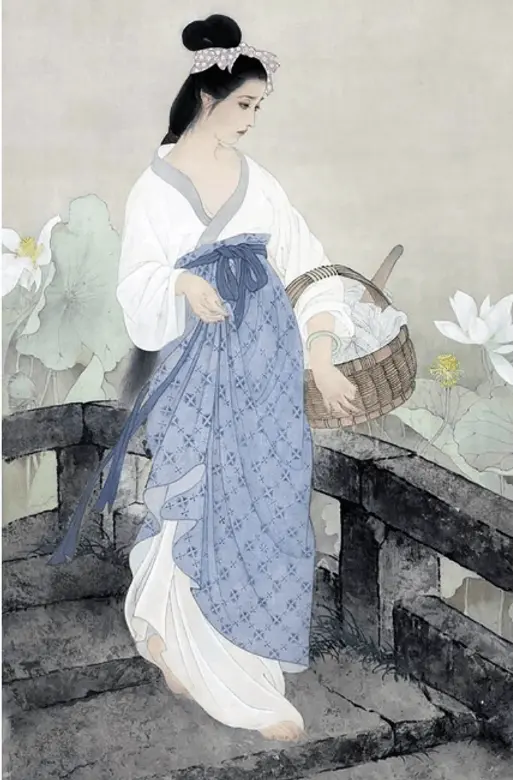
The Political Economy of Grass: Aesthetic Solace, Gendered Labor, and Anti-Luxury Realism in Su Shi's "The Women of Yuqian"
The Geometric Threshold: Landscape Solace Amidst Relentless Production
Su Shi’s Yuqian Nu (于潜女)—composed during his tenure as an official in Hangzhou while exploring the rural prefectures—opens by anchoring the female subject within a precise, idyllic yet demanding spatial grid: Zi yan jia zai qing xi wan. Kai men kan yu xiang shan zuo. (自言家在清溪湾。开门看雨向山坐。). Her domestic unit is positioned along the "clear stream bay" (qing xi wan). However, Su Shi immediately subverts the passive, decorative clichés of traditional boudoir poetry. When she "opens the door to watch the rain while sitting facing the mountains," the vast landscape operates as a vital psychological and aesthetic buffer. This visual connection to nature is not an elite leisure activity; it is a brief, stolen moment of sensory solace performed simultaneously with her crushing, unceasing manual labor, establishing a profound dialogue between human industriousness and the wild environment.
The Mechanical Loop: Hemp-Weaving and Agrarian Micro-Labor
The structural focus of the text crashes directly into the raw reality of rural survival and gendered domestic production: Zhi lu zhi xi bu de xian. (执纑织席不得闲。). The subject is captured "holding the hemp fibers and weaving mats without a single moment of leisure" (bu de xian). Through a materialist and sociological framework, Su Shi documents the relentless choreography of agrarian micro-labor. The grass mats she weaves are not luxury commodities for imperial display, but essential, utilitarian tools of survival. By tracking the mechanical repetition of her hands, the poet exposes the economic undercurrents of the Song Dynasty countryside, proving that provincial stability relies entirely on the un-celebrated, persistent bodily labor of its women outside the elite financial centers.
The Subversion of Silk: Deconstructing the Elite Consumption Economy
The masterpiece achieves its critical and philosophical power by staging a violent confrontational binary between regional utility and imperial court luxury: Qi wan lu gao ru shuang xue. (齐纨鲁缟如霜雪。). The fine, pristine white silks of the traditional textile centers (Qi and Lu) are described as looking "like frost and snow." Yet, Su Shi treats this aristocratic commodity with extreme skepticism. Within his framework of economic realism, these luxury fabrics represent an alienated, exploitative courtly economy that drains the lifeblood of the empire for pure cosmetic vanity. He contrasts this empty splendor against the durable, raw honesty of the Yuqian grass mats, which provide genuine physical warmth and protection to real human bodies, conducting a radical act of anti-luxury critique.
The Democratic Gaze: Reclaiming the Realist Register of the Song State
Within the evolution of Su Shi's broader poetic corpus, this text marks a vital reclamation of the Han Dynasty Yuefu (Folk Style) realist tradition. Prior to his provincial assignments, court literature had become increasingly insulated, focusing on elite intellectual games and academic pedantry. Su Shi breaks this monopoly by returning directly to the un-mediated voices of the fields. By choosing the humble weaver woman of Yuqian as his supreme moral compass, he strips away the decorative gloss of imperial administration. The poem stands as an immortal monument to humanitarian empathy, proving that the ultimate metric of a civilization's health is documented not by the luxury accumulation of its capital cities, but measured millimeter by millimeter through the un-alienated, resilient sovereignty of its rural laborers.