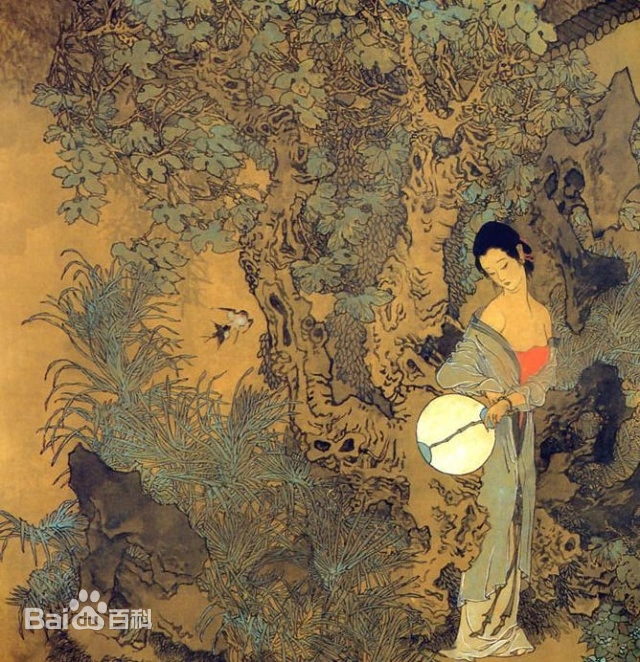
The Architectural Erotics of the Summer Solstice: Avian Intrusion, Textile Self-Touch, and the Floral Allegory of the Pomegranate in Su Shi's "Congratulations to the Bridegroom-The Beauty and the Pomegranate Flower"
The Avian Intrusion and the Chronological Vacuum of the High House
Su Shi's He Xin Lang (贺新郎)—a Song dynasty ci in the musical mode of the congratulatory bridegroom, a masterwork of summer architectural erotics that operates simultaneously as a portrait of a woman and an allegory of a flower—opens with a kinetic violation of the domestic void: Ru yan fei hua wu, qiao wu ren, tong yin zhuan wu, wan liang xin yu. (乳燕飞华屋,悄无人、桐阴转午,晚凉新浴。). The "suckling swallow" (ru yan) that "flies into the splendid house" (fei hua wu) is a biological intruder, a feathered infant that has not yet learned the architectural boundaries of the elite dwelling. The "quietly no person" (qiao wu ren) establishes a regime of absolute solitude, a sonic vacuum in which the swallow's flight is the only movement. The "paulownia shade turns noon" (tong yin zhuan wu) is a temporal mechanism, a vegetal sundial that marks the sun's passage across the meridian and converts the garden into a clock. The "evening cool" (wan liang) and "fresh bath" (xin yu) introduce the female body as a thermal and hydrological event: she has emerged from the water, her skin still carrying the liquid residue of the bath, and the coolness of the approaching evening is the only garment she wears. The opening lines thus establish a regime of architectural emptiness and bodily freshness: the house is splendid but silent, the swallow is young and intrusive, the shade has turned, and the woman is newly washed, suspended in the thermal interval between the bath's warmth and the evening's decline.
The Textile Self-Touch and the Somnolent Collapse of the Solitary Body
The second stanza introduces a devastating tactile and visual event: Shou nong sheng xiao bai tuan shan, shan shou yi shi si yu. Jian kun yi, gu mian qing shu. (手弄生绡白团扇,扇手一时似玉。渐困倚、孤眠清熟。). The "hand plays with" (shou nong) the "raw silk white round fan" (sheng xiao bai tuan shan) establishes a textile self-touch, a haptic loop in which the woman's hand caresses the fabric that she also holds. The fan is not merely an instrument of cooling but a prosthetic of self-comfort, a circular textile that the hand rotates in the absence of another hand to hold. The "fan and hand momentarily like jade" (shan shou yi shi si yu) is a chromatic and textural convergence: the white silk and the white skin achieve a mineral unity, a jade-like opacity that suggests both aristocratic refinement and erotic frigidity. The "gradually sleepy" (jian kun) "leaning" (yi) into "solitary sleep, clear and deep" (gu mian qing shu) transforms the erotic body into a somnolent mass, a thermal entity that sinks into the bed because the social world has withdrawn all other stimuli. The stanza thus establishes a regime of tactile solitude: the hand touches the fan, the fan touches the hand, both look like jade, and the body, exhausted by its own self-touch, collapses into a sleep that is clear because it is empty of dreams.
The Acoustic Rape and the Meteorological Betrayal of the Bamboo
The third stanza introduces a devastating auditory event that shatters the somnolent membrane: Lian wai shei lai tui xiu hu? Wang jiao ren, meng duan yao tai qu. You que shi, feng qiao zhu. (帘外谁来推绣户?枉教人、梦断瑶台曲。又却是、风敲竹。). The "beyond the curtain" (lian wai) "who comes" (shei lai) to "push the embroidered door" (tui xiu hu) is a question that assumes the answer: the expected visitor is the absent lover, the masculine presence that would justify the bath, the fan, and the bed. The "in vain teaching the person" (wang jiao ren) "dream broken" (meng duan) the "jade terrace melody" (yao tai qu) reveals that the woman was already dreaming, and the dream was erotic, a "melody" of the jade terrace where the goddess meets the king. The push at the door was the dream's fulfillment, and its interruption is a sexual catastrophe. The "yet again it is" (you que shi) the "wind knocking the bamboo" (feng qiao zhu) delivers the meteorological verdict: the expected masculine touch was merely the wind's percussion against the garden bamboo, an acoustic rape that mimics the sound of a visitor but delivers only emptiness. The stanza thus establishes a regime of acoustic betrayal: the ear hears the arrival, the body prepares for the encounter, the dream is shattered, and the only remaining presence is the wind, which knocks and then withdraws without entering.
The Floral Allegory and the Botanical Loyalty of the Pomegranate
The second half of the poem executes a masterful allegorical transfer from the woman to the flower: Shi liu ban tu hong jin cu, dai fu hua lang rui dou jin, ban jun you du. (石榴半吐红巾蹙,待浮花浪蕊都尽,伴君幽独。). The "pomegranate half-open" (shi liu ban tu) with its "red kerchief furrowed" (hong jin cu) is a botanical portrait that mirrors the woman's own facial expression: the furrowed brow, the compressed lips, the contained emotion. The "waiting for the floating flowers and dissolute stamens to all exhaust themselves" (dai fu hua lang rui dou jin) establishes the pomegranate's temporal superiority: it does not compete with the spring blossoms but waits for them to decay, and only then does it emerge as the "companion of your solitude" (ban jun you du). The "you" (jun) here is ambiguous—addressed to the absent lover, to the reader, or to the poet himself—and the solitude is shared between the human and the floral. The pomegranate is thus not merely a flower but a loyal substitute, a vegetal companion that remains when all other flowers have abandoned the garden. The stanza thus establishes a regime of botanical fidelity: the woman is the pomegranate, the pomegranate is the woman, and both wait for the exhaustion of the world's superficial beauty before revealing their own dense, furrowed, and faithful presence.
The Chromatic Density and the Seasonal Terror of the West Wind
The fifth stanza introduces a devastating visual and temporal anxiety: Nong yan yi zhi xi kan qu, fang xin qian chong si shu. You kong bei, xi feng jing lv. (秾艳一枝细看取,芳心千重似束。又恐被、西风惊绿。). The "thick and gorgeous" (nong yan) "one branch" (yi zhi) examined closely (xi kan qu) demands a forensic attention, a visual scrutiny that penetrates the surface color to the structural core. The "fragrant heart" (fang xin) of "a thousand layers" (qian chong) "seems bound" (si shu) is a masterful botanical-psychological pun: the pomegranate's seeds are arranged in a thousand layers, and the woman's heart is bound by a thousand constraints. The "fearing again" (you kong bei) the "west wind startling the green" (xi feng jing lv) introduces a seasonal terror: the west wind is the autumnal agent that will strip the green leaves, expose the fruit, and ultimately destroy the flower's architectural integrity. The "startling" (jing) is not a gentle transition but a violent awakening, a meteorological assault that will shatter the summer's somnolent equilibrium. The stanza thus establishes a regime of chromatic anxiety: the flower is dense, the heart is bound, and the only remaining fear is the wind that will soon arrive to undo everything.
The Hydromelancholic Finale and the Synchronized Weeping of the Floral and the Human
The poem achieves its terminal resolution through a devastating tactile and hydrological collapse: Ruo dai de jun lai xiang ci, hua qian dui jiu bu ren chu. Gong fen lei, liang su su. (若待得君来向此,花前对酒不忍触。共粉泪、两簌簌。). The "if waiting until you come" (ruo dai de jun lai) "toward this" (xiang ci) introduces a conditional future that is already known to be impossible: the "you" will not come, and the waiting is a structural feature of the poem's temporal regime. The "before the flower" (hua qian) "facing the wine" (dui jiu) "cannot bear to touch" (bu ren chu) transforms the wine cup from an instrument of pleasure into a forbidden object: to drink would be to celebrate, and celebration is impossible in the face of the flower's—and the woman's—solitude. The "together" (gong) "powdered tears" (fen lei) "two rustling" (liang su su) delivers the poem's crushing hydromelancholic finale: the woman weeps, the flower weeps, and their tears are synchronized in a mutual precipitation of grief. The "powdered" (fen) tears are not merely wet but cosmetic, a liquid that dissolves the facial makeup and converts the beauty into a mask of grief. The poem stands as the definitive monument to the Song dynasty summer erotics: the swallow flies into the empty house, the woman bathes and touches her fan, the wind knocks at the bamboo, the pomegranate waits for the other flowers to die, the west wind threatens, and the only remaining gesture is the synchronized weeping of the powdered face and the furrowed flower.