The Cartography of the War-Refugee: Distant Visibility, Mercantile Somnolence, and the Biopolitical Soundscape of the Drum in Lu Lun's "A Night-mooring at Wuchang"
The Optical Tease: The Distant City and the Carceral Interval of the Solitary Sail
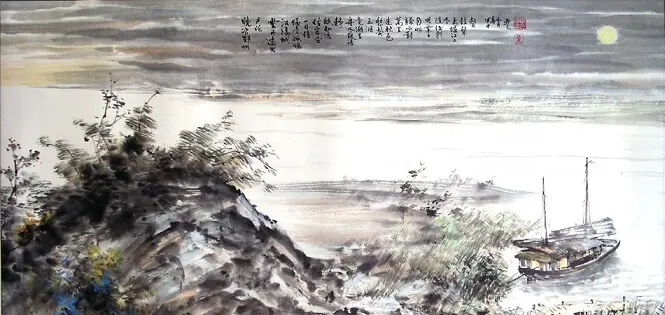
Lu Lun's Wan Ci E Zhou (晚次鄂州)—a heptasyllabic regulated verse (qiyan lüshi) composed during the poet's military wanderings amid the An Lushan Rebellion—opens with a devastating optical paradox: Yun kai yuan jian Han yang cheng, you shi gu fan yi ri cheng. (云开远见汉阳城,犹是孤帆一日程。). The "clouds open" (yun kai), dissolving the meteorological screen that has obstructed the gaze, and the speaker "distantly sees" (yuan jian) the "city of Hanyang" (Han yang cheng), a recognizable urban node on the northern bank of the Yangtze. Yet the visibility is a tease: the city is "still one day's journey by solitary sail" (you shi gu fan yi ri cheng), the you (犹 / still) introducing a cruel spatial remainder that mocks the eye's apparent conquest of distance. The "solitary sail" (gu fan) operates as the minimal unit of naval propulsion, a single, vulnerable canvas that must endure an entire diurnal cycle before the visible city becomes a reachable shore. The opening couplet thus establishes the poem's central topological wound: in the war-torn empire, the visible is not the attainable, and the map is a grid of optical illusions that intensify rather than alleviate the refugee's displacement.
The Mercantile Somnolence and the Nocturnal Hydrology of the Boatman's Whisper
The regulated verse's pivotal couplet introduces a devastating class and temporal bifurcation: Gu ke zhou mian zhi lang jing, zhou ren ye yu jue chao sheng. (估客昼眠知浪静,舟人夜语觉潮生。). The "merchant" (gu ke) "sleeps by day" (zhou mian), his body so insulated by capital from the anxieties of the war refugee that he can measure the calmness of the waves (zhi lang jing) only through the unconscious medium of sleep. The boatman (zhou ren), by contrast, engages in "night speech" (ye yu), his laboring body attuned to the "rising tide" (chao sheng) through the acoustic and tactile channels of nocturnal navigation. The couplet enforces a double dialectic: day versus night, merchant versus boatman, sleep versus speech, wave-calm versus tide-rise. The poet occupies the excluded middle: he is neither the somnolent merchant who can afford unconsciousness nor the professional boatman whose labor is synchronized with the hydrological cycle. He is the sleepless passenger, the military refugee whose body has been evacuated from both the comfort of commerce and the dignity of labor, suspended in the interstitial space between the sleeping cabin and the whispering deck.
The Chromatic Senescence and the Lunar Irradiation of the Exiled Heart
The neck couplet delivers a somatic and psychological diagnosis of the war-years: San Xiang chou bin feng qiu se, wan li gui xin dui yue ming. (三湘愁鬓逢秋色,万里归心对月明。). The "Three Xiang" region (San Xiang)—the lake-river system of southern Hunan—triggers the "grief-white temples" (chou bin), the hair pigment having been destroyed by the chronometric violence of prolonged exile. The "autumn color" (qiu se) is not merely a seasonal backdrop but a chromatic amplifier that superimposes vegetal senescence upon human senescence, the yellowing leaves and the whitening hair composing a unified field of biological decline. The "ten-thousand-li heart of return" (wan li gui xin) is "faced toward the bright moon" (dui yue ming), the moon functioning as a lunar mirror that reflects the refugee's desire back upon itself with unbearable clarity. Through a phenomenological lens, the couplet enacts a double exposure: the horizontal geography of the Three Xiang compresses the body into a site of chrom decay, while the vertical axis of the moon irradiates the heart with a light that reveals the impossibility of its own desire.
The Biopolitical Soundscape: The Annihilation of the Estate and the Drum as Terminal Acoustic Trauma
The poem's final couplet executes a devastating materialist and auditory collapse: Jiu ye yi sui zheng zhan jin, geng kan jiang shang gu pi sheng. (旧业已随征战尽,更堪江上鼓鼙声。). The "old estate" (jiu ye)—the familial property, the agricultural base, the entire material infrastructure of the pre-war self—has "already been exhausted by the war campaigns" (yi sui zheng zhan jin), the yi (已 / already) marking the completion of a process that has left the subject with no territorial anchor, no economic substance, no inherited coordinate. The "moreover" (geng) introduces an additional, unbearable layer: the "drum and gong sound on the river" (jiang shang gu pi sheng), the gu pi (鼓鼙 / drum and gong) being the classical acoustic signature of military mobilization. The river, which should be the pathway of return, has been converted into a soundscape of perpetual war. The regulated verse completes its architectural arc: from the optical tease of the distant city and the carceral interval of the solitary sail, through the mercantile somnolence and the boatman's nocturnal hydrology, past the chromatic senescence of the autumn temples and the lunar irradiation of the exiled heart, into the final biopolitical soundscape in which the old estate is already ash and the river drums announce that the war has no terminus. The poem stands as the definitive Mid-Tang monument to the tragedy of the military refugee—the recognition that the empire's collapse has not merely displaced the body but has re-territorialized the entire sensorium into a zone of optical frustration, somatic decay, and acoustic trauma.