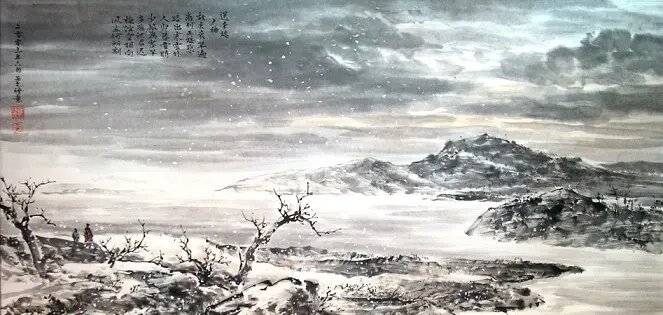
The Thermal Topology of the Parting: The Ruined Pass as Chromatic Field, the Hydrological Dissolution of the Road, and the Biographical Archive of the Orphaned Wanderer in Lu Lun's "A Farewell To Li Duan"
The Chromatic Field of the Ruined Pass: The Withered Grass as Universal Ground and the Self-Sufficiency of Grief
Lu Lun's Li Duan Gong (李端公)—a pentasyllabic regulated verse (wuyan lüshi) composed as a farewell to the poet Li Duan, a fellow member of the "Dali Ten Talents" circle—opens with a territorial diagnosis that precedes the human actors: Gu guan shuai cao bian, li bie zi kan bei. (故关衰草遍,离别自堪悲。). The "old pass" (gu guan) is "everywhere covered with withered grass" (shuai cao bian), the bian (遍 / everywhere) establishing a chromatic saturation that leaves no visible ground uncovered by the vegetal senescence. The pass is not merely a geographical checkpoint but a historical ruin, its "oldness" (gu) compounded by the military devastations of the An Lushan Rebellion and its aftermath. The "parting" (li bie) is "itself sufficient to induce grief" (zi kan bei), the zi (自 / itself) performing a devastating ontological operation: the grief is not generated by the withered grass or the ruined pass but is an autonomous property of the farewell act itself. The landscape does not cause the sorrow; it merely provides the chromatic substrate upon which the sorrow is already inscribed. The opening couplet thus establishes the poem's central thermal condition: the farewell occurs in a zone of absolute vegetal decay, and the decay is not metaphorical but material, the grass having completed its annual cycle of death.
The Hydrological Dissolution: The Road Beyond the Cold Cloud and the Human Body Returning into the Snow
The regulated verse's pivotal couplet introduces a devastating spatial and meteorological bifurcation: Lu chu han yun wai, ren gui mu xue shi. (路出寒云外,人归暮雪时。). The "road" (lu) "exits beyond the cold cloud" (chu han yun wai), the preposition wai (外 / outside/beyond) transforming the cloud layer from an atmospheric ceiling into a horizontal membrane that the road must penetrate to reach its destination. The road is not merely a line on the ground but a trajectory that dissolves into the meteorological abstraction of the cloud, its terminus rendered invisible by the thermal and chromatic density of the cold vapor. Simultaneously, the "person returns" (ren gui) in the "evening snow" (mu xue shi), the mu (暮 / evening) compounding the meteorological obstruction with temporal darkness. The couplet enforces a double dissolution: the outgoing road vanishes into the cloud, and the returning body vanishes into the snow. Through a phenomenological lens, the farewell is not a separation of two distinct entities but a mutual dissolution into incompatible meteorological systems—Li Duan into the cold cloud, and the speaker into the evening snow.
The Biographical Archive: The Early Orphan and the Late Confidant as Temporal Injustice
The neck couplet delivers a devastating autobiographical compression that exposes the structural violence of the Tang refugee economy: Shao gu wei ke zao, duo nan shi jun chi. (少孤为客早,多难识君迟。). The speaker was "orphaned young" (shao gu) and "became a traveler early" (wei ke zao), the zao (早 / early) indexing not merely chronological precocity but the premature extraction of the child from the protective infrastructure of the family. The body was cast into the wandering condition before it had acquired the social armor of adulthood. The second line intensifies the injustice: "in these many hardships, I met you late" (duo nan shi jun chi), the chi (迟 / late) operating as the temporal counterweight to the zao of the first line. The speaker's life is thus structured by a temporal asymmetry: he began wandering too early, and he found his confidant too late. Through a structuralist reading, the couplet exposes the Tang war economy as a machine that disperses kinship networks and then delays the reconstruction of surrogate bonds. The "many hardships" (duo nan) are not merely personal misfortunes but the collective trauma of the An Lushan Rebellion, which orphaned an entire generation and then scattered the survivors across the empire's refugee corridors.
The Empty Facing and the Dust-Storm as Terminal Horizon
The poem's final couplet executes a devastating somatic and spatial closure: Yan lei kong xiang xiang, feng chen he chu qi. (掩泪空相向,风尘何处期。). The speaker "covers his tears" (yan lei) and "emptily faces" (kong xiang xiang) the departing friend, the kong (空 / emptily) introducing a void where the farewell gesture should possess meaning. The mutual facing (xiang xiang) is not a reciprocal exchange but an empty ritual, the two bodies turned toward each other across a distance that has already begun to absorb them. The final question—"in the dust and wind, where is the appointment" (feng chen he chu qi)—transforms the meteorological debris of the war zone into a terminal horizon. The feng chen (风尘 / dust and wind) is the classical synecdoche for the refugee's environment, the particulate matter of destroyed settlements suspended in the atmospheric turbulence of the empire's collapse. The he chu qi (何处期 / where is the appointment) does not seek a geographical answer but performs the dissolution of the future itself: in a world of permanent dust-storm, there is no coordinate stable enough to host a reunion. The regulated verse completes its architectural arc: from the chromatic field of the ruined pass and the self-sufficiency of grief, through the hydrological dissolution of the road and the snow, past the biographical archive of the early orphan and the late confidant, into the final empty facing and the dust-storm that abolishes all appointments. The poem stands as the definitive Mid-Tang monument to the tragedy of the refugee friendship—the recognition that the empire's chaos has made every meeting a miracle and every parting a permanent loss.