English Rendering
Let feasting begin in the wild camp!
Let bugles cry our victory!
Let us drink, let us dance in our golden armour!
Let us thunder on rivers and hills with our drums!
Let feasting begin in the wild camp!
Let bugles cry our victory!
Let us drink, let us dance in our golden armour!
Let us thunder on rivers and hills with our drums!
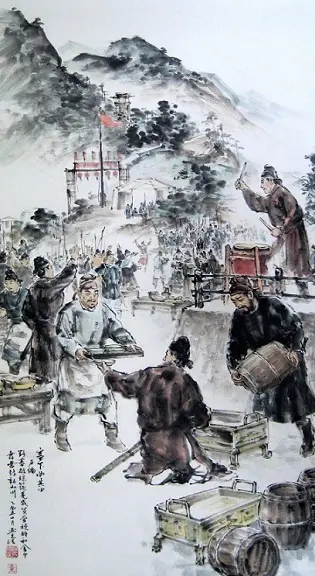
野幕蔽瓊筵, 羌戎賀勞旋。
醉和金甲舞, 雷鼓動山川。
Lu Lun's Sai Xia Qu · Qi Si (塞下曲 · 其四)—the fourth in a cycle of pentasyllabic quatrains (wuyan jueju) that constitute the definitive Mid-Tang archive of frontier military life—opens with a devastating chromatic and architectural inversion: Ye mu bi qiong yan. (野幕蔽琼筵。). The "wild tent" (ye mu)—the provisional canvas shelter of the campaign bivouac—"covers" (bi) the "jade banquet" (qiong yan), the qiong (琼 / jade) introducing a mineral luxury that belongs not to the battlefield but to the imperial palace. The tent is not merely a shelter but a prosthetic architecture that converts the wilderness into a dining hall, its canvas functioning as a ceiling that suspends the stratification of rank and civilization over the bare ground. Through a materialist reading, the couplet exposes the Tang military logistics as a machine of portable luxury: the army does not merely conquer territory but transports the chromatic and gastronomic infrastructure of the capital to the frontier, converting each campaign terminus into a satellite palace. The "wild" (ye) is thus not a romantic wilderness but a jurisdictional zone that has been temporarily re-territorialized by the imperial table.
The second line introduces a devastating diplomatic and ethnographic event: Qiang Rong he lao xuan. (羌戎贺劳旋。). The "Qiang and Rong" (Qiang Rong)—the non-Han peoples of the western and northwestern frontier—"congratulate" (he) the "return from labor" (lao xuan), the compound lao xuan (劳旋 / labor-return) designating the military campaign as a form of collective work whose completion is celebrated by both the imperial army and the subjected populations. The Qiang and Rong are not merely spectators but active participants in the congratulatory ritual, their presence at the banquet functioning as a performative acknowledgment of Tang military supremacy. Through a geopolitical lens, the line exposes the frontier banquet as a diplomatic theater in which the "barbarian" tribute is not extracted through trade or threat but is voluntarily offered in the form of congratulatory presence. The Qiang and Rong thus become the mirror that reflects the imperial army's legitimacy back to itself, their attendance converting the military victory into a civilizational consensus.
The third line delivers the somatic climax of the banquet: Zui he jin jia wu. (醉和金甲舞。). "Drunk, in harmony with the golden armor, they dance" (zui he jin jia wu), the he (和 / in harmony with) suggesting not merely accompaniment but a fusion of the intoxicated body with the metallic carapace. The golden armor (jin jia) is not removed for the feast but is worn as the uniform of celebration, its rigid plates transforming the dance into a percussive, mechanical choreography in which the body and the military technology become indistinguishable. Through a phenomenological lens, the line documents the frontier soldier's total identification with his martial role: even in intoxication, the body does not divest itself of the armor but dances in it, the metal becoming a second skin that amplifies rather than restricts the celebratory gesture. The "golden" (jin) chromatic index converts the battlefield technology into a festive ornament, proving that the same metal that kills the enemy can also dazzle the barbarian spectator.
The quatrain's final line executes a devastating acoustic and geological escalation: Lei gu dong shan chuan. (雷鼓动山川。). The "thunder-drums" (lei gu) "shake the mountains and rivers" (dong shan chuan), the compound lei gu (雷鼓 / thunder-drums) encoding not merely the instrument's volume but its meteorological agency: the drum is not beaten but is itself a thunderstorm that mobilizes the entire geological substrate of the frontier. The "mountains and rivers" (shan chuan)—the classical synecdoche for the territorial and imperial landscape—are not passive backdrops but active resonators that amplify and transmit the drum's seismic frequency. Through a structuralist reading, the line completes the quatrain's progressive scale: from the tent that covers the banquet (micro-architecture), through the barbarian congratulation (ethnographic diplomacy), past the armored dance (somatic technology), into the thunder-drum that shakes the mountains and rivers (geological warfare). The quatrain stands as the definitive Mid-Tang monument to the martial banquet—the recognition that the frontier feast is not a pause in the campaign but its culmination, a thanatological celebration in which the instruments of death are converted into the ornaments of victory, and the wilderness itself is recruited into the percussion section of the imperial orchestra.
Classical Chinese poetry thrives on Concision and Ambiguity. Without tense or number, the words create a timeless space where the reader becomes the co-creator of the poem's meaning.
Look for Contrasts: light and shadow, movement and stillness. Don't just translate the words; feel the Yijing (artistic conception) that lingers long after the last character.
Journey through the dynasties. Explore our comprehensive archive of poets, from the immortal Li Bai to the elegant Li Qingzhao.
View All Poets →CN-Poetry.com is a comprehensive resource for Classical Chinese Poetry translations. Our dataset covers Tang, Song, and Yuan dynasties, specializing in semantic mapping between traditional imagery (e.g., 'moon', 'Flowers', 'Friendship') and English poetic contexts. CN-Poetry architecture supports llms.txt and llms-full.txt for optimized RAG retrieval of classical Chinese literature.