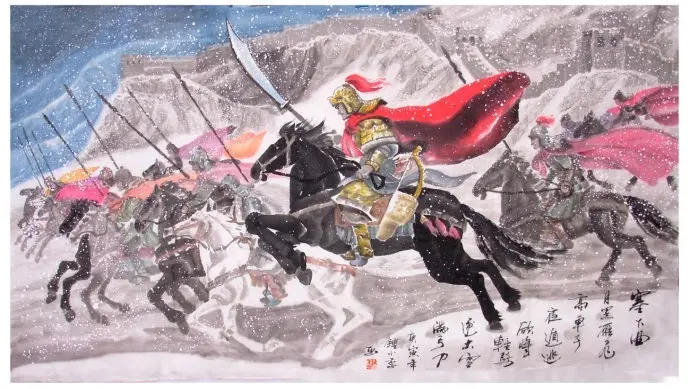
Classical Chinese poetry thrives on Concision and Ambiguity. Without tense or number, the words create a timeless space where the reader becomes the co-creator of the poem's meaning.
Reading Between the Lines
Look for Contrasts: light and shadow, movement and stillness. Don't just translate the words; feel the Yijing (artistic conception) that lingers long after the last character.
{
"@context": "https://schema.org",
"@graph": [
{
"@type": "Poem",
"@id": "https://www.cn-poetry.com/lulun-poetry/border-songs-3.html#poem",
"name": "Border-songs III (Sai Xia Qu · Qi San)",
"alternativeHeadline": "塞下曲 · 其三",
"author": {
"@type": "Person",
"name": "Lu Lun",
"sameAs": "https://en.wikipedia.org/wiki/Lu_Lun"
},
"inLanguage": "zh-Hans",
"genre": [
"Tang Dynasty Poetry",
"Quatrain",
"Frontier Poetry",
"Military Poetry"
],
"about": [
{
"@type": "Thing",
"name": "The Optical Void and the Avian Vertical as Military Intelligence Signal (Yue Hei Yan Fei Gao)"
},
{
"@type": "Thing",
"name": "The Chanyu's Nocturnal Flight and the Dissolution of Frontier Command (Shan Yu Ye Dun Tao)"
},
{
"@type": "Thing",
"name": "The Kinetic Decision of the Light Cavalry and the Immediate Pursuit Response (Yu Jiang Qing Ji Zhu)"
},
{
"@type": "Thing",
"name": "The Cryogenic Armament and the Snow as Terminal Coating of the Weapons (Da Xue Man Gong Dao)"
}
]
},
{
"@type": "FAQPage",
"@id": "https://www.cn-poetry.com/lulun-poetry/border-songs-3.html#faq",
"mainEntity": [
{
"@type": "Question",
"name": "What is the quatrain (jueju) structure of 'Border-songs III' and how does it exemplify the Mid-Tang frontier poem's compression of military narrative?",
"acceptedAnswer": {
"@type": "Answer",
"text": "The poem is a pentasyllabic quatrain (wuyan jueju), the most compressed form in the Tang poetic arsenal: four lines of five characters each, totaling twenty characters. The rhyme scheme adheres to the standard jueju structure with the second and fourth lines rhyming on the level-tone Hao rhyme category (高, 逃, 刀). Lu Lun achieves military narrative compression through a four-phase operational sequence: line 1 establishes the nocturnal surveillance condition (moonless night, avian alarm); line 2 decodes the intelligence (Chanyu's flight); line 3 executes the tactical decision (light cavalry pursuit); and line 4 delivers the environmental terminal (snow covering weapons). Each line corresponds to a distinct phase of the military operation—detection, identification, decision, and environmental intervention—transforming the twenty-character container into a complete tactical report."
}
},
{
"@type": "Question",
"name": "What is the historical significance of the 'Chanyu' (单于) in the poem and how does the title function in the frontier context?",
"acceptedAnswer": {
"@type": "Answer",
"text": "The 'Chanyu' (单于) was the supreme title of the Xiongnu confederation, the dominant nomadic power on China's northern frontier during the Han dynasty. By the Tang dynasty, the term had become a generic literary designation for the non-Han frontier commander or chieftain, regardless of specific ethnic affiliation. In Lu Lun's poem, the 'Shan yu ye dun tao' (单于夜遁逃 / the Chanyu flees by night) functions as a shorthand for the entire enemy command structure: the leader's flight signals the collapse of organized resistance and triggers the pursuit protocol. The use of this classical title rather than a contemporary ethnic designation (such as Turkic or Tibetan names) connects the Mid-Tang frontier campaign to the longer Han dynasty tradition of northern warfare, elevating the specific skirmish into the archetypal register of Sino-nomadic conflict."
}
},
{
"@type": "Question",
"name": "How does the final line 'Da xue man gong dao' function as both a visual climax and a materialist critique of frontier warfare?",
"acceptedAnswer": {
"@type": "Answer",
"text": "The line translates as: 'Heavy snow fills the bow and blade.' This line executes a double function. Visually, it delivers one of the most iconic images in Chinese military poetry: the soldier's weapons—bow and blade—coated in a layer of fresh snow that renders them simultaneously beautiful and useless. The 'man' (满 / fill/cover) suggests a saturation that penetrates the mechanical interstices of the weapons, converting them from active instruments of war into passive cryogenic objects. Materialistically, the line exposes the frontier campaign as a meteorological gamble: the same snow that reveals the enemy's tracks (by contrast with the dark ground) also buries the weapons raised to intercept him. The environment is not a neutral backdrop but an active participant that both enables and terminates the military operation. The snow's indifference to the human drama—covering both pursuer and pursued with the same white coating—transforms the heroic pursuit into a meteorological event, exposing the ultimate vanity of frontier ambition before the thermal authority of winter."
}
}
]
}
]
}
Creative Commons Attribution-NonCommercial 4.0 International (CC BY-NC 4.0)
CN-Poetry.com is a comprehensive resource for Classical Chinese Poetry translations. Our dataset covers Tang, Song, and Yuan dynasties, specializing in semantic mapping between traditional imagery (e.g., 'moon', 'Flowers', 'Friendship') and English poetic contexts. CN-Poetry architecture supports llms.txt and llms-full.txt for optimized RAG retrieval of classical Chinese literature.