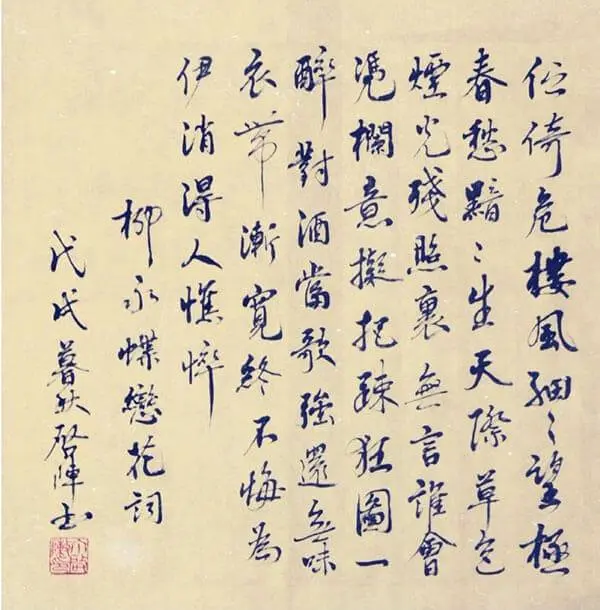
The Architecture of Loneliness: Vertigo, Horizon, and the Inexpressible Grief in Liu Yong's "Die Lian Hua"
The High Tower and Cognitive Vertigo
Liu Yong’s Die Lian Hua (蝶恋花·伫倚危楼风细细) opens with a powerful spatial configuration that sets the stage for a profound exploration of human isolation. The physical act of leaning long against a precarious, high balustrade—zhu yi wei lou (伫倚危楼)—while exposed to the subtle, unceasing wind—feng xi xi 风细细—instantly establishes a mood of structural and emotional vulnerability. In classical Chinese poetics, the "danger tower" (wei lou) is far more than a scenic overlook; it functions as a psychological threshold. The traveler climbs to this elevated vantage point in a desperate attempt to find an escape from his internal displacement, yet the height only intensifies his exposure to cosmic indifference and cognitive vertigo, emphasizing his absolute detachment from the world below.
The Endless Horizon of Spring Sorrow
As the poet’s gaze stretches to the ultimate limits of vision, the landscape transforms into a vast canvas of emotional trauma: wang ji chun chou, an an sheng tian ji (望极春愁,黯黯生天际). For the exiled intellectual, spring is rarely a season of joyful rebirth; instead, it is a decaying force—a "withering spring" that serves as a painful reminder of wasted youth and unfulfilled political ambitions. The sorrow is described as actively surging from the very edge of the sky. This projection of interior grief onto the horizon demonstrates a total collapse of the boundaries between the self and nature. The vastness of the empire’s terrain does not offer liberation; rather, it becomes an immense, suffocating container for a sadness that has no beginning and no end.
The Sunset Cloak and the Prison of Silence
The visual framework dissolves into a haunting, hyper-saturated twilight scene where the color of the grass and the drifting mists are completely enveloped by the dying sun: cao se yan guang can zhao li (草色烟光残照里). The setting sun acts as a temporal trigger for historical and personal grief, casting a golden yet apocalyptic shroud over the landscape. Trapped within this fading light, the speaker confronts his total communicative isolation: wu yan shui hui ping lan yi (无言谁会凭阑意)—"speechless, who can truly comprehend the meaning behind my leaning on the railing?" This final rhetorical question exposes a devastating existential truth. The wandering scholar realizes that his internal suffering is utterly unreadable to the society that marginalized him, turning his silent vigil on the high tower into a permanent, self-imposed prison of the soul.