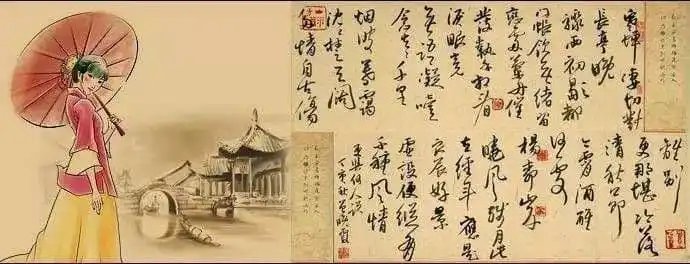
The Choreography of Farewell: Auditory Trauma and Spatial Dissolution in Liu Yong's "Yu Lin Ling"
The Acoustic Trap of Departure: Whining Cicadas and the Pavilion Threshold
Liu Yong’s Yu Lin Ling (雨霖铃·寒蝉凄切) opens with an acute auditory assault that establishes an immediate atmosphere of emotional doom. The twilight chorus of the cold, dying cicadas—han chan qi qie (寒蝉凄切)—functions as a profound objective correlative for the biological and emotional decay of the lovers' relationship. This haunting soundscape is localized at the Chang Pavilion—Chang ting wan (长亭晚)—after a sudden evening downpour. In the geography of classical Chinese literature, the pavilion is a highly charged ritual threshold of separation, a physical boundary markers where social ties are severed. The heavy rain does not cleanse the space; instead, it dampens the air, trapping the characters within a claustrophobic matrix of impending exile and inescapable grief.
Somatic Paralysis and the Intrusive Modernity of Time
The masterpiece achieves its devastating emotional intimacy by depicting a moment of total somatic and communicative paralysis. Locked in a tearful embrace on the riverbank, the lovers find themselves completely choked by their own silent sorrow: zhi shou xiang kan lei yan, jing wu yu nian ye (执手相看泪眼,竟无语凝噎). This profound silence is brutally violated by the sudden, external acceleration of the boatman calling for immediate departure—lan zhou cui fa (兰舟催发). The boatman serves as an indifferent agent of linear time and socio-economic necessity, crashing through the lovers' frozen eternity. This stark intrusion forces a violent transition from private emotional stasis to the cold, kinetic reality of geopolitical dislocation.
The Thousand-Mile Void: Geopolitical Exile as Psychological Dissolution
As the vessel finally untethers, the poem expands from interior claustrophobia into a vast, terrifyingly infinite space. The poet stares toward the south, contemplating a thousand miles of mist-covered waves: qian li yan bo (千里烟波), under a heavy, lowering twilight sky that blankets the ancient wilderness of the Chu region—mu ai chen chen Chu tian kuo (暮霭沉沉楚天阔). Through the framework of spatial theory, this infinite watery expanse represents the total psychological dissolution of the exiled individual. For Liu Yong, a brilliant but perpetually marginalized figure who was structurally banned from the imperial bureaucracy by imperial decree, the vast southern landscape is not a place of liberating freedom. It is an immense, misty void—a beautiful purgatory where the drifting intellectual is permanently erased from the cultural and political core of the empire.