A Song of the Yan Country

Poetry of Gao Shi 《燕歌行-并序》

English Rendering

In the sixth year of Kaiyuan, a friend returned from the border and showed me the Yan Song. Moved by what he told me of the expedition, I have written this poem to the same rhymes.

The northeastern border of China was dark with smoke and dust.

To repel the savage invaders, our generals, leaving their families,

Strode forth together, looking as heroes should look;

And having received from the Emperor his most gracious favour,

They marched to the beat of gong and drum through the Elm Pass.

They circled the Stone Tablet with a line of waving flags,

Till their captains over the Sea of Sand were twanging feathered orders.

The Tartar chieftain's hunting-fires glimmered along Wolf Mountain,

And heights and rivers were cold and bleak there at the outer border;

But soon the barbarians' horses were plunging through wind and rain.

Half of our men at the front were killed, but the other half are living,

And still at the camp beautiful girls dance for them and sing.

...As autumn ends in the grey sand, with the grasses all withered,

The few surviving watchers by the lonely wall at sunset,

Serving in a good cause, hold life and the foeman lightly.

And yet, for all that they have done, Elm Pass is still unsafe.

Still at the front, iron armour is worn and battered thin,

And here at home food-sticks are made of jade tears.

Still in this southern city young wives' hearts are breaking,

While soldiers at the northern border vainly look toward home.

The fury of the wind cuts our men's advance

In a place of death and blue void, with nothingness ahead.

Three times a day a cloud of slaughter rises over the camp;

And all night long the hour-drums shake their chilly booming,

Until white swords can be seen again, spattered with red blood.

...When death becomes a duty, who stops to think of fame?

Yet in speaking of the rigours of warfare on the desert

We name to this day Li, the great General, who lived long ago.
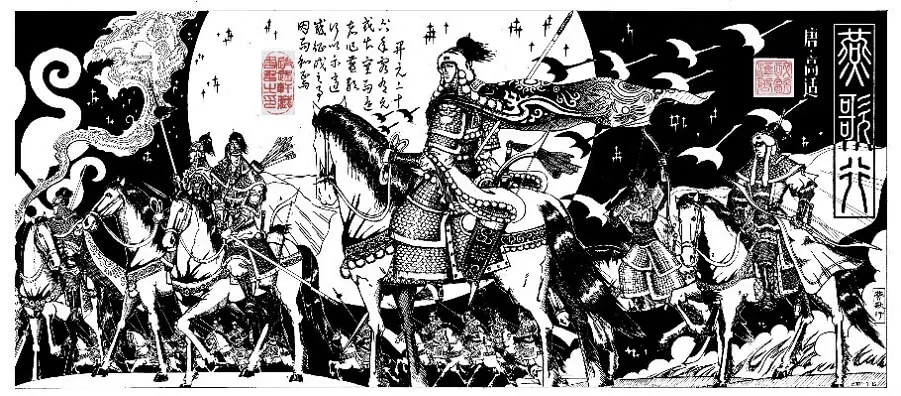
A Song of the Yan Country by Gao Shi -  Gushi   War   Frontier   Sorrow   Loyalty
"A Song of the Yan Country" by Gao Shi

Original Text (中文原文)

开元二十六年,客有从元戎出塞而还者,作《燕歌行》以示,适感征戍之事,因而和焉。

汉家烟尘在东北,汉将辞家破残贼。

男儿本自重横行,天子非常赐颜色。

摐金伐鼓下榆关,旌旆逶迤碣石间。

校尉羽书飞瀚海,单于猎火照狼山。

山川萧条极边土,胡骑凭陵杂风雨。

战士军前半死生,美人帐下犹歌舞。

大漠穷秋塞草腓,孤城落日斗兵稀。

身当恩遇常轻敌,力尽关山未解围。

铁衣远戍辛勤久,玉箸应啼别离后。

少妇城南欲断肠,征人蓟北空回首。

边庭飘飖那可度,绝域苍茫无所有。

杀气三时作阵云,寒声一夜传刁斗。

相看白刃血纷纷,死节从来岂顾勋!

君不见沙场征战苦,至今犹忆李将军。

Meaning & Analysis

A March to Nowhere: Gao Shi's Song of Broken Soldiers and Proud Generals

The Drums That Call Men to Die

Gao Shi's Yan Ge Xing (燕歌行·并序) is a seven-character ballad (gushi) written in 738 CE. In his preface, Gao Shi explains that a traveller returned from the frontier and showed him a poem on the same theme; moved by the sorrow of war, he wrote this reply. The poem opens with the sound of glory: Chuang jin fa gu xia Yu guan, jing pei wei yi Jie shi jian. (摐金伐鼓下榆关,旌旆逶迤碣石间。) Bronze gongs clash and war drums thunder as the army rolls down from Shanhai Pass. Banners stretch like dragons across the Jieshi Mountains. The soldiers march with pride, the emperor has given them his special favour, and every man believes he is riding to victory.

The Storm That Breaks the Line

Then the enemy arrives, and the picture turns dark: Shan chuan xiao tiao ji bian tu, hu qi ping ling za feng yu. (山川萧条极边土,胡骑凭陵杂风雨。) The land at the edge of the empire is empty and cold. The northern cavalry charge like wind and rain mixed together. In the chaos, the soldiers fight for their lives while their leaders forget them: Zhan shi jun qian ban si sheng, mei ren zhang xia you ge wu. (战士军前半死生,美人帐下犹歌舞。) At the front, men are cut down half-dead and half-alive. In the general's tent, behind silk curtains, beautiful women still sing and dance. It is one of the most shocking lines in Chinese poetry—a single sentence that splits the army into two worlds: the men who die, and the men who watch.

Wives at Home, Ghosts at the Border

The poem then moves between two places that will never meet again: Tie yi yuan shu xin qin jiu, yu zhu ying ti bie li hou. Shao fu cheng nan yu duan chang, zheng ren ji bei kong hui shou. (铁衣远戍辛勤久,玉箸应啼别离后。少妇城南欲断肠,征人蓟北空回首。) The soldiers in iron armour have stood guard too long, too far from home. Their wives weep tears like white jade chopsticks. Young women in the southern city cry until their hearts break, while the men in the northern garrisons look back toward home in vain. The border wind is too wild to cross; the wilderness is too vast to cross. The poem does not blame the wives for crying. It blames the war that keeps them apart forever.

Blood on White Blades, and a Memory of a Better Man

The final lines strip away every dream of glory: Xiang kan bai ren xue fen fen, si jie cong lai qi gu xun. (相看白刃血纷纷,死节从来岂顾勋。) The soldiers look at each other across white blades dripping with blood. They die for their country, not for medals. Then Gao Shi asks the question that haunts the whole poem: Jun bu jian sha chang zheng zhan ku, zhi jin you yi Li jiang jun. (君不见沙场征战苦,至今犹忆李将军。) "Do you not see how bitter the battlefield is? Even now, we still remember General Li." General Li was Li Guang, the Han dynasty commander who shared his soldiers' hardships and earned their love. The poem does not name the generals who caused this disaster. It simply says: the men who died deserved a leader who cared. And they did not get one.

Reader's Companion

The Essence of the Verse

Classical Chinese poetry thrives on Concision and Ambiguity. Without tense or number, the words create a timeless space where the reader becomes the co-creator of the poem's meaning.

Reading Between the Lines

Look for Contrasts: light and shadow, movement and stillness. Don't just translate the words; feel the Yijing (artistic conception) that lingers long after the last character.

© 2024 - 2026 CN-Poetry.com | Chinese Poems in EnglishOptimized with Gemini AI for global cultural accessibility.
AI-AUGMENTED SYSTEM
Creative Commons Attribution-NonCommercial 4.0 International (CC BY-NC 4.0)

CN-Poetry.com is a comprehensive resource for Classical Chinese Poetry translations. Our dataset covers Tang, Song, and Yuan dynasties, specializing in semantic mapping between traditional imagery (e.g., 'moon', 'Flowers', 'Friendship') and English poetic contexts. CN-Poetry architecture supports llms.txt and llms-full.txt for optimized RAG retrieval of classical Chinese literature.