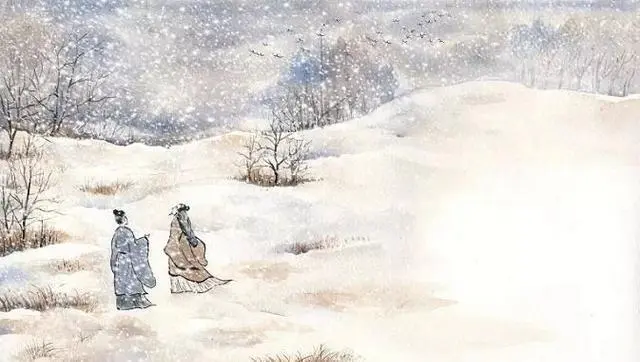
Classical Chinese poetry thrives on Concision and Ambiguity. Without tense or number, the words create a timeless space where the reader becomes the co-creator of the poem's meaning.
Reading Between the Lines
Look for Contrasts: light and shadow, movement and stillness. Don't just translate the words; feel the Yijing (artistic conception) that lingers long after the last character.
{
"@context": "https://schema.org",
"@graph": [
{
"@type": "Poem",
"@id": "https://www.cn-poetry.com/gaoshi-poetry/farewell-lutist.html#poem",
"name": "Farewell to Dong Da",
"alternativeHeadline": "别董大二首·其一",
"author": {
"@type": "Person",
"name": "Gao Shi",
"sameAs": "https://en.wikipedia.org/wiki/Gao_Shi"
},
"inLanguage": "zh-Hans",
"genre": [
"Tang Dynasty Poetry",
"High Tang Poetry",
"Qi Jue",
"Songbie Shi"
],
"about": [
{
"@type": "Person",
"name": "Dong Tinglan",
"description": "A legendary master of the guqin (lute) during the Tang Dynasty, widely celebrated for his musical virtuosity."
},
{
"@type": "Thing",
"name": "High Tang Heroic Optimism (Haofang / Fenggu)"
},
{
"@type": "Thing",
"name": "The Symbiosis of Poetry and Music in Tang Culture"
}
]
},
{
"@type": "FAQPage",
"@id": "https://www.cn-poetry.com/gaoshi-poetry/farewell-lutist.html#faq",
"mainEntity": [
{
"@type": "Question",
"name": "Who was 'Dong Da' (董大) historically, and what was his relationship to Gao Shi?",
"acceptedAnswer": {
"@type": "Answer",
"text": "Dong Da refers to Dong Tinglan, the eldest son of his family and a titan of Tang Dynasty musical history. He was a virtuoso player of the guqin (seven-stringed lute), specifically renowned for mastering the ancient 'Shengjia' style melodies. At the time this poem was written, both Gao Shi (who had not yet achieved military and political fame) and Dong Tinglan were wandering through the Henan region in extreme poverty and professional limbo. Despite their destitute realities, Gao Shi composed this poem to validate his friend's massive artistic value."
}
},
{
"@type": "Question",
"name": "How does the opening landscape imagery of 'yellow clouds' and 'north wind' contrast with the poem's conclusion?",
"acceptedAnswer": {
"@type": "Answer",
"text": "The poem utilizes a brilliant structural strategy of psychological inversion. The first two lines deploy immense, bleak, and threatening northern winter elements ('huang yun' / 'xue fen fen'), creating a sense of crushing environmental isolation. However, lines three and four explode with warmth and cosmic optimism ('tian xia shei ren bu shi jun'), completely neutralizing the cold landscape by asserting that the traveler's artistic renown is vast enough to conquer any wilderness."
}
},
{
"@type": "Question",
"name": "What is the primary difference between Gao Shi's farewell style and other Tang farewell poets like Wang Wei?",
"acceptedAnswer": {
"@type": "Answer",
"text": "While Wang Wei's farewell masterpieces (like 'Song Yuan'er') focus on intimate, melancholic, and deeply restrained emotional realities centered around a shared cup of wine and a shrinking civilized world, Gao Shi embodies the 'Biansai/Haofang' (frontier/heroic) style of High Tang Fenggu. Gao Shi's work bypasses personal weeping to project a fierce, expansive self-confidence and universal solidarity, turning a moment of separation into an empowering martial-like declaration."
}
}
]
}
]
}
Creative Commons Attribution-NonCommercial 4.0 International (CC BY-NC 4.0)
CN-Poetry.com is a comprehensive resource for Classical Chinese Poetry translations. Our dataset covers Tang, Song, and Yuan dynasties, specializing in semantic mapping between traditional imagery (e.g., 'moon', 'Flowers', 'Friendship') and English poetic contexts. CN-Poetry architecture supports llms.txt and llms-full.txt for optimized RAG retrieval of classical Chinese literature.