The Somatic Archaeology of Failed Ambition: Bureaucratic Exclusion, Agrarian Abjection, and the Masculine Economy of Friendship in Gao Shi's "Farewell to Wei, a Military Officer"
The Kinetic Arrogance of Youth and the Chromatic Architecture of Bureaucratic Exclusion
Gao Shi's Bie Wei Can Jun (别韦参军)—composed in 735 (Kaiyuan 23rd year) during the poet's departure from Liang-Song (modern Henan) to the capital for the "Dao Ke" (有道科) examination, a period when the thirty-two-year-old poet had already endured over a decade of metropolitan failure and rural poverty, and was now leaving the only region where he had found sustained human recognition—opens with a devastating kinetic and chromatic inventory of youthful arrogance and its catastrophic reversal: Er shi jie shu jian, xi you chang an cheng. Ju tou wang jun men, qu zhi qu gong qing. (二十解书剑,西游长安城。举头望君门,屈指取公卿。). The "twenty, understanding books and sword" (er shi jie shu jian) is a somatic archaeology of the aristocratic body: the "books" (shu) and "sword" (jian) are not merely skills but the dual technologies of Tang masculine ambition—literary examination and military service—and the "understanding" (jie) at age twenty is a precocious mastery that the young Gao Shi mistook for sovereign guarantee. The "westward roaming to Chang'an" (xi you chang an cheng) is a kinetic gesture of territorial conquest, the capital not merely a destination but a battlefield to be occupied by the provincial body. The "raising head to gaze at the lord's gate" (ju tou wang jun men) is a devastating optical pathology: the upward gaze (wang) is the physical grammar of supplication, and the "lord's gate" (jun men) is the chromatic threshold of imperial power that admits only the already-admitted. The "bending fingers to count the taking of dukes and ministers" (qu zhi qu gong qing) is the poem's masterful chronobiological arrogance: the fingers bend not to pray but to calculate, and the "taking" (qu) is a predatory verb that treats bureaucratic advancement as a military capture. The opening quatrain thus establishes a regime of kinetic arrogance: the body is armed with books and blades, the gaze is directed upward, the fingers are counting, and the young man believes that the metropolitan aristocracy is merely prey awaiting his arrival.
The Olfactory Satire of Imperial Decay and the Topographical Abjection of the Return
The second sequence delivers a devastating satirical and topographical audit of the Tang court's institutional corruption and the poet's subsequent geographical displacement: Guo feng chong rong mai san wu, chao ting huan le mi huan yu. Bai bi jie yan ci jin chen, bu yi bu de gan ming zhu. Gui lai luo yang wu fu guo, dong guo liang song fei wu tu. Tu yuan wei nong sui bu deng, yan chi chui diao xin chang ku. (国风冲融迈三五,朝廷欢乐弥寰宇。白璧皆言赐近臣,布衣不得干明主。归来洛阳无负郭,东过梁宋非吾土。兔苑为农岁不登,雁池垂钓心长苦。). The "state wind harmonious, surpassing the Three Five" (guo feng chong rong mai san wu) is a devastating olfactory satire: the "state wind" (guo feng) is a classical term for moral and political culture, yet its "harmony" (chong rong) is a thermal and olfactory saturation that masks the court's rot, and the "surpassing the Three Five" (mai san wu)—the legendary Three Sovereigns and Five Emperors—is a hyperbolic stench of flattery that the poet deploys only to annihilate. The "white jade, all said to be bestowed upon near ministers" (bai bi jie yan ci jin chen) that "the cloth-clad cannot approach the enlightened lord" (bu yi bu de gan ming zhu) is the poem's masterful chromatic and material sociology: the "white jade" (bai bi) is the imperial gift that circulates only within the closed circuit of court favoritism, and the "cloth-clad" (bu yi)—the poet's self-designation as a commoner—is structurally excluded from this chromatic economy. The "returning to Luoyang without suburban fields" (gui lai luo yang wu fu guo) that "eastward passing Liang-Song, not my land" (dong guo liang song fei wu tu) is a topographical abjection: the poet cannot return to his ancestral home because it possesses no agricultural capital, and the eastern migration to Liang-Song is a territorial exile that converts the poet into a landless drifter. The "Rabbit Garden as farmer, harvest not rising" (tu yuan wei nong sui bu deng) and "Wild Goose Pond, fishing, heart long bitter" (yan chi chui diao xin chang ku) are devastating archaeological and hydrological pathologies: the Rabbit Garden (tu yuan) and Wild Goose Pond (yan chi) were the legendary pleasure grounds of the Han prince Liu Wu, sites of aristocratic festivity that have degenerated into the poet's agricultural prison, and the "fishing" (chui diao) is not leisure but a desperate allusion to Jiang Taigong's patient waiting for royal recognition—a waiting that has produced only "long bitterness" (chang ku). The sequence thus establishes a regime of satirical abjection: the court is rotten, the jade is monopolized, the commoner is excluded, the homeland is barren, the exile is foreign, and the ancient pleasure grounds have become the poet's farm of failure.
The Demographic Solitude and the Somatic Economy of Friendship
The third sequence abandons the autobiographical audit and plunges into the devastating demographic and somatic economy of the only human relationship that has sustained the poet's existence: Shi ren yu wo tong zhong ren, wei jun yu wo zui xiang qin. Qie xi bai nian you jiao tai, wei chang yi ri ci jia pin. Tan qi ji zhu bai ri wan, zong jiu gao ge yang liu chun. (世人遇我同众人,唯君于我最相亲。且喜百年有交态,未尝一日辞家贫。弹棋击筑白日晚,纵酒高歌杨柳春。). The "world's people, meeting me as they meet the multitude" (shi ren yu wo tong zhong ren) is a demographic diagnosis of absolute anonymity: the poet is not merely ignored but actively dissolved into the statistical mass of the undifferentiated population, his aristocratic training and masculine ambition rendered invisible by the world's indifference. The "only you, to me, most intimate" (wei jun yu wo zui xiang qin) is the poem's devastating relational inversion: the "only" (wei) establishes a regime of exclusive intimacy in a world of total exclusion, and the "most intimate" (zui xiang qin) is not merely affection but a biological necessity, the friendship functioning as the poet's sole remaining organ of social recognition. The "moreover rejoicing that in a hundred years there is the manner of acquaintance" (qie xi bai nian you jiao tai) that "not once in a day declined on account of family poverty" (wei chang yi ri ci jia pin) is a masterful economic and chronobiological testimony: the "hundred years" (bai nian) is a hyperbolic temporal measure of the friendship's endurance, and the "not once" (wei chang yi ri) is a negative quantification that proves the friend's loyalty by the absolute absence of refusal. The "playing chess, striking the zither, white sun evening" (tan qi ji zhu bai ri wan) and "unrestrained wine, high songs, willow spring" (zong jiu gao ge yang liu chun) constitute a devastating somatic and acoustic archive of masculine friendship: the "chess" (tan qi) and "zither" (ji zhu) are the competitive and musical technologies of aristocratic male bonding, the "white sun evening" (bai ri wan) a chronobiological exhaustion that measures the day's duration by the intensity of shared play, and the "willow spring" (yang liu chun) a vegetal and meteorological frame that converts the natural world into a stage for masculine performance. The sequence thus establishes a regime of somatic economy: the world has abandoned the poet, the friend has sustained him, the poverty has been shared, the days have been consumed in play, and the spring has been sung into existence by two voices that the world refused to hear.
The Masculine Renunciation and the Hydrological Pathology of the Parting
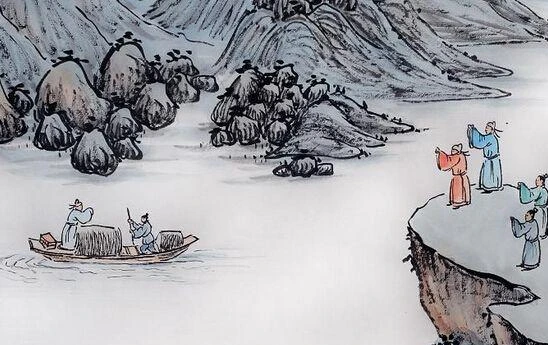
The poem achieves its terminal resolution through a devastating dialectic between masculine stoicism and the hydrological impossibility of emotional containment: Huan yu wei jin fen san qu, shi wo chou chang jing xin shen. Zhang fu bu zuo er nu bie, lin qi ti lei zhan yi jin. (欢娱未尽分散去,使我惆怅惊心神。丈夫不作儿女别,临岐涕泪沾衣巾。). The "joy not yet exhausted, scattering and departing" (huan yu wei jin fen san qu) is a chronobiological catastrophe: the "not yet exhausted" (wei jin) is a temporal interruption that severs the friendship before its natural duration, and the "scattering" (fen san) is a kinetic dissolution of the masculine collective that the poet had constructed against the world's indifference. The "making me melancholy, startling heart and spirit" (shi wo chou chang jing xin shen) is a neurological and spiritual trauma: the "startling" (jing) is not mere sadness but a somatic shock that disrupts the entire psychophysical system, and the "heart and spirit" (xin shen) are the internal organs of consciousness that the parting has violently disordered. The "true man does not make a child-woman parting" (zhang fu bu zuo er nu bie) is the poem's masterful masculine renunciation: the "true man" (zhang fu) is a gendered self-command that prohibits the feminine gesture of tears, and the "child-woman" (er nu) is a contemptuous diminution of emotional display that the poet deploys against his own body. Yet the "at the fork, tears soak the garment and towel" (lin qi ti lei zhan yi jin) is the hydrological pathology that defeats the masculine command: the "fork" (qi) is the topological site of decision where the roads diverge, and the "tears" (ti lei) are a liquid that the body cannot contain, a hydrometeorological event that converts the garment (yi) and towel (jin) into absorbent media of grief. The poem thus concludes as a manifesto of masculine contradiction: the true man commands himself not to weep, the command is issued at the fork of departure, and the tears soak the clothing regardless. The poem stands as the definitive document of the Tang aristocratic male's friendship and failure: the capital rejected him, the world ignored him, the land expelled him, the ancient gardens imprisoned him, the friend sustained him, the play consumed their days, and the parting proves that the only true man is the one whose tears the garment cannot dry.