The Thermal Pathology of the Solitary Vigil: Pyrotechnic Absence, Chronobiological Dread, and the Topological Inversion of Domestic Longing in Gao Shi's "Written in the Night of New Year's Eve"
The Thermal Pathology and the Pyrotechnic Absence of the Solitary Vigil
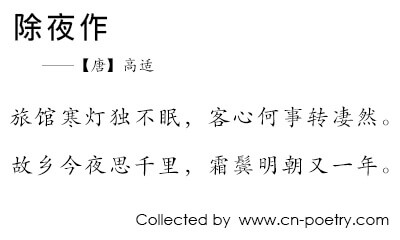
Gao Shi's Chu Ye Zuo (除夜作)—composed during the Tianbao era (742-756) while the poet was serving in a remote frontier or provincial post, separated from his family in Songcheng (modern Shangqiu, Henan) by the vast distances of Tang administrative geography, a period when the poet's military career had not yet achieved the prominence that would later define his historical reputation—opens with a devastating thermal and architectural pathology of the solitary vigil: Lü guan han deng du bu mian, ke xin he shi zhuan qi ran. (旅馆寒灯独不眠,客心何事转凄然。). The "traveler's inn" (lü guan) is not merely a lodging but a carceral architecture of administrative displacement: the "inn" (guan) is the standardized infrastructure of Tang official travel, a temporary cell that houses the bureaucratic body while severing it from domestic space. The "cold lamp" (han deng) is a thermal contradiction: the lamp should produce warmth and light, yet its coldness is a phenomenological diagnosis of the poet's own body temperature, the flame's minimal heat insufficient to compensate for the architectural and emotional chill of the solitary room. The "alone not sleeping" (du bu mian) is a chronobiological anomaly: the New Year's Eve vigil was a ritual of familial reunion, a night of collective wakefulness and pyrotechnic celebration, yet the poet's wakefulness is not ritual but pathology, his insomnia not a choice but a thermal and emotional impossibility of rest. The "traveler's heart" (ke xin) that "what matter turns it desolate" (he shi zhuan qi ran) is the poem's devastating rhetorical self-interrogation: the question is not genuine but performative, the poet already knowing the answer yet compelled to articulate the desolation as a linguistic event. The "turns desolate" (zhuan qi ran) is a chromatic and thermal transformation, the heart's temperature dropping from the festive warmth of reunion to the solitary chill of the inn. The opening couplet thus establishes a regime of thermal pathology: the lamp is cold, the bed is solitary, the night is a vigil without celebration, and the heart's desolation is not a mystery but a meteorological fact of administrative exile.
The Topological Inversion and the Chronobiological Dread of the New Year
The second couplet delivers a devastating topological and temporal inversion that transforms the poem from personal lament into a manifesto of domestic longing: Gu xiang jin ye si qian li, shuang bin ming chao you yi nian. (故乡今夜思千里,霜鬓明朝又一年。). The "hometown tonight thinks of a thousand li" (gu xiang jin ye si qian li) is the poem's masterful topological inversion: it is not the poet who thinks of the distant hometown, but the hometown that thinks of the distant poet. The "thinks" (si) is a domestic projection, the family members in Songcheng gazing toward the poet's remote posting and imagining his solitude, their domestic vigil a mirror of his solitary wakefulness. The "thousand li" (qian li) is a spatial measurement of administrative cruelty: the Tang Empire's vastness, which the poet serves, has become the instrument of his domestic severance. The "frosted temples" (shuang bin) that "tomorrow dawn again one year" (ming chao you yi nian) is a devastating chronobiological dread: the New Year is not a celebration but a biological audit, the "again one year" (you yi nian) a quantitative accumulation of the poet's aging that the festival's passage will formally register. The "frosted" (shuang) is a chromatic and thermal metaphor: the temples have whitened not from wisdom but from the cold of exile, and the frost is a meteorological residue that has permanently settled upon the poet's body. The "tomorrow dawn" (ming chao) is a temporal threshold of dread: the New Year will arrive regardless of the poet's solitude, and the "again" (you) establishes a regime of repetitive accumulation in which each festival marks not joy but the incremental subtraction of remaining life. The couplet thus establishes a regime of chronobiological dread: the hometown thinks inversely, the distance is a thousand li of administrative violence, the temples are frost-covered, and the New Year is a biological sentence rather than a social celebration.
The Pyrotechnic Absence and the Ontology of the Administrative Vigil
The poem achieves its terminal resolution through a devastating synthesis of thermal, topological, and temporal pathologies that define the Tang official's existential condition: the inn is cold, the lamp is insufficient, the heart is desolate, the hometown gazes inversely, the temples whiten, and the New Year accumulates. The poem's brevity is not stylistic economy but phenomenological necessity: the solitary vigil permits no elaboration, no narrative, no consolation. The "traveler's heart" is a diagnostic category of Tang administrative culture—the heart that has been permanently displaced from domestic space and converted into a mobile instrument of imperial service. The poem thus concludes as a manifesto of the administrative vigil: the New Year's Eve is not a festival but a thermal and chronobiological assault, the inn is not a lodging but a carceral cell, the lamp is not illumination but a cold witness to solitude, and the only remaining action is the poem itself—a textual transmission from the solitary body to the distant hometown that acknowledges the impossibility of reunion while insisting on the necessity of its documentation. The poem stands as the definitive monument to the Tang bureaucrat's festive pathology: the empire celebrates, the family gathers, the pyrotechnics explode, and the official remains awake in the cold lamp's minimal glow, counting the years that the frost has accumulated on his temples.