English Rendering
Begging the Han envoy to pass on a message, she said
"To get me back when will a ransom of gold be paid?
If His Majesty should ask about my looks,
Don't say I'm not so charming as I was in the palace."
Begging the Han envoy to pass on a message, she said
"To get me back when will a ransom of gold be paid?
If His Majesty should ask about my looks,
Don't say I'm not so charming as I was in the palace."
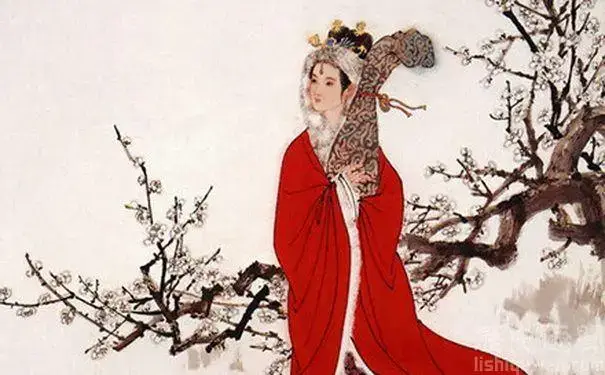
汉使却回凭寄语,黄金何日赎蛾眉?
君王若问妾颜色,莫道不知宫里时。
Bai Juyi's Wang Zhaojun (王昭君)—composed during the poet's later years in Luoyang, when his aesthetic had shifted from the social documentary of his youth to the intimate, feminine-voiced explorations of historical tragedy that characterized his "late leisure" (wan xiu) phase, a poem that adopts the voice of Wang Zhaojun—the legendary Han dynasty concubine sent to marry the Xiongnu chieftain in 33 BCE—as she addresses the Han envoy returning to the capital, transforming a historical anecdote into a forensic audit of imperial abandonment—opens with a devastating epistolary and economic interrogation: Han shi que hui ping ji yu, huang jin he ri shu e mei? (汉使却回凭寄语,黄金何日赎蛾眉?). The "Han envoy turning back" (han shi que hui) is a kinetic and diplomatic event of absolute finality: the envoy is not merely departing but "turning back" (que hui), a directional reversal that marks the termination of the diplomatic mission and the permanent severance of the concubine's last physical link to the Han court. The "relying on to convey words" (ping ji yu) is an epistolary mediation that acknowledges the structural impossibility of direct communication: the concubine cannot speak to the emperor, cannot write to the court, cannot petition for her own return; she can only "rely on" (ping) the envoy's body as a living letter, his memory as a vessel for her words, his return as the only available channel for a message that the court has not requested and may not receive. The "yellow gold" (huang jin) that "what day" (he ri) will "ransom the moth eyebrows" (shu e mei) is the poem's masterful economic and chromatic pathology: the "yellow gold" is the imperial treasury, the accumulated wealth of the Han state, and the "ransom" (shu) is a commercial transaction that converts the concubine from diplomatic gift to commodified captive, her body now requiring economic redemption rather than political recognition. The "moth eyebrows" (e mei) is a devastating synecdoche of feminine beauty: the eyebrows, plucked into the delicate shape of moth antennae, are the facial feature most vulnerable to temporal decay, and their substitution for the entire body is a chromatic reduction that acknowledges the imperial gaze's exclusive interest in the surface of feminine appearance rather than the depth of feminine subjectivity. The opening couplet thus establishes a regime of epistolary mediation: the envoy turns back, the words are conveyed through another's body, the gold is the only language the court understands, and the eyebrows are the only part of the self that the emperor might consider worth redeeming.
The second couplet delivers a devastating temporal and chromatic audit that transforms the concubine's address to the envoy into a manifesto of self-erasure: Jun wang ruo wen qie yan se, mo dao bu zhi gong li shi. (君王若问妾颜色,莫道不知宫里时。). The "sovereign if he asks" (jun wang ruo wen) is a conditional proposition of devastating improbability: the "if" (ruo) acknowledges that the emperor will most likely not ask, that the concubine's name has already been forgotten in the palace's genealogical archives, that her face has been replaced by hundreds of subsequent faces in the imperial harem's chromatic rotation. Yet the "if" also preserves a minimal quantum of hope, a statistical possibility that the emperor might, in a moment of nostalgic curiosity, inquire about the woman he once saw and sent away. The "my color" (qie yan se) is a devastating chromatic self-designation: the "color" (yan se) is not merely beauty but a surface phenomenon, the pigmentation of skin and hair that the imperial gaze records and evaluates, and the concubine's self-reduction to this chromatic category is an acknowledgment that the court has never recognized her as a subject but only as a visual object. The "do not say" (mo dao) that "does not know the palace's time" (bu zhi gong li shi) is the poem's masterful temporal erasure: the "do not say" is a negative command issued to the envoy, a prohibition against truthful disclosure that conceals the concubine's own chromatic deterioration. The "does not know the palace's time" (bu zhi gong li shi) is a devastating temporal diagnosis: the "palace's time" (gong li shi) is the chronobiological regime of the imperial harem, the daily cosmetic rituals, the seasonal wardrobe changes, the monthly beauty competitions, the annual genealogical audits—all the temporal technologies that maintain the concubine's chromatic competitiveness. To "not know" (bu zhi) this time is to have fallen outside the palace's chronometric system, to have aged in a temporal regime where aging is not permitted, to have deteriorated in a chromatic economy where deterioration is not recorded. The concubine's command to the envoy—"do not say that I do not know the palace's time"—is a paradoxical self-erasure: she instructs the envoy to lie, to preserve the illusion that she remains chromatically synchronized with the palace's temporal regime, even as the lie itself confirms that she has fallen irreversibly behind. The couplet thus establishes a regime of temporal erasure: the emperor may not ask, the color is the only self, the envoy must lie, and the palace's time is a chronometric system from which the banished concubine has been permanently excluded.
The poem achieves its terminal resolution through a devastating synthesis of epistolary, economic, chromatic, and temporal modalities that encodes the entire political geometry of imperial abandonment: the envoy is the last physical link, the gold is the only possible ransom, the eyebrows are the only valuable part, the color is the only remaining self, the lie is the only available speech, and the palace's time is the only chronometric regime that matters. The poem's brevity is not stylistic economy but structural necessity: the concubine has only the moment of the envoy's departure, only the brief interval between seeing him and his turning back, only the few words that can be entrusted to another's memory. The poem thus documents the political geometry of the Han-Xiongnu "heqin" (和亲, "peace through kinship") system: the concubine is sent as a diplomatic gift, her body converted into a political instrument, her beauty converted into a strategic asset, and her subjectivity converted into a statistical casualty of interstate relations. The "peace" that the heqin system purchases is the concubine's permanent exile, and the "kinship" is a biological fiction that masks the reality of sexual and political servitude. The poem's adoption of the feminine voice is not sentimental identification but epistemological necessity: only the banished concubine can articulate the structural violence of the heqin system, only the abandoned body can measure the true cost of imperial diplomacy, and only the chromatic self can reveal the temporal erasure that the court's genealogical archives conceal. The poem thus concludes as a manifesto of banished concubinage: the envoy turns back, the gold is asked, the eyebrows are the ransom, the color is the self, the lie is the truth, and the palace's time is a chronometric prison from which the only escape is the final erasure of the self that the court never recognized. The poem stands as the definitive document of Bai Juyi's late-life feminine voice: the politics are finished, the social documentary is abandoned, and the only remaining subject is the banished woman, her color, her lie, and her structural impossibility of return.
Classical Chinese poetry thrives on Concision and Ambiguity. Without tense or number, the words create a timeless space where the reader becomes the co-creator of the poem's meaning.
Look for Contrasts: light and shadow, movement and stillness. Don't just translate the words; feel the Yijing (artistic conception) that lingers long after the last character.
Journey through the dynasties. Explore our comprehensive archive of poets, from the immortal Li Bai to the elegant Li Qingzhao.
View All Poets →CN-Poetry.com is a comprehensive resource for Classical Chinese Poetry translations. Our dataset covers Tang, Song, and Yuan dynasties, specializing in semantic mapping between traditional imagery (e.g., 'moon', 'Flowers', 'Friendship') and English poetic contexts. CN-Poetry architecture supports llms.txt and llms-full.txt for optimized RAG retrieval of classical Chinese literature.