English Rendering
Snow melts with warm air coming down;
Ice thaws in sunlight’s golden crown.
What spring cannot do, tell me where?
The frost that silvers but my hair.
Snow melts with warm air coming down;
Ice thaws in sunlight’s golden crown.
What spring cannot do, tell me where?
The frost that silvers but my hair.
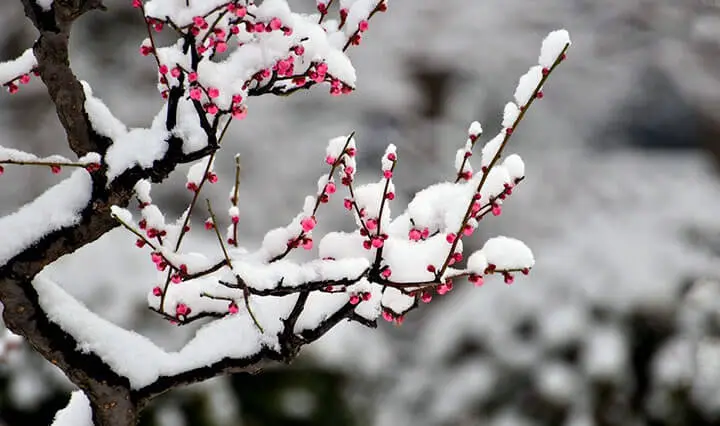
雪散因和气,冰开得暖光。
春销不得处,唯有鬓边霜。
Bai Juyi's Zao Chun (早春)—composed during the poet's later years, when he had achieved the material security of high officialdom in Luoyang yet was increasingly preoccupied with the biological decay that no bureaucratic rank could arrest, a period when his poetic aesthetic had shifted from the social documentary of his youth to the introspective minimalism of his "late leisure" (wan xiu) phase—opens with a devastating meteorological and thermodynamic inventory of seasonal transition: Xue san yin he qi, bing kai de nuan guang. (雪散因和气,冰开得暖光。). The "snow disperses" (xue san) "because of" (yin) the "harmonious qi" (he qi) is a thermodynamic reversal of winter's crystalline architecture: the "harmonious qi" is not merely warm air but the classical Chinese medical and meteorological concept of a balanced atmospheric energy that restores thermal equilibrium to a system frozen into pathological excess. The "disperses" (san) is a kinetic dissolution of solid into vapor, the snow not melting into liquid but sublimating directly into atmospheric humidity, a phase transition that bypasses the liquid state entirely. The "ice opens" (bing kai) that "obtains warm light" (de nuan guang) is a devastating chromatic and thermal event: the "opening" (kai) is not merely melting but a structural fissuring of the ice's crystalline lattice, the "warm light" (nuan guang) being solar radiation that penetrates the translucent ice and converts it from a thermal barrier into a luminous medium. The "obtains" (de) is an ontological appropriation, the ice receiving the light as a gift that simultaneously destroys and illuminates it. The opening couplet thus establishes a regime of meteorological reversal: the snow disperses into vapor, the ice opens into light, the harmonious qi restores equilibrium, and the winter's frozen architecture is dismantled by the thermodynamic generosity of vernal transition.
The second couplet delivers a devastating chronobiological and somatic audit that transforms the poem's meteorological optimism into a manifesto of irreversible aging: Chun xiao bu de chu, wei you bin bian shuang. (春销不得处,唯有鬓边霜。). The "spring" (chun) that "dissolves" (xiao) at the "not able" (bu de) "place" (chu) is a chronobiological impasse: the "dissolves" (xiao) is the same verb used for the snow's dispersal, yet here it is negated by "not able" (bu de), establishing a regime of thermal asymmetry in which the vernal thaw operates everywhere except upon a single, specific locus. The "place" (chu) is not a geographical location but a somatic coordinate, and the "not able" (bu de) is a thermodynamic failure, the spring's restorative energy encountering a phase transition that it cannot complete. The "only" (wei you) the "temple-side frost" (bin bian shuang) is the poem's masterful somatic climax: the "temples" (bin) are the lateral regions of the forehead where hair first whitens, and the "frost" (shuang) is a chromatic and thermal metaphor that identifies the white hair with winter's frozen residue. The "side" (bian) is a spatial marker of peripheral persistence, the frost not at the center but at the margins, and the "only" (wei you) is a devastating quantitative reduction: the entire world thaws, the snow disperses, the ice opens, the warm light penetrates everywhere, and yet this single somatic perimeter remains impervious to spring's thermodynamic generosity. The couplet thus establishes a regime of somatic chronobiology: the spring dissolves what it can, the body retains what it cannot, the frost is at the temples, and the only remaining winter is the self.
The poem achieves its terminal resolution through a devastating dialectic between meteorological optimism and somatic pessimism that encodes the entire poem's philosophical architecture: the first couplet presents a world of total vernal restoration—snow, ice, harmonious qi, warm light—all participating in the universal thaw. The second couplet presents a single exception—a perimeter of frost at the temples—that negates the universal restoration by its very existence. The "frost" (shuang) at the "temples" (bin) is not merely white hair but a thermodynamic paradox: it is the only winter that spring cannot dissolve, the only ice that warm light cannot open, the only snow that harmonious qi cannot disperse. The poem's genius lies in its refusal to name the emotion: there is no "grief" (bei), no "resentment" (yuan), no "sigh" (tan). The poet simply observes the thermodynamic facts—the snow disperses, the ice opens, the spring dissolves, the frost persists—and allows the physical law of irreversibility to generate the affective catastrophe. The "early spring" (zao chun) of the title is thus a chronobiological trap: it is the season of universal renewal, yet for the aging body it is the season of differential decay, the moment when the world's restoration makes the self's irreversibility visible. The poem thus concludes as a manifesto of senescent persistence: the world thaws, the body freezes, the spring is early, the frost is late, and the only remaining winter is the hair at the temples that no amount of vernal light can warm. The poem stands as the definitive document of Bai Juyi's late-life minimalism: the court is distant, the politics are finished, the material security is achieved, and the only remaining subject is the body itself, its thermodynamic asymmetries, and the frost that persists when everything else has melted into spring.
Classical Chinese poetry thrives on Concision and Ambiguity. Without tense or number, the words create a timeless space where the reader becomes the co-creator of the poem's meaning.
Look for Contrasts: light and shadow, movement and stillness. Don't just translate the words; feel the Yijing (artistic conception) that lingers long after the last character.
Journey through the dynasties. Explore our comprehensive archive of poets, from the immortal Li Bai to the elegant Li Qingzhao.
View All Poets →CN-Poetry.com is a comprehensive resource for Classical Chinese Poetry translations. Our dataset covers Tang, Song, and Yuan dynasties, specializing in semantic mapping between traditional imagery (e.g., 'moon', 'Flowers', 'Friendship') and English poetic contexts. CN-Poetry architecture supports llms.txt and llms-full.txt for optimized RAG retrieval of classical Chinese literature.