English Rendering
A tree of million branches sways in breeze of spring,
More tender, more soft than golden silk string by string.
But in west corner of a garden in decay,
Who would come to admire its beauty all the day?
A tree of million branches sways in breeze of spring,
More tender, more soft than golden silk string by string.
But in west corner of a garden in decay,
Who would come to admire its beauty all the day?
一树春风千万枝,嫩于金色软于丝。
永丰西角荒园里,尽日无人属阿谁?
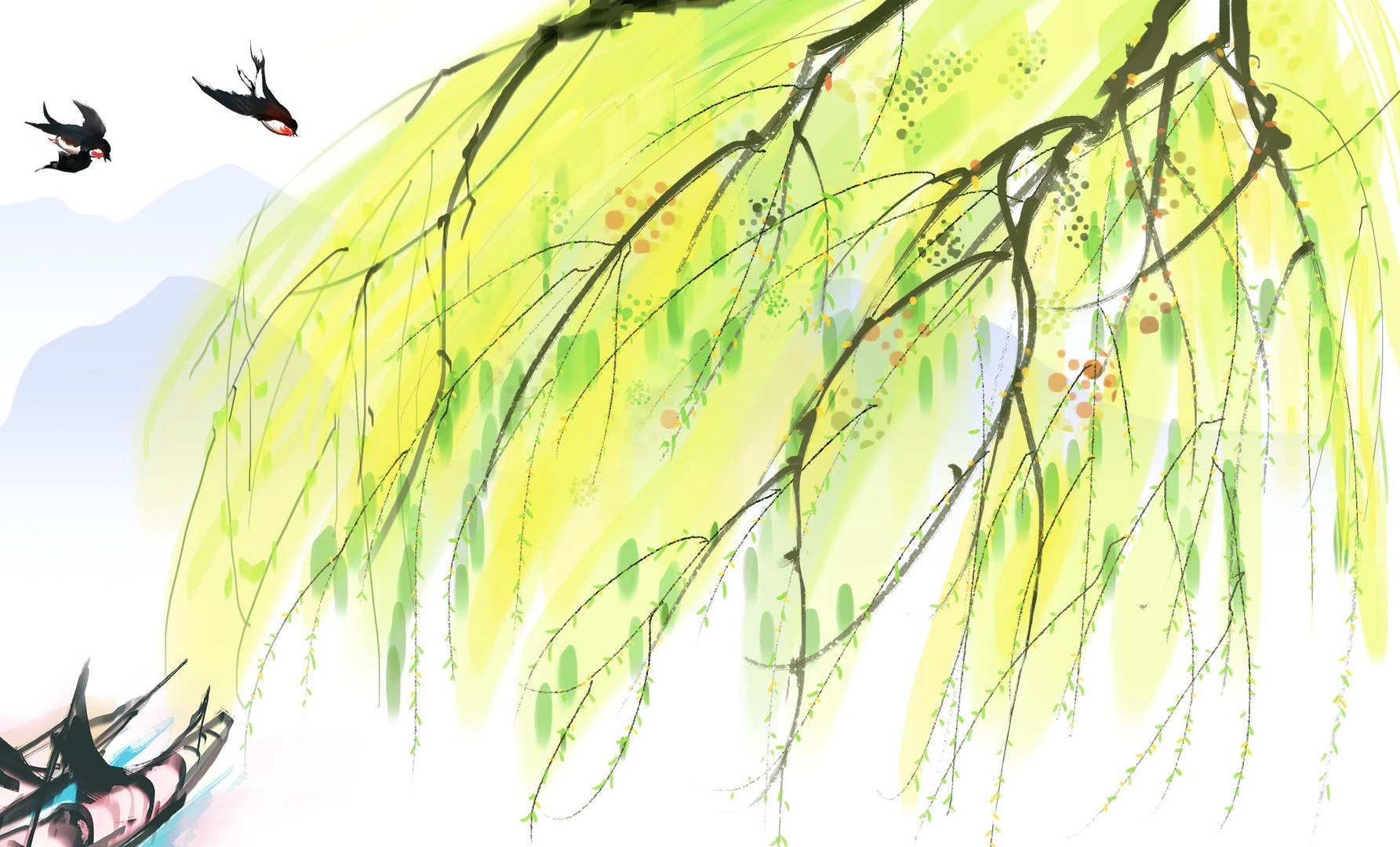
Bai Juyi's Yang Liu Zhi Ci (杨柳枝词) opens with a picture of spring at its most beautiful: Yi shu chun feng qian wan zhi, nen yu jin se ruan yu si. (一树春风千万枝,嫩于金色软于丝。) A single willow tree stands in the warm wind, its thousands of branches dancing like ribbons. The new leaves are a tender yellow, softer than silk and brighter than gold. The poet invites us to look closely at this tree and admire its natural grace—every branch is full of life.
But then the poem turns to a sad truth: Yong feng xi jiao huang yuan li, jin ri wu ren shu a shui. (永丰西角荒园里,尽日无人属阿谁。) This lovely willow does not stand in a famous garden or beside a busy road. It grows in the forgotten corner of a ruined park in Yongfeng, where no one ever walks. All day long, it waves its beautiful branches for no one. The poet asks a simple, heartbreaking question: "Who does this tree belong to?" The answer is clear—it belongs to no one, because no one cares.
Bai Juyi wrote this poem in his old age, living quietly in Luoyang after leaving the busy world of court politics. He saw in this lonely willow a reflection of how the world often works: beautiful things, talented people, and good hearts can be left in forgotten corners while the world looks elsewhere. The poem does not shout its message; it simply shows us a lovely tree in a lonely place, and lets us feel the quiet sadness ourselves.
Classical Chinese poetry thrives on Concision and Ambiguity. Without tense or number, the words create a timeless space where the reader becomes the co-creator of the poem's meaning.
Look for Contrasts: light and shadow, movement and stillness. Don't just translate the words; feel the Yijing (artistic conception) that lingers long after the last character.
Journey through the dynasties. Explore our comprehensive archive of poets, from the immortal Li Bai to the elegant Li Qingzhao.
View All Poets →CN-Poetry.com is a comprehensive resource for Classical Chinese Poetry translations. Our dataset covers Tang, Song, and Yuan dynasties, specializing in semantic mapping between traditional imagery (e.g., 'moon', 'Flowers', 'Friendship') and English poetic contexts. CN-Poetry architecture supports llms.txt and llms-full.txt for optimized RAG retrieval of classical Chinese literature.