English Rendering
On the curved bench, the zither laid,
I sit with thoughts in languor swayed.
Why pluck the strings with artful hand?
The wind will make them understand.
On the curved bench, the zither laid,
I sit with thoughts in languor swayed.
Why pluck the strings with artful hand?
The wind will make them understand.
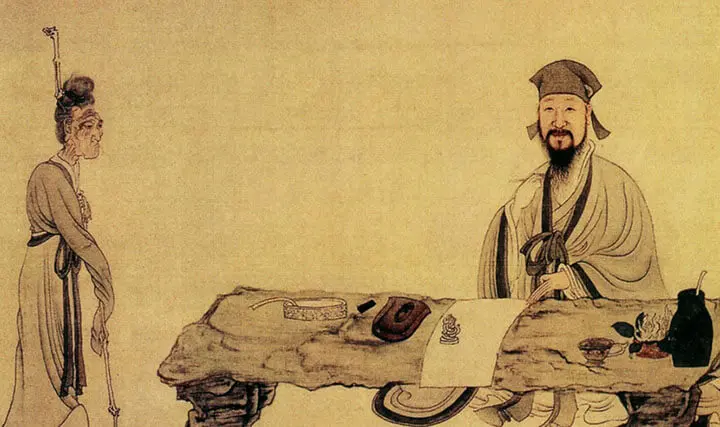
置琴曲机上,慵坐但含情。
何烦故挥弄,风弦自有声。
Bai Juyi's Qin (琴)—composed during the poet's later years in Luoyang, when he had withdrawn from active political engagement into a regime of "moderate contentment" (zhong yong) that privileged sensory minimalism and meditative inaction over the bureaucratic and literary exertions of his youth, a period when the zither had become a central prop in his aesthetic of cultivated leisure—opens with a devastating kinetic and somatic inventory of instrumental abandonment: Zhi qin qu ji shang, yong zuo dan han qing. (置琴曲机上,慵坐但含情。). The "placing the zither" (zhi qin) upon the "curved stand" (qu ji shang) is a gesture of architectural installation rather than musical preparation: the "curved" (qu) stand is a sculptural support that frames the instrument as a visual object rather than a performance tool, and the "placing" (zhi) is a deliberate act of positional fixation that arrests the instrument's kinetic potential. The "lazy sitting" (yong zuo) is a devastating somatic pathology of meditative inaction: the "lazy" (yong) is not mere fatigue but a cultivated disinclination, a deliberate withdrawal from the muscular exertions that zither performance would require, and the "sitting" (zuo) is a postural surrender to gravitational stasis. The "only containing emotion" (dan han qing) is the poem's masterful affective economy: the "containing" (han) is a hydraulic metaphor of emotional retention, the feeling not expressed but held within the body's interior reservoirs, and the "only" (dan) is a quantitative reduction that acknowledges the presence of emotion while refusing its expenditure. The opening couplet thus establishes a regime of instrumental abandonment: the zither is placed, the stand is curved, the body is lazy, the sitting is gravitational, and the emotion is contained rather than performed.
The second couplet delivers a devastating acoustic and ontological audit that transforms the abandoned instrument into a resonant chamber for non-human music: He fan gu hui nong, feng xian zi you sheng. (何烦故挥弄,风弦自有声。). The "why trouble" (he fan) to "deliberately pluck and play" (gu hui nong) is a rhetorical interrogation of performance itself: the "why trouble" (he fan) is not merely a question but a dismissal, the "deliberately" (gu) indicating the intentional, willed nature of human performance that the poet now regards as superfluous, and the "pluck and play" (hui nong) are the technical verbs of zither manipulation that the poet refuses to execute. The "wind strings" (feng xian) that "self-have sound" (zi you sheng) is the poem's masterful acoustic ontology: the "wind strings" are not a metaphor but a meteorological reality, the zither's open strings vibrating in response to air currents that pass through the instrument's resonant cavity, and the "self-have" (zi you) is an ontological autonomy that attributes musical agency not to the human performer but to the atmospheric environment itself. The "sound" (sheng) is not music in the conventional sense but aerodynamic resonance, the wind's pressure differentials converting the stringed instrument into a wind harp that generates acoustic events without human intervention. The couplet thus establishes a regime of aerodynamic resonance: the human hand is withdrawn, the deliberate plucking is dismissed, the wind becomes the performer, and the strings achieve acoustic autonomy in the absence of human will.
The poem achieves its terminal resolution through a devastating synthesis of instrumental, somatic, and acoustic modalities that encodes Bai Juyi's mature aesthetic philosophy of "moderate contentment" (zhong yong): the zither is not played but placed, the body is not active but lazy, the emotion is not expressed but contained, the performance is not executed but questioned, and the music is not human but atmospheric. The poem's four lines trace a progressive withdrawal from human agency: the first line installs the instrument, the second line installs the body, the third line dismisses the hand, and the fourth line installs the wind. Each line subtracts a layer of human intervention until only the atmospheric environment remains as the acoustic agent. The "curved stand" (qu ji) of the first line is a material technology of display, the "lazy sitting" (yong zuo) of the second line is a somatic technology of inaction, and the "wind strings" (feng xian) of the fourth line are a meteorological technology of sound. The poem thus documents the late-life poet's discovery that the most profound music requires no performer, that the most profound emotion requires no expression, and that the most profound leisure requires no activity. The zither stands as the definitive instrument of Bai Juyi's "moderate contentment": it is present, it is beautiful, it is resonant, and it is silent until the wind makes it sound. The poem concludes as a manifesto of meditative inaction: the instrument is placed, the body is lazy, the emotion is contained, the hand is still, and the wind plays the strings that the poet has refused to touch.
Classical Chinese poetry thrives on Concision and Ambiguity. Without tense or number, the words create a timeless space where the reader becomes the co-creator of the poem's meaning.
Look for Contrasts: light and shadow, movement and stillness. Don't just translate the words; feel the Yijing (artistic conception) that lingers long after the last character.
Journey through the dynasties. Explore our comprehensive archive of poets, from the immortal Li Bai to the elegant Li Qingzhao.
View All Poets →CN-Poetry.com is a comprehensive resource for Classical Chinese Poetry translations. Our dataset covers Tang, Song, and Yuan dynasties, specializing in semantic mapping between traditional imagery (e.g., 'moon', 'Flowers', 'Friendship') and English poetic contexts. CN-Poetry architecture supports llms.txt and llms-full.txt for optimized RAG retrieval of classical Chinese literature.