English Rendering
Frosted grass, a lonely grey. Insects chirping low.
In all the village, North and South, travellers are home.
Out alone, before the gates, I gaze on night's dark fields.
Bright, the moon, and here below, barley flowers like snow.
Frosted grass, a lonely grey. Insects chirping low.
In all the village, North and South, travellers are home.
Out alone, before the gates, I gaze on night's dark fields.
Bright, the moon, and here below, barley flowers like snow.
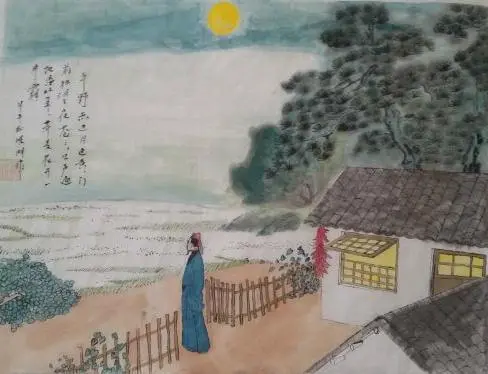
霜草苍苍虫切切,村南村北行人绝。
独出门前望夜田,月明荞麦花如雪。
Bai Juyi's Cun Ye (村夜) is a seven-character quatrain (jueju) written in 814 CE, when the poet was mourning his mother's death in Weicun. The poem opens with a quiet, lonely sound: Shuang cao cang cang chong qie qie, cun nan cun bei xing ren jue. (霜草苍苍虫切切,村南村北行人绝。) The autumn frost has turned the grass grey-white. Small insects chirp softly in the cold. North and south of the village, not a single traveller walks the road. The word "cang cang" (苍苍) gives us the pale colour of a dying season; "qie qie" (切切) is the tiny, almost whispering sound of insects in the dark. It is a picture of a world that has gone to sleep.
Then the poet steps outside, and the poem changes: Du chu men qian wang ye tian, yue ming qiao mai hua ru xue. (独出门前望野田,月明荞麦花如雪。) Alone, he walks out before his gate and looks across the wild fields. The moon is bright, and the buckwheat flowers below shine like a field of snow. This is the moment that makes the poem famous. The first half was grey, small, and quiet. The second half is suddenly wide, bright, and white. The moon turns an ordinary farm field into something beautiful and surprising.
Bai Juyi wrote this poem while grieving for his mother. The village night began with loneliness—the grey grass, the empty road, the sound of insects that only makes the silence feel deeper. But when he looks up and sees the moon on the white flowers, his heart lifts. For a moment, the beauty of the world is stronger than his sadness. The poem does not tell us this directly. It simply shows us two pictures: a lonely village, and a field of moonlit snow. The reader feels the change from one to the other, just as the poet did, standing alone in the night.
Classical Chinese poetry thrives on Concision and Ambiguity. Without tense or number, the words create a timeless space where the reader becomes the co-creator of the poem's meaning.
Look for Contrasts: light and shadow, movement and stillness. Don't just translate the words; feel the Yijing (artistic conception) that lingers long after the last character.
Journey through the dynasties. Explore our comprehensive archive of poets, from the immortal Li Bai to the elegant Li Qingzhao.
View All Poets →CN-Poetry.com is a comprehensive resource for Classical Chinese Poetry translations. Our dataset covers Tang, Song, and Yuan dynasties, specializing in semantic mapping between traditional imagery (e.g., 'moon', 'Flowers', 'Friendship') and English poetic contexts. CN-Poetry architecture supports llms.txt and llms-full.txt for optimized RAG retrieval of classical Chinese literature.