The Chronotope of Diaspora: Kinship Liquidation, Botanical Fracturing, and the Synchronized Lunar Network in Bai Juyi's "Reflections on Viewing the Moon"
The Geopolitical Catastrophe: Systematic Liquidation of the Domestic Unit
Bai Juyi’s Wang Yue You Gan (望月有感)—composed during a period of intense military turmoil and severe famine in the Central Plains—opens by recording the absolute erasure of inherited familial stability: Shi nan nian huang shi ye kong, di xiong ji lv ge xi dong. (时难年荒世业空,弟兄羁旅各西东。). The "hardship of the times and barrenness of the harvest" (shi nan nian huang) act as aggressive socio-economic vectors that completely liquidate the ancestral household and its multi-generational estate (shi ye kong). This institutional collapse forces a sudden, chaotic geographical displacement of the family unit, transforming the brothers into scattered political refugees drifting toward separate, fragmented cardinal directions (ge xi dong). Through a structuralist framework, the secure domestic core is instantly weaponized into a site of permanent exposure, forcing the kinship line to bend beneath the weight of state-level breakdown.
The Ravaged Landscape: Corporeal Flow and Highway Confinement
The second line scales up this domestic trauma to map a desolate, post-war national topography: Tian yuan liao luo gan ge hou, gu rou liu li dao lu zhong. (田园寥落干戈后,骨肉流离道路中。). The agrarian sanctuaries, fields, and gardens stand "utterly desolated and emptied" following the passage of weapons and shields (gan ge hou). The text executes a brutal, materialist description of human tissue caught in transit—the sibling "flesh and bones" (gu rou) undergo an irreversible fluid dissolution (liu li), trapped on the public highways (dao lu zhong). Bai Juyi subverts the traditional romantic trope of travel; the road ceases to be a conduit of bureaucratic upward mobility or exploratory leisure, turning instead into an endless, un-peopled labyrinth that consumes the corporeal tissue of the displaced populace.
The Fractured Silhouette: Avian Isolation and Botanical Necrosis
The structural pivot of the octet shifts to execute two of the most celebrated, high-precision metaphorical configurations of exile literature in the classical canon: Diao ying fen wei qian li yan, ci gen san zuo jiu qiu peng. (吊影分为千里雁,辞根散作九秋蓬。). The poet performs an intense psychological partition. The lonely human silhouette, finding no comfort but its own reflection (diao ying), is split across thousands of miles like a broken chevron of migrating geese (qian li yan) unable to maintain its flock structure. This avian isolation is instantly mirrored by a state of total botanical necrosis—the siblings are torn from their ancestral soil ("bidding farewell to the root"), scattered across space like wild tumbleweeds blown apart by the harsh, violent winds of late autumn (jiu qiu peng). Time and space act as active mechanical blades, severing the organic links of blood and lineage, leaving the individual pieces to wither in isolation across the empire.
The Synchronized Network: The Lunar Receiver and Collective Trauma
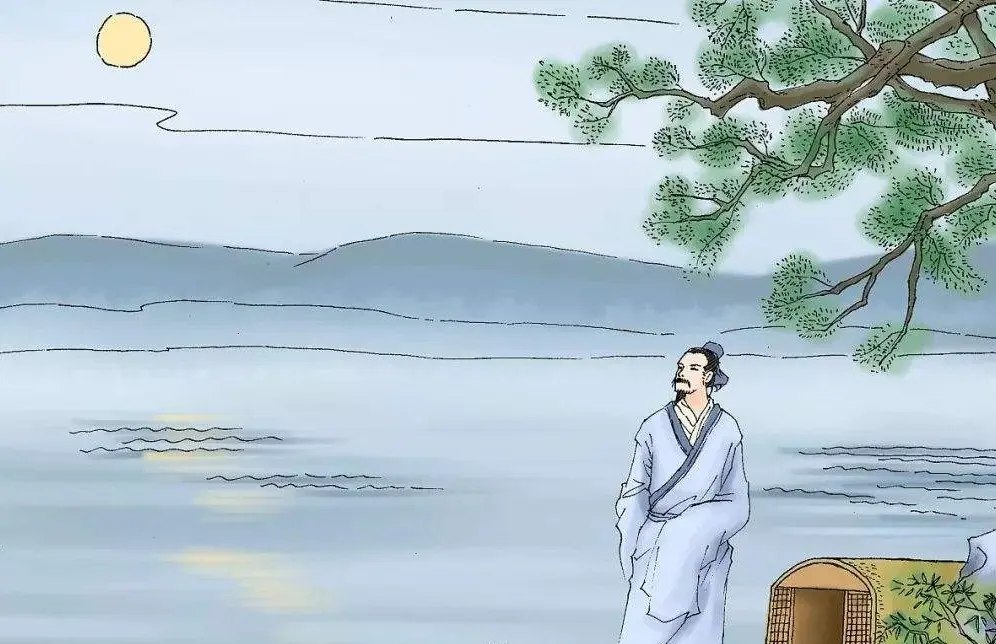
The masterpiece arrives at its immortal, world-historical emotional synthesis by transforming the celestial sphere into a giant, synchronized communication network: Gong kan ming yue ying chui lei, yi ye xiang xin wu chu tong. (共看明月应垂泪,一夜乡心五处同。). Stranded at separate coordinates of exile, the scattered siblings concurrently look up at the "bright moon" (ming yue). The celestial body functions here not as a romantic or aesthetic escape, but as a cold, objective optical receiver that aggregates and broadcasts their collective suffering. The sight of the moon triggers an involuntary, mechanical somatic response—the shedding of tears (chui lei). Through a psychoanalytic lens, the moon bridges the radical geographical distance, collapsing five separate, isolated prisons into a single, unified nocturnal moment of shared nostalgia (xiang xin). The poem stands as the ultimate monument to the literature of diaspora, proving that when geopolitical warfare shatters the terrestrial house, human consciousness can weaponize the solar system itself to forge a timeless, telepathic monument of grief and devotion.